



Simulation analysis of electron beam performance and beam-wave interaction in megawatt-class gyrotron
-
摘要: 在考虑不同电子注性能(速度离散、电子注厚度、空间电荷效应、起振过程、单/双阳极结构)情况下,建立了完善的时域多模自洽非线性注-波互作用模型。以自研的兆瓦级170 GHz、TE25,10模式工作的回旋管为研究对象,系统分析了高频腔结构参数变化、起振电流、单/双阳极电子注电压调制及不同速度和电子注离散下的模式竞争情况。数值模拟研究表明:双阳极调制方式能明显抑制模式竞争,在电子注电压80 kV、电流40 A、磁场6.72 T、横纵速度比1.3的工作条件下,可实现1.35 MW输出功率和42.2%的互作用效率。Abstract:
Background The gyrotron is a relativistic nonlinear device capable of generating high-power electromagnetic radiation in the millimeter-wave and terahertz frequency ranges. In most operating magnetically confined thermonuclear fusion reactors (ECH&CD), high-power gyrotrons serve as the core microwave source devices for their electron cyclotron wave heating and current drive systems. For high-power gyrotrons, the high-frequency cavity must operate in a high-order whispering gallery mode to meet the power capacity requirements. However, high order mode operation conversely introduces severe mode competition. Electron beam performance is a major factor affecting the mode competition, further limiting their efficient and stable operation, particularly in long-pulse or continuous-wave regimes. Therefore, it is essential to investigate the impact of megawatt-level gyrotron electron beam performance on beam-wave interaction.Method This paper comprehensively considers electron beam performance (velocity spread, beam thickness, space charge effects, oscillation startup process, single/double-anode configuration) and establishes a sophisticated time-domain, multi-mode, multi-frequency self-consistent nonlinear beam-wave interaction model.Purpose The study focuses on a self-developed megawatt-level 170 GHz gyrotron operating at TE25,10 mode, analyzing the structural parameter variations of the high-frequency cavity, the start-oscillation current, and the mode competition in single/dual-anode electron beam modulation.Results Under operating conditions of 80 kV beam voltage, 40 A beam current, 6.72 T magnetic field, and a velocity ratio of 1.3, the output power reaches 1.35 MW with an interaction efficiency of 42.2%.Conclusion Numerical simulations demonstrate that the dual-anode modulation method significantly suppresses mode competition. The successful demonstration of this device establishes a foundation for further studies on higher power and higher-frequency gyrotron. -
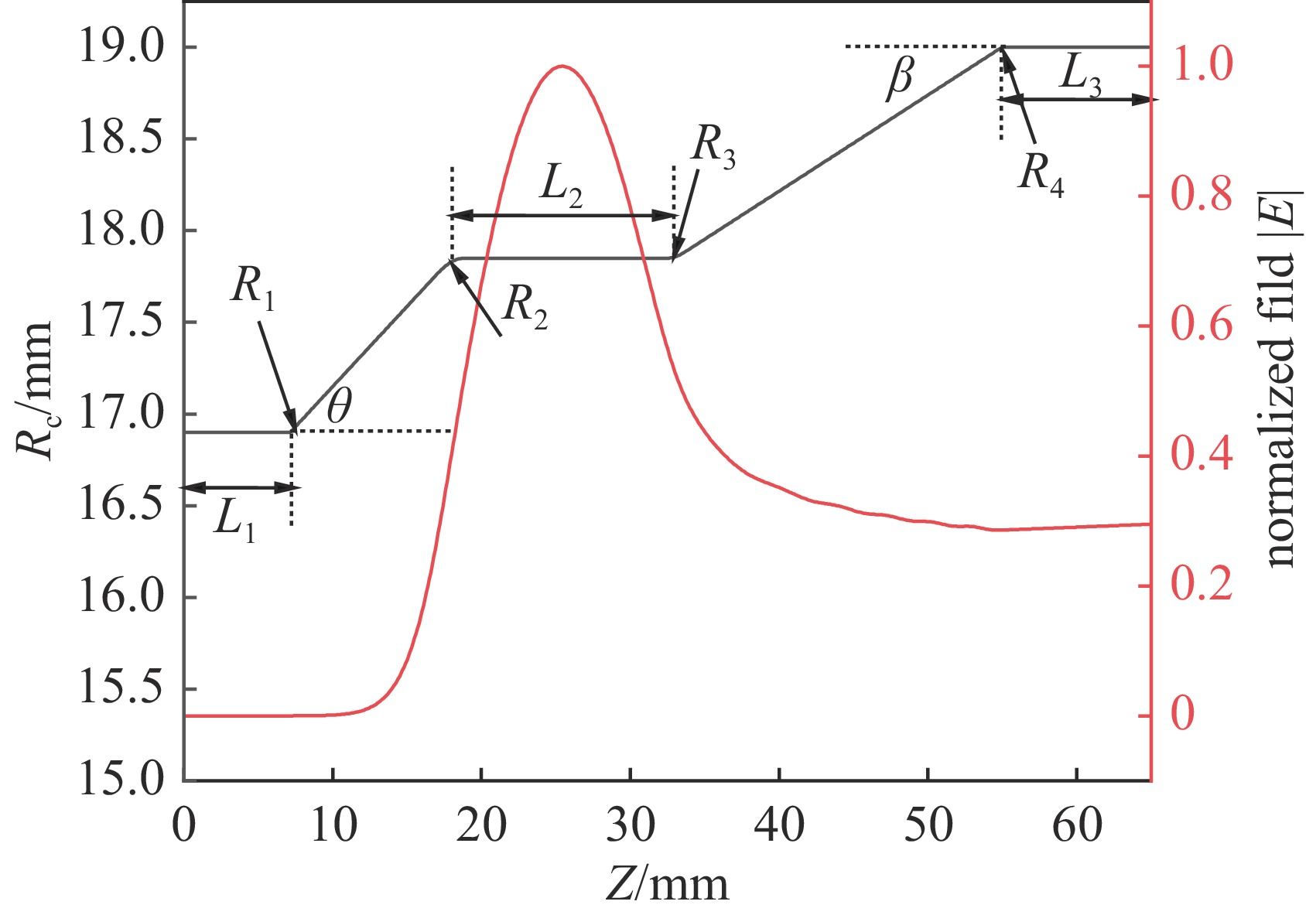
图 1 互作用高频结构及主模的归一化电场幅值分布
Figure 1. Interaction circuit and the normalized electric field amplitude distribution of the main mode
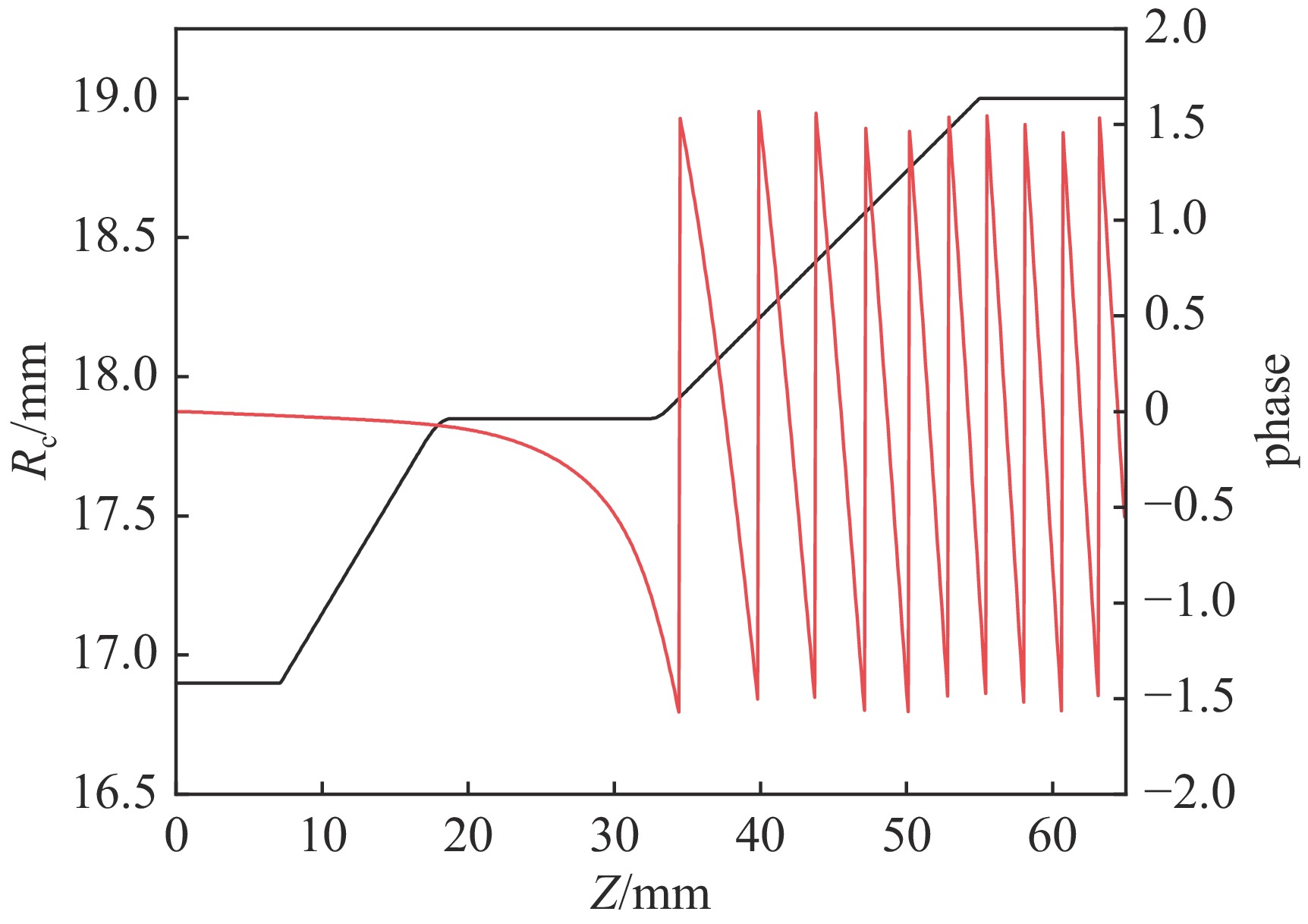
图 2 170 GHz、TE25.10模式回旋管高频腔体内主模的相位分布
Figure 2. Phase distribution of the main mode in the high-frequency cavity of a 170 GHz TE25.10 mode gyrotron
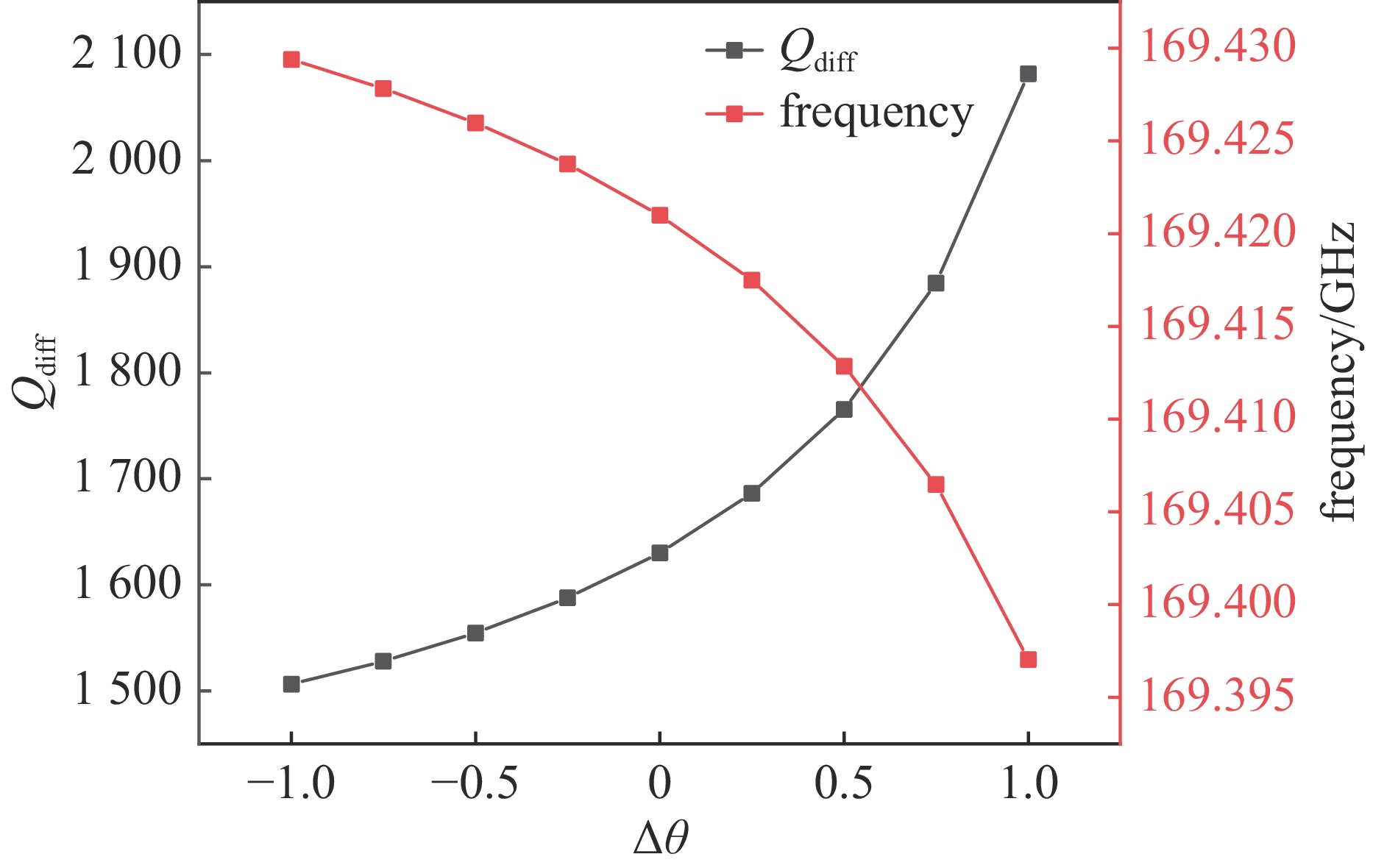
图 3 腔体谐振频率和衍射Q值随着入口段倾角变化的关系
Figure 3. The relationship between the resonant frequency of the cavity and the diffraction Q value with the variation of the input section inclination angle
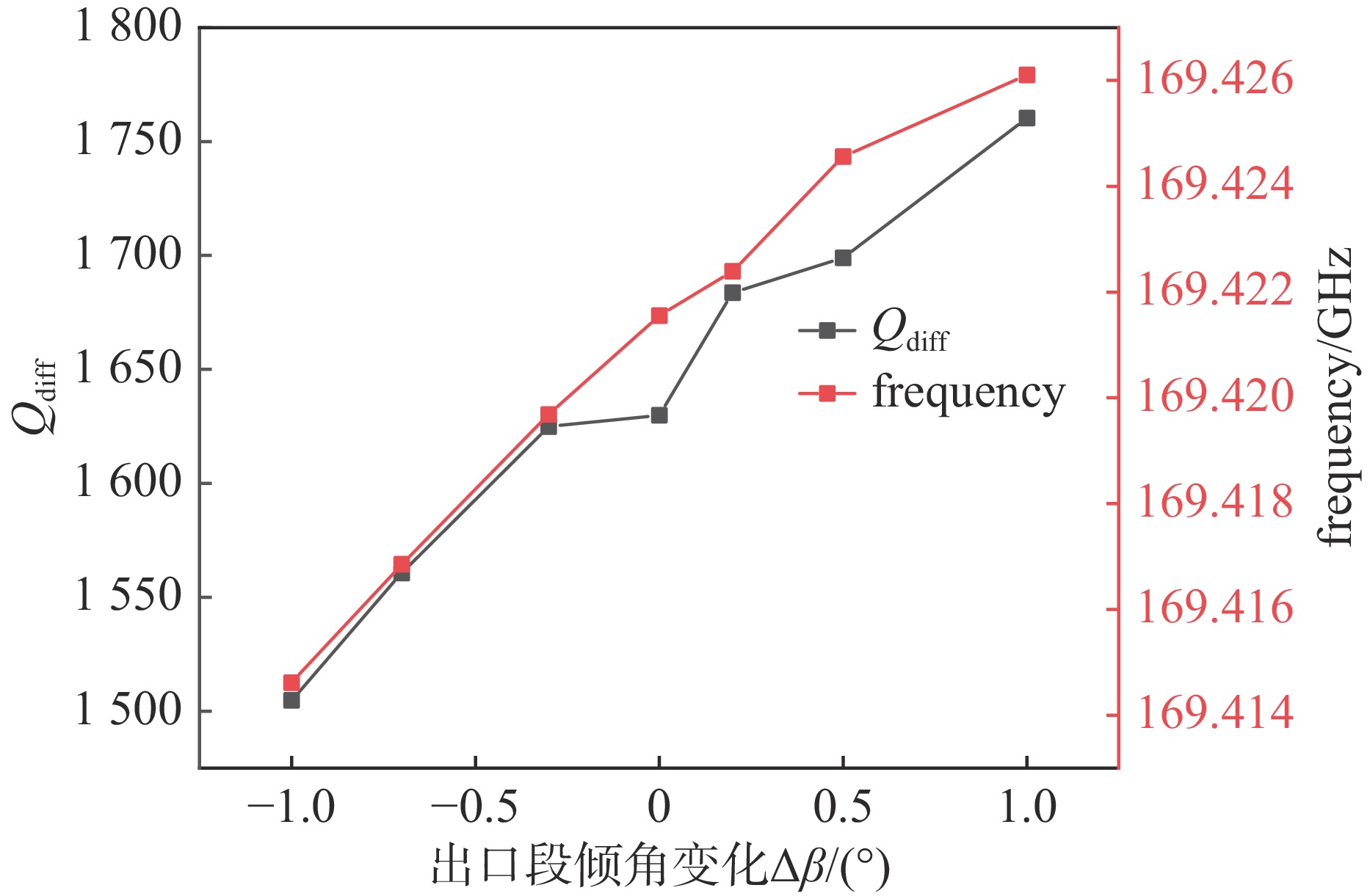
图 4 腔体谐振频率和衍射Q值随着出口段倾角变化的关系
Figure 4. The relationship between the resonant frequency of the cavity and the diffraction Q value with the variation of the output section inclination angle
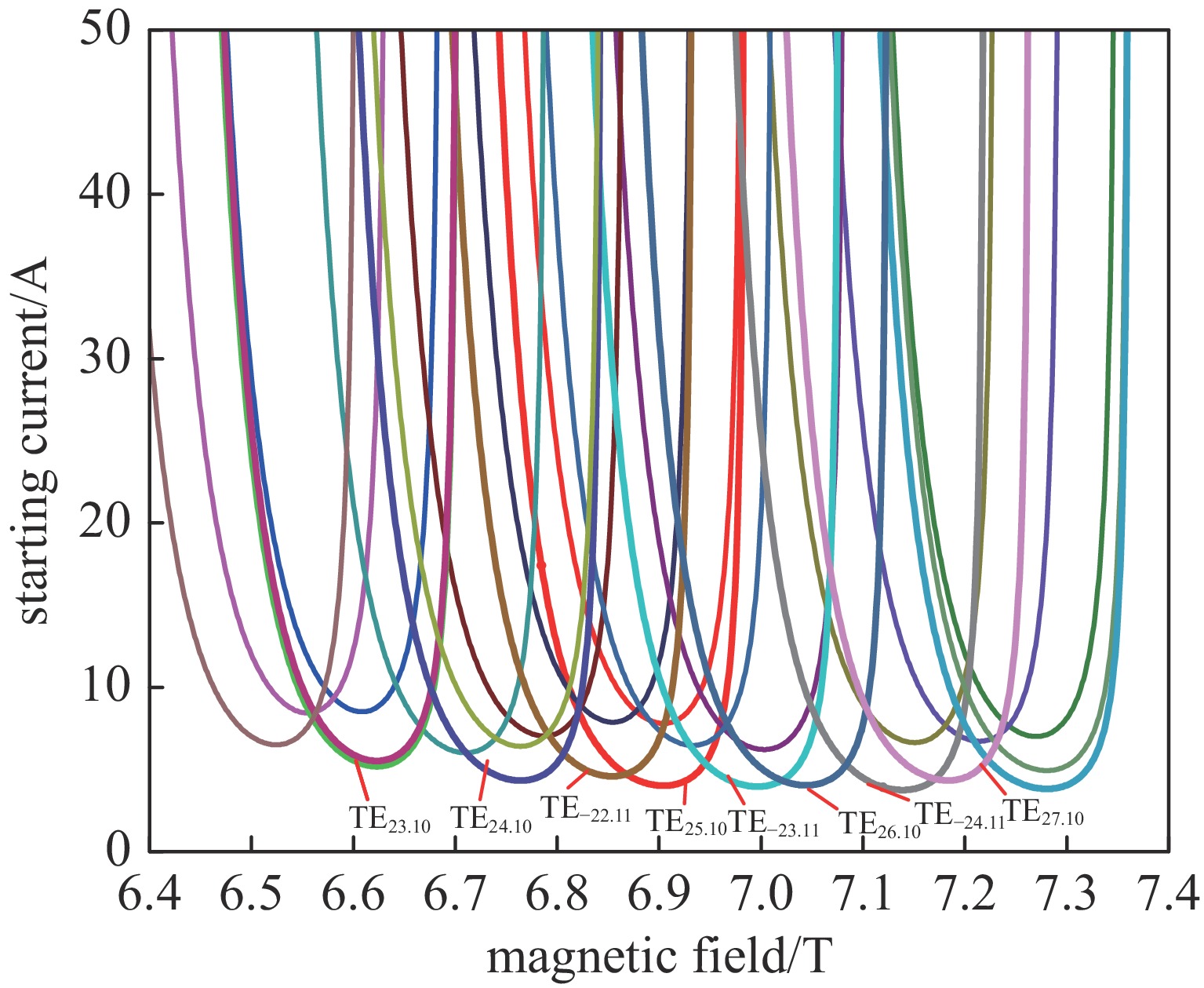
图 5 主模TE+25.10及其附近主要竞争模式的起振电流随磁场变化情况
Figure 5. The variation of the starting current of the main mode TE+25.10 and its neighboring competing modes with the magnetic field
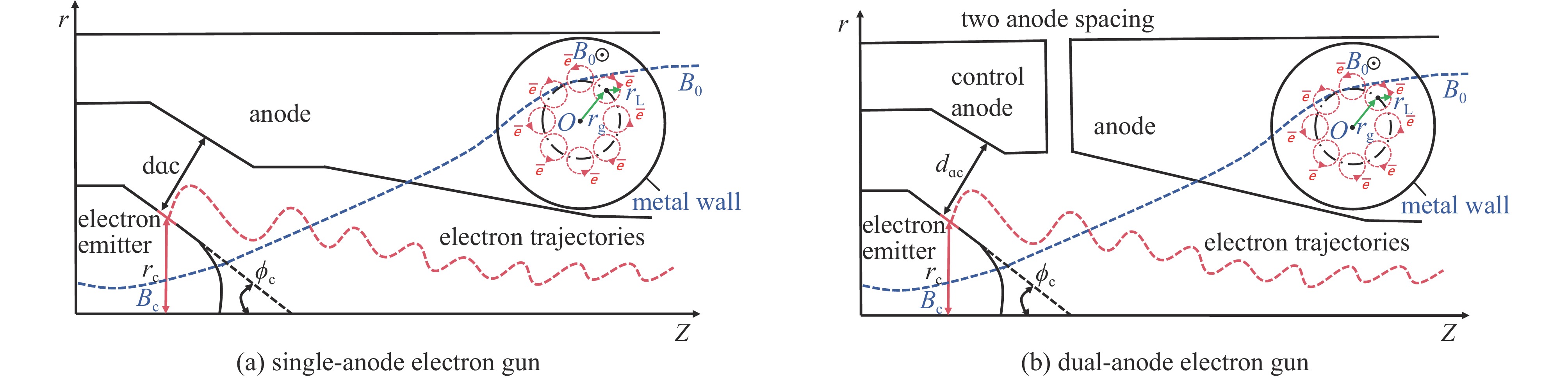
图 6 单阳极和双阳极电子枪结构示意图
Figure 6. Structural diagrams of single-anode and dual-anode electron guns
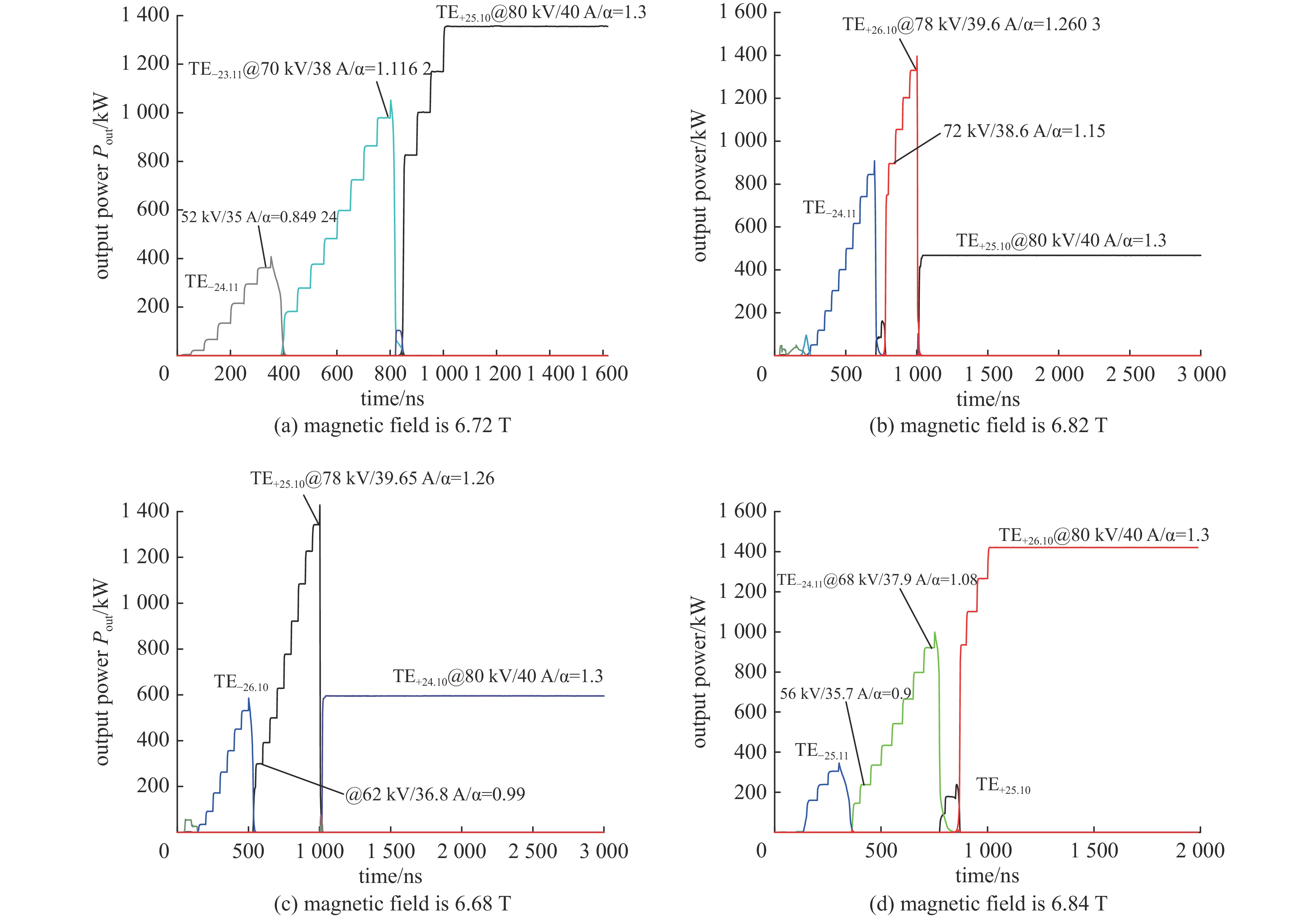
图 7 不同工作磁场下输出功率与互作用时间关系
Figure 7. The output power varied with interaction time under different magnetic field
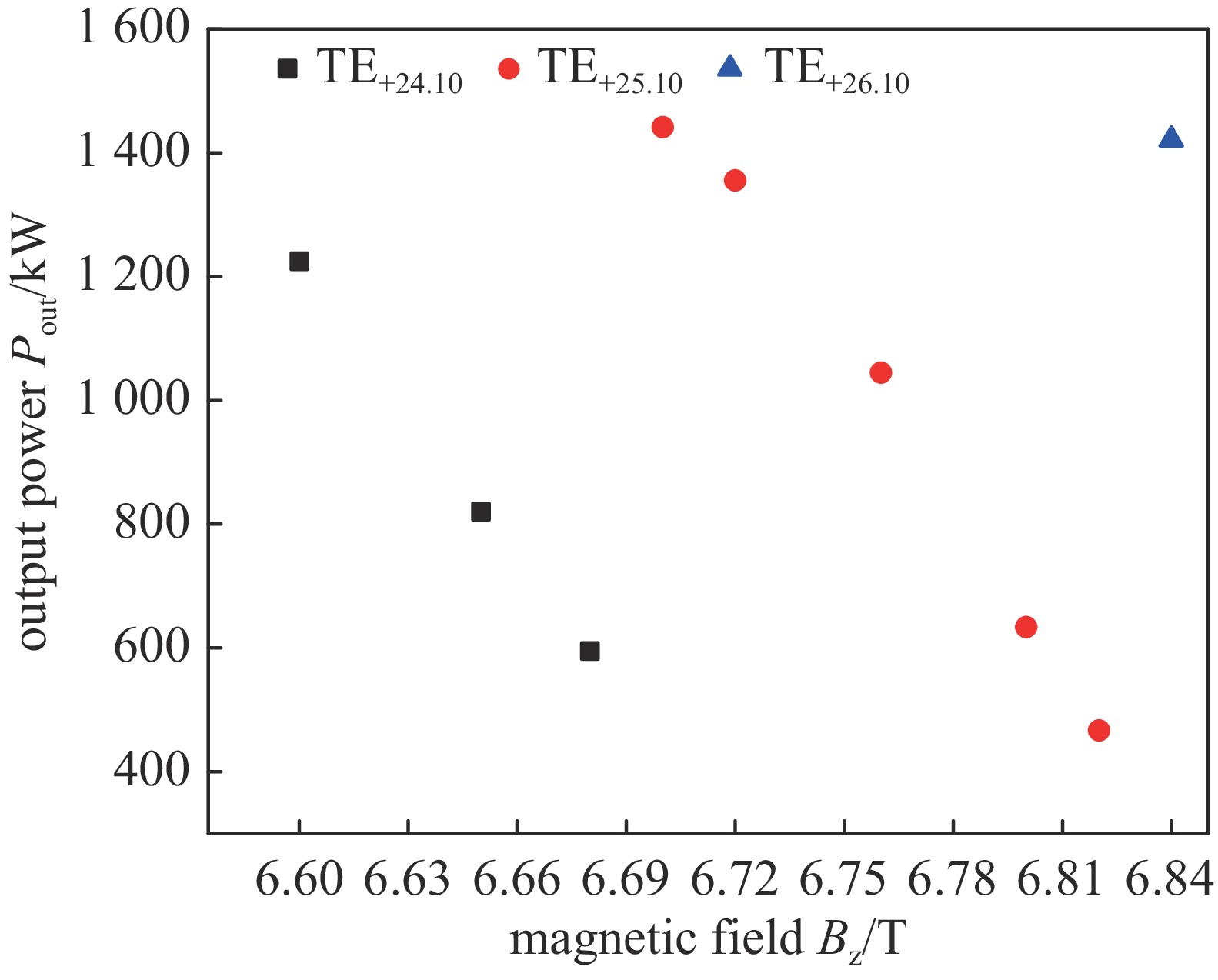
图 8 不同模式输出功率与磁场的关系当电压为80 kV,电流为40 A,速度比1.3,
$ {R}_{g} $ = 7.414 mmFigure 8. Relationship between output power and magnetic field when the voltage is 80 kV, current is 40 A,
$ \alpha $ is 1.3,$ {R}_{g} $ = 7.414 mm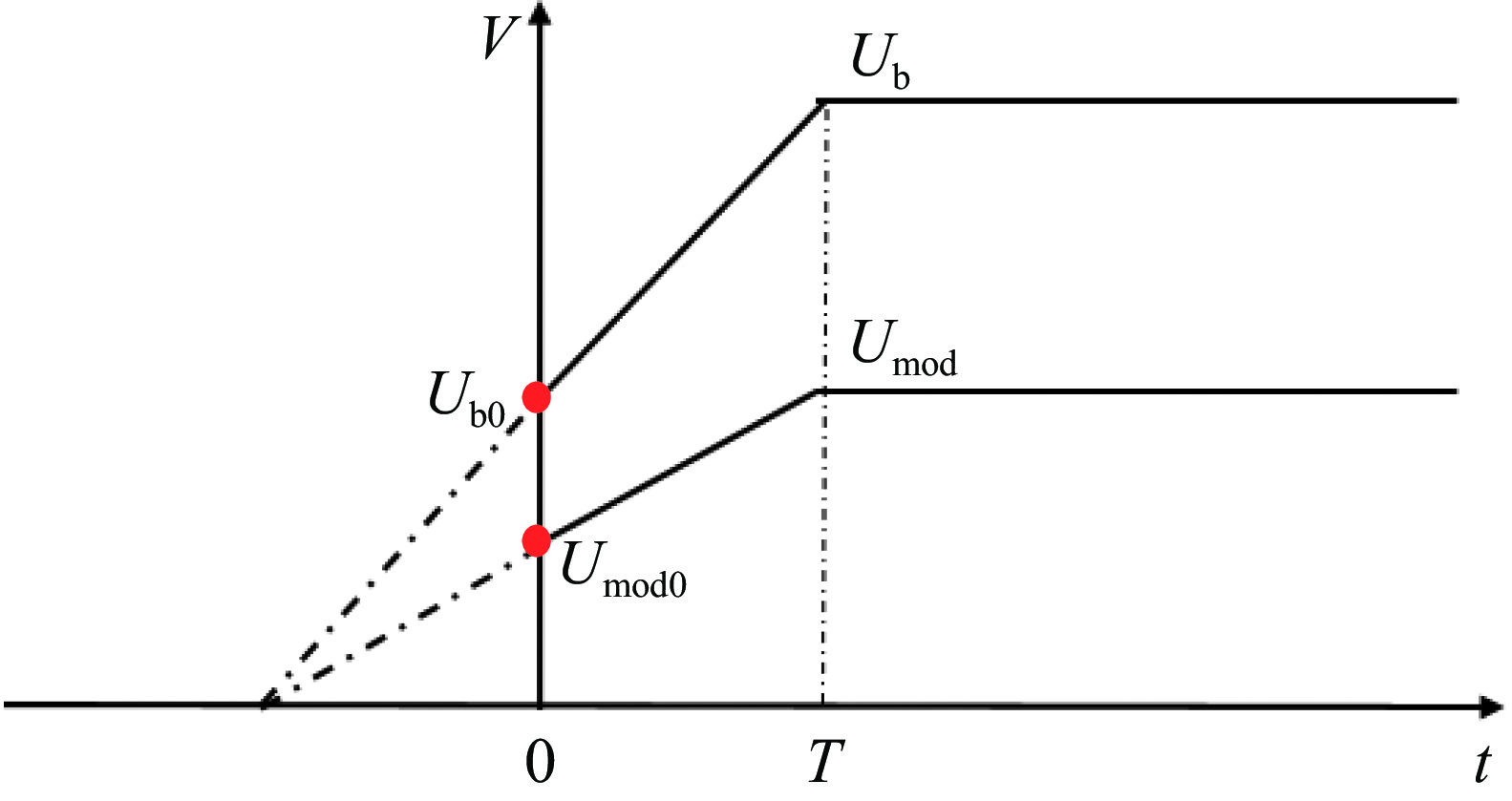
图 9 模拟阴极电压与调制极电压在同一时刻达到稳定状态时,电压和调制电压随时间的变化
Figure 9. Simulated cathode voltage and modulation electrode voltage reaching stability simultaneously
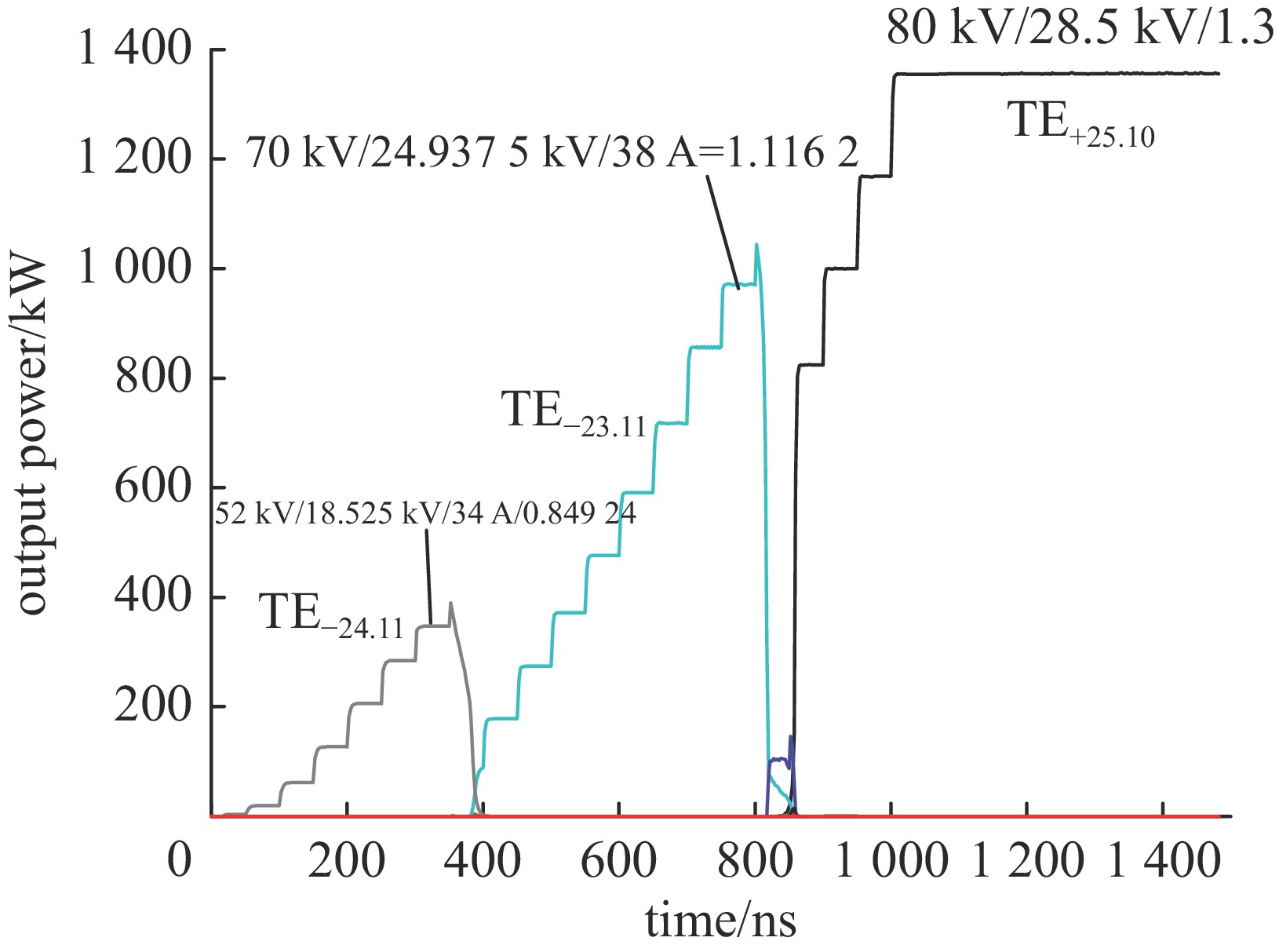
图 10 输出功率与互作用时间关系,当磁场为6.72 T,最终工作阴极电压为80 kV,阳极电压为28.5 kV,电流为40 A,速度比1.3,
$ {R}_{g} $ = 7.414 mmFigure 10. Relationship between output power and interaction time when the magnetic field is 6.72 T, final operation cathode voltage is 80 kV, anode voltage is 28.5 kV, current is 40 A,
$ \alpha $ is 1.3,$ {R}_{g} $ = 7.414 mm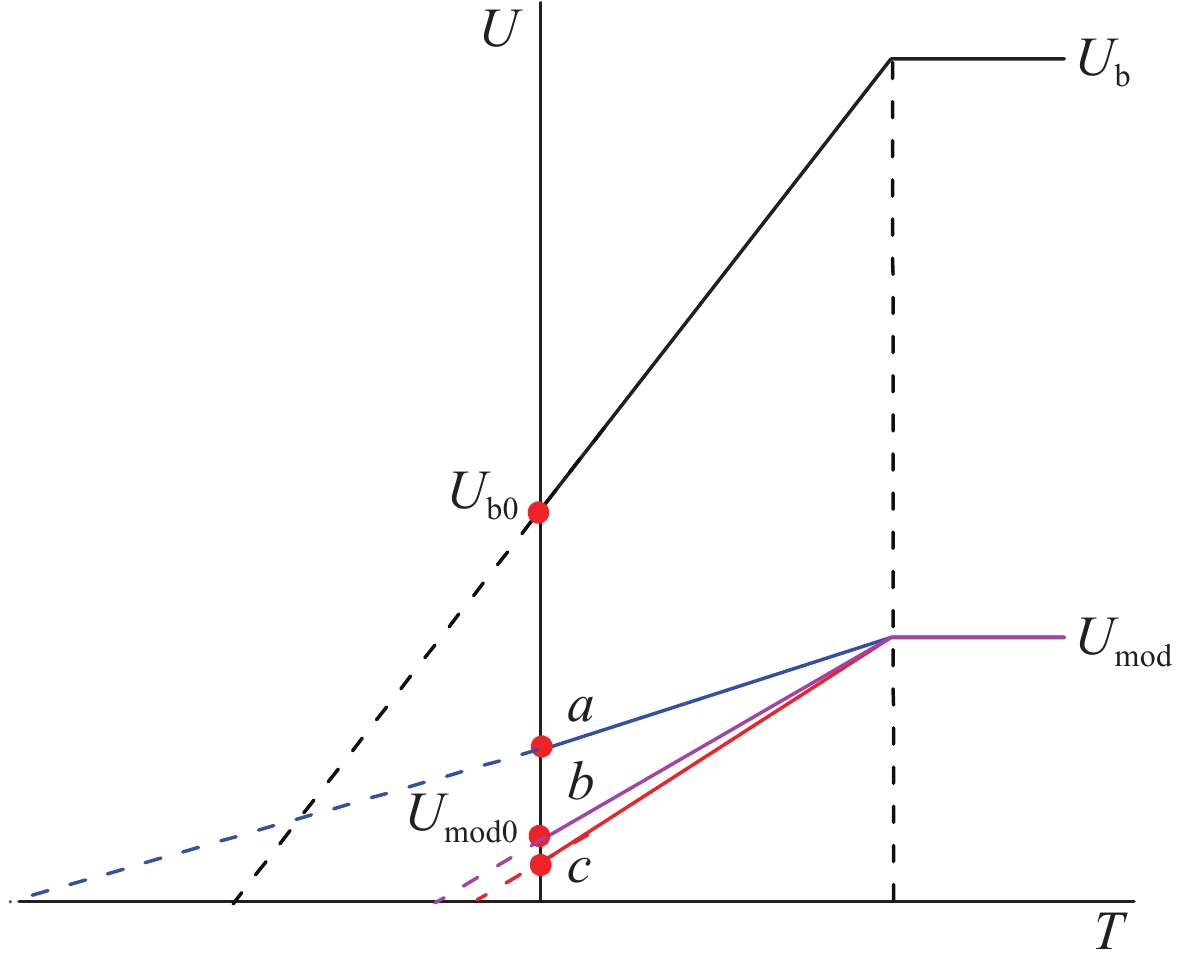
图 11 电压和调制电压随时间的变化。
Figure 11. Simulated variation of cathode voltage and modulation electrode voltage
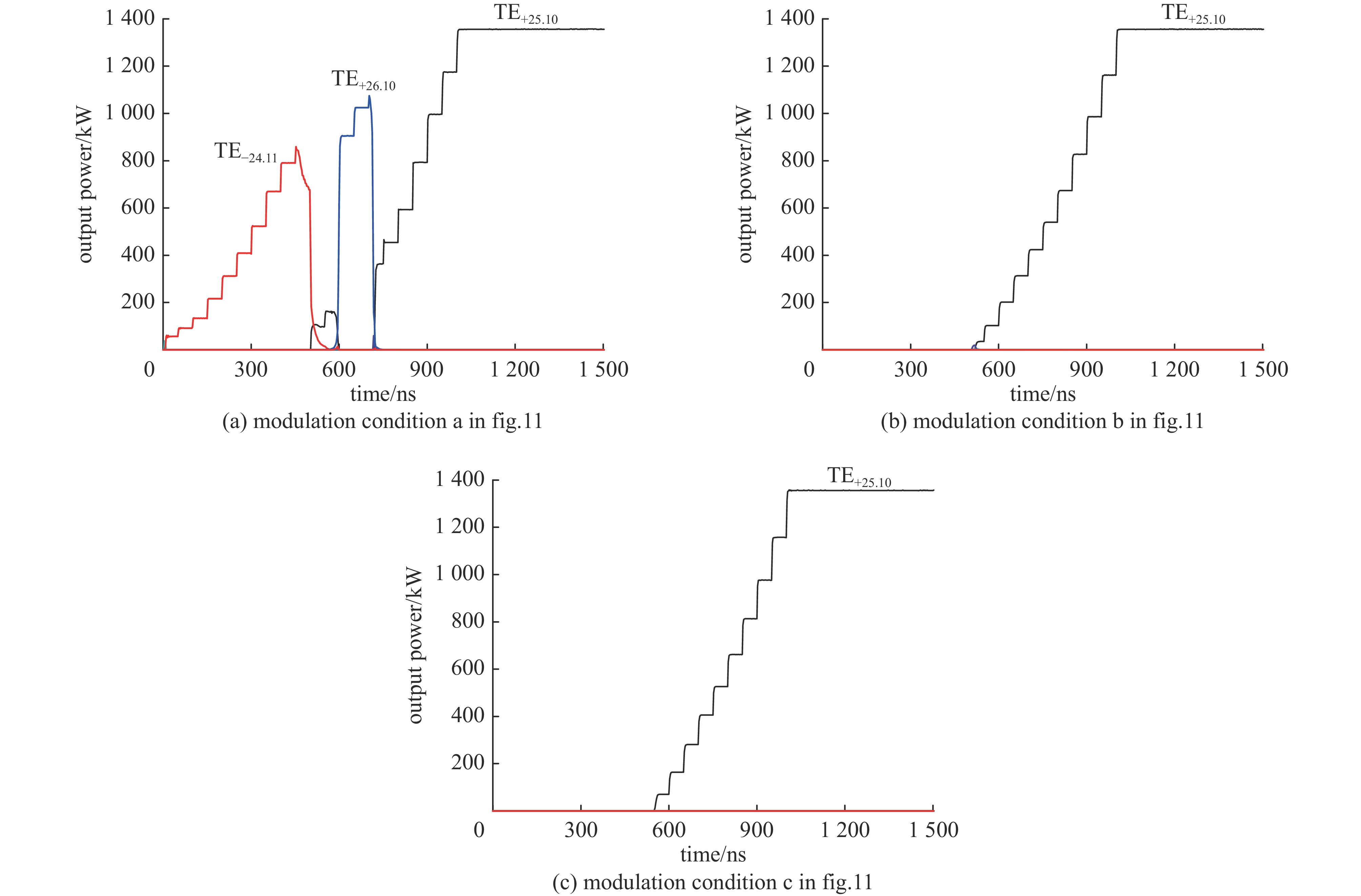
图 12 不同调制状态下,输出功率与互作用时间关系,其中磁场为6.72 T,阴极电压为80 kV,电流为40 A,速度比为1.3,
$ {R}_{g} $ = 7.414 mmFigure 12. Relationship between output power and interaction time under different modulation states when magnetic field is 6.72 T, cathode voltage is 80 kV, current is 40 A,
$ \alpha $ is 1.3,$ {R}_{g} $ = 7.414 mm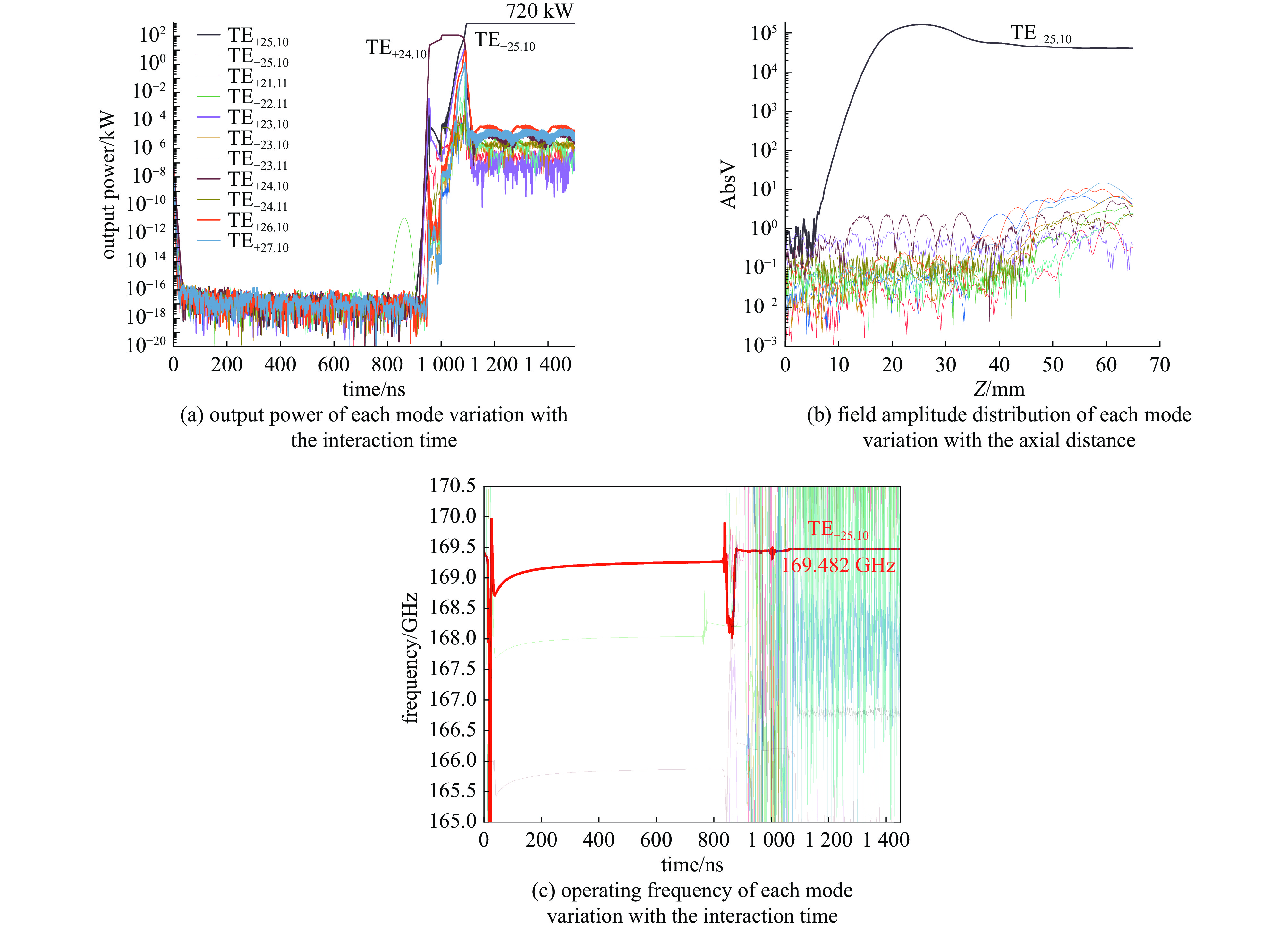
图 15 电子注电压为76 kV,电流为45 A,磁场为6.71 T,横纵速度比为1.05,速度离散为10%,电子注厚度为
$ \Delta R=3{R}_{L} $ 工作条件下注-波互作用结果Figure 15. Beam-wave interaction results when magnetic field: 6.71 T, cathode voltage: 76 kV, current: 42 A, velocity ratio: 1.05,
$ \delta {\mathrm{v}}_{\mathrm{t}}=10\mathrm{{\text{%}} } $ ,$ \Delta R=3{R}_{L} $ 表 1 170 GHz TE25.10回旋管高频腔体的相关参数
Table 1. Relevant parameters of 170 GHz TE25.10 gyrotron high-frequency cavity
$ {\boldsymbol{R}}_{\boldsymbol{in}} $ $ {\boldsymbol{R}}_{\boldsymbol{m}} $ $ {\boldsymbol{R}}_{\boldsymbol{out}} $ $ {\boldsymbol{L}}_{\boldsymbol{1}} $ $ {\boldsymbol{L}}_{\boldsymbol{2}} $ $ {\boldsymbol{R}}_{\boldsymbol{1}} $ $ {\boldsymbol{R}}_{\boldsymbol{2}} $ $ {\boldsymbol{R}}_{\boldsymbol{3}} $ $ {\boldsymbol{R}}_{\boldsymbol{4}} $ $ \boldsymbol{\theta }/({^{\circ}}) $ $ \boldsymbol{\beta }/({^{\circ}}) $ $ {\boldsymbol{L}}_{\boldsymbol{3}} $ $ \boldsymbol{\sigma } $/($ \boldsymbol{S}\cdot {\boldsymbol{m}}^{-\boldsymbol{1}} $) $ {\boldsymbol{Q}}_{\boldsymbol{diff}} $ $ {\boldsymbol{Q}}_{\boldsymbol{ohm}} $ $ {\boldsymbol{Q}}_{\boldsymbol{T}} $ 9.6$ \boldsymbol{\lambda } $ 10.1$ \lambda $ 10.8$ \lambda $ 4.1$ \lambda $ $ 7.7\lambda $ 0 $ 11.3\lambda $ $ 11.3\lambda $ 0 5 3 $ 5.6\lambda $ 1.5$ \times {10}^{7} $ 1630 47725 1576  下载: 导出CSV
表 2 不同位置倒角半径时,腔体谐振频率
$ \boldsymbol{f} $ 与衍射品质因数$ {\boldsymbol{Q}}_{\boldsymbol{d}\boldsymbol{i}\boldsymbol{f}\boldsymbol{f}} $ Table 2. Resonant frequency f and diffractive quality factor
$ {Q}_{diff} $ at Different bevel radius positionsNo. $ {\boldsymbol{R}}_{\boldsymbol{1}}/\boldsymbol{\lambda } $ $ {\boldsymbol{R}}_{\boldsymbol{2}}/\boldsymbol{\lambda } $ $ {\boldsymbol{R}}_{\boldsymbol{3}}/\boldsymbol{\lambda } $ $ {\boldsymbol{R}}_{\boldsymbol{4}}/\boldsymbol{\lambda } $ $ \boldsymbol{f} $/GHz $ {\boldsymbol{Q}}_{\boldsymbol{d}\boldsymbol{i}\boldsymbol{f}\boldsymbol{f}} $ 1 0 0 0 0 169.41937 1681 2 28.3 0 0 0 169.4197 1675.8 2 0 5.7 0 0 169.4202 1668.6 3 0 11.3 0 0 169.4215 1648.6 4 0 17.0 0 0 169.4237 1617.1 5 0 0 10 0 169.4197 1670 6 0 0 11.3 0 169.4198 1653.7 7 0 0 17.0 0 169.4198 1626.7 8 0 5.7 5.7 0 169.4202 1663.4 9 0 8.5 8.5 0 169.4208 1648.1 10 0 11.3 11.3 0 169.42 1630 11 0 14.2 14.2 0 169.4226 1601 12 0 17.0 17.0 0 169.4238 1570.1 13 0 11.3 11.3 11.3 169.4216 1631.7 14 0 11.3 11.3 28.3 169.4217 1646.7 15 11.3 11.3 11.3 28.3 169.4217 1646.7 16 28.3 11.3 11.3 28.3 169.4217 1646.7
下载: 导出CSV
表 3 热腔计算参数
Table 3. Hot cavity calculation parameters
Guiding center
radius $ {\boldsymbol{R}}_{\boldsymbol{g}} $/mmBeam voltage
$ {\boldsymbol{U}}_{\boldsymbol{b}} $/kVModulation voltage
$ {\boldsymbol{U}}_{\boldsymbol{m}\boldsymbol{o}\boldsymbol{d}} $/kVVoltage division
ratio $ \boldsymbol{\eta } $/(%)Beam current
$ {\boldsymbol{I}}_{\boldsymbol{b}} $/AMagnetic field
$ {\boldsymbol{B}}_{\boldsymbol{z}} $/TPitch factor
α7.414 80 28.5 64 40 6.72 1.3
下载: 导出CSV
表 4 170 GHz TE25.10回旋管实测值与数值模拟值对比
Table 4. Comparison Between Measured and Simulated Values of a 170 GHz TE25,10 Gyrotron
Parameter $ {\boldsymbol{U}}_{\boldsymbol{b}} $ (kV) $ {\boldsymbol{I}}_{\boldsymbol{b}} $(A) $ {\boldsymbol{B}}_{\boldsymbol{0}} $(T) $ \boldsymbol{\alpha } $ $ \Delta \boldsymbol{R} $(mm) $ \boldsymbol{\delta }{\boldsymbol{v}}_{\boldsymbol{t}} $ Output power (kW) Output frequency (GHz) Measured value 76 45 6.71 1.1 / / 710 169.65 Simulated value 76 45 6.71 1.05 0.49 10% 720 169.482
下载: 导出CSV
-
[1] 李志良, 冯进军, 刘本田, 等. 国际热核聚变装置用回旋管的现状及技术分析[J]. 真空电子技术, 2012(2): 47-54Li Zhiliang, Feng Jinjun, Liu Bentian, et al. Current status and technical analysis of gyrotron for fusion applications[J]. Vacuum Electronics, 2012(2): 47-54 [2] 安晨翔, 周宁, 陈坤, 等. 相对论强流电子束驱动的X波段同轴回旋管腔体设计[J]. 强激光与粒子束, 2025, 37: 073001 doi: 10.11884/HPLPB202537.250042An Chenxiang, Zhou Ning, Chen Kun, et al. Design of X-band coaxial gyrotron cavity driven by intense relativistic electron beam[J]. High Power Laser and Particle Beams, 2025, 37: 073001 doi: 10.11884/HPLPB202537.250042 [3] 胡林林, 孙迪敏, 黄麒力, 等. 105/140 GHz双频兆瓦回旋管实现1.0 MW脉冲输出[J]. 强激光与粒子束, 2023, 35: 023001 doi: 10.11884/HPLPB202335.220388Hu Linlin, Sun Dimin, Huang Qili, et al. 1.0 MW pulse power achieved in 105/140 GHz dual-frequency MW-level gyrotron[J]. High Power Laser and Particle Beams, 2023, 35: 023001 doi: 10.11884/HPLPB202335.220388 [4] Kariya T, Minami R, Imai T, et al. Development of high power gyrotrons for advanced fusion devices[J]. Nuclear Fusion, 2019, 59: 066009. doi: 10.1088/1741-4326/ab0e2c [5] Thumm M K A, Denisov G G, Sakamoto K, et al. High-power gyrotrons for electron cyclotron heating and current drive[J]. Nuclear Fusion, 2019, 59: 073001. doi: 10.1088/1741-4326/ab2005 [6] Kariya T, Imai T, Minami R, et al. Development of over-MW gyrotrons for fusion at 14 GHz to sub-THz frequencies[J]. Nuclear Fusion, 2017, 57: 066001. doi: 10.1088/1741-4326/aa6875 [7] Idei H, Kariya T, Imai T, et al. Fully non-inductive second harmonic electron cyclotron plasma ramp-up in the QUEST spherical tokamak[J]. Nuclear Fusion, 2017, 57: 126045. doi: 10.1088/1741-4326/aa7c20 [8] Nakashima Y, Ichimura K, Islam M S, et al. Recent progress of divertor simulation research using the GAMMA 10/PDX tandem mirror[J]. Nuclear Fusion, 2017, 57: 116033. doi: 10.1088/1741-4326/aa7cb4 [9] Xu Handong, Wang Xiaojie, Zhang Jian, et al. Recent progress of the development of a long pulse 140GHz ECRH system on EAST[J]. EPJ Web of Conferences, 2019, 203: 04002. doi: 10.1051/epjconf/201920304002 [10] Erckmann V, Brand P, Braune H, et al. Electron cyclotron heating for W7-X: physics and technology[J]. Fusion Science and Technology, 2007, 52(2): 291-312. doi: 10.13182/FST07-A1508 [11] Felch K, Blank M, Borchard P, et al. Recent ITER-relevant gyrotron tests[J]. Journal of Physics: Conference Series, 2005, 25(1): 13-23. [12] Dammertz G, Alberti S, Arnold A, et al. Development of a 140-GHz 1-MW continuous wave gyrotron for the W7-X stellarator[J]. IEEE Transactions on Plasma Science, 2002, 30(3): 808-818. doi: 10.1109/TPS.2002.801509 [13] Gantenbein G, Erckmann V, Illy S, et al. 140 GHz, 1 MW CW gyrotron development for fusion applications—Progress and recent results[J]. Journal of Infrared, Millimeter, and Terahertz Waves, 2011, 32(3): 320-328. doi: 10.1007/s10762-010-9749-2 [14] Dammertz G, Alberti S, Bariou D, et al. 140 GHz high-power gyrotron development for the stellarator W7-X[J]. Fusion Engineering and Design, 2005, 74(1/4): 217-221. [15] Felch K, Blank M, Borchard P, et al. Long-pulse and CW tests of a 110-GHz gyrotron with an internal, quasi-optical converter[J]. IEEE Transactions on Plasma Science, 1996, 24(3): 558-569. doi: 10.1109/27.532938 [16] Felch K, Blank M, Borchard P, et al. Operating experience on six 110 GHz, 1 MW gyrotrons for ECH applications[J]. Nuclear Fusion, 2008, 48: 054008. doi: 10.1088/0029-5515/48/5/054008 [17] Lohr J, Cengher M, Doane J L, et al. The multiple gyrotron system on the DIII-D tokamak[J]. Journal of Infrared, Millimeter, and Terahertz Waves, 2011, 32(3): 253-273. doi: 10.1007/s10762-010-9706-0 [18] Bigot B. Progress toward ITER’s first plasma[J]. Nuclear Fusion, 2019, 59: 112001. doi: 10.1088/1741-4326/ab0f84 [19] Oda Y, Ikeda R, Kajiwara K, et al. Development of the first ITER gyrotron in QST[J]. Nuclear Fusion, 2019, 59: 086014. doi: 10.1088/1741-4326/ab22c2 [20] Krasilnikov A V, Abdyuhanov I M, Aleksandrov E V, et al. Progress with the ITER project activity in Russia[J]. Nuclear Fusion, 2015, 55: 104007. doi: 10.1088/0029-5515/55/10/104007 [21] Ioannidis Z C, Rzesnicki T, Albajar F, et al. CW experiments with the EU 1-MW, 170-GHz industrial prototype gyrotron for ITER at KIT[J]. IEEE Transactions on Electron Devices, 2017, 64(9): 3885-3892. doi: 10.1109/TED.2017.2730242 [22] Botton M, Antonsen T M, Levush B, et al. MAGY: a time-dependent code for simulation of slow and fast microwave sources[J]. IEEE Transactions on Plasma Science, 1998, 26(3): 882-892. doi: 10.1109/27.700860 [23] 刘巧. 高功率回旋管多模自洽非线性问题研究[D]. 成都: 电子科技大学, 2020: 36-45Liu Qiao. Multi-mode self-consistent non-linear research on high-power gyrotron[D]. Chengdu: University of Electronic Science and Technology of China, 2020: 36-45 [24] Liu Yinghui, Liu Qiao, Niu Xinjian, et al. Design and experiment on a 95-GHz 400 kW-level gyrotron[J]. IEEE Transactions on Electron Devices, 2021, 68(1): 434-437. doi: 10.1109/TED.2020.3036324 -




 点击查看大图
计量
- 文章访问数: 24
- HTML全文浏览量: 15
- PDF下载量: 1
- 被引次数: 0
