



Numerical simulation of beam coupling impedance of ceramic chamber in dynamic magnetic field
-
摘要: 在快循环同步加速器(RCS)中,磁场与束流能量保持同步,形成高动态的磁场环境。为完全避免涡流效应并降低阻抗,RCS通常使用陶瓷真空盒,并覆盖复杂的屏蔽层结构。虽然传统理论认为此类结构的实部阻抗对束流动力学的影响可以忽略,但中国散裂中子源(CSNS)的阻抗测量却揭示了陶瓷真空盒中存在低频谐振阻抗。理论溯源表明,这一阻抗正是导致CSNS/RCS束流不稳定性的关键机制。由于该谐振阻抗的物理机制复杂,尚无独立方法验证测量阻抗。为此,本研究首次采用数值模拟方法证实了谐振阻抗的客观存在,并通过系统模拟涵盖了RCS各类陶瓷真空盒的构型,成功构建了高精度阻抗模型,为强流加速器中的束流不稳定性研究提供了重要的理论支持。Abstract:
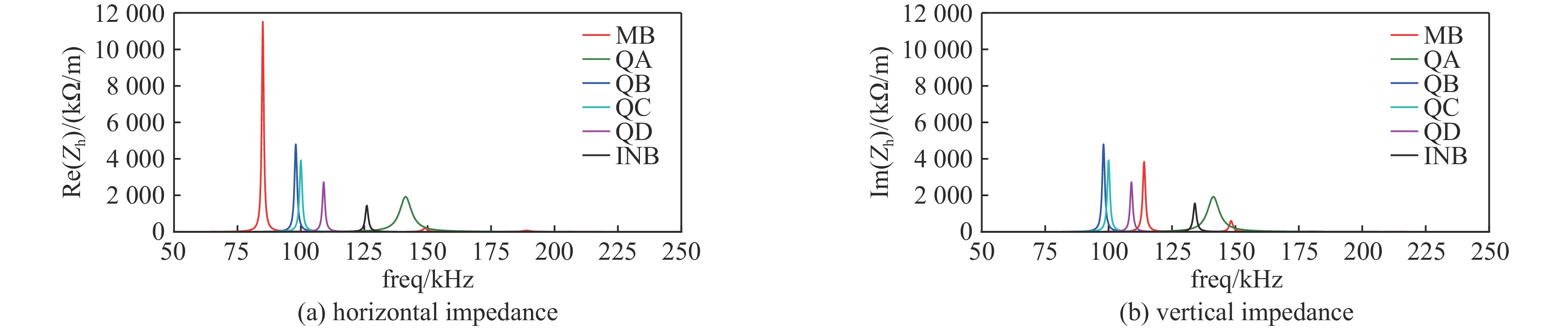
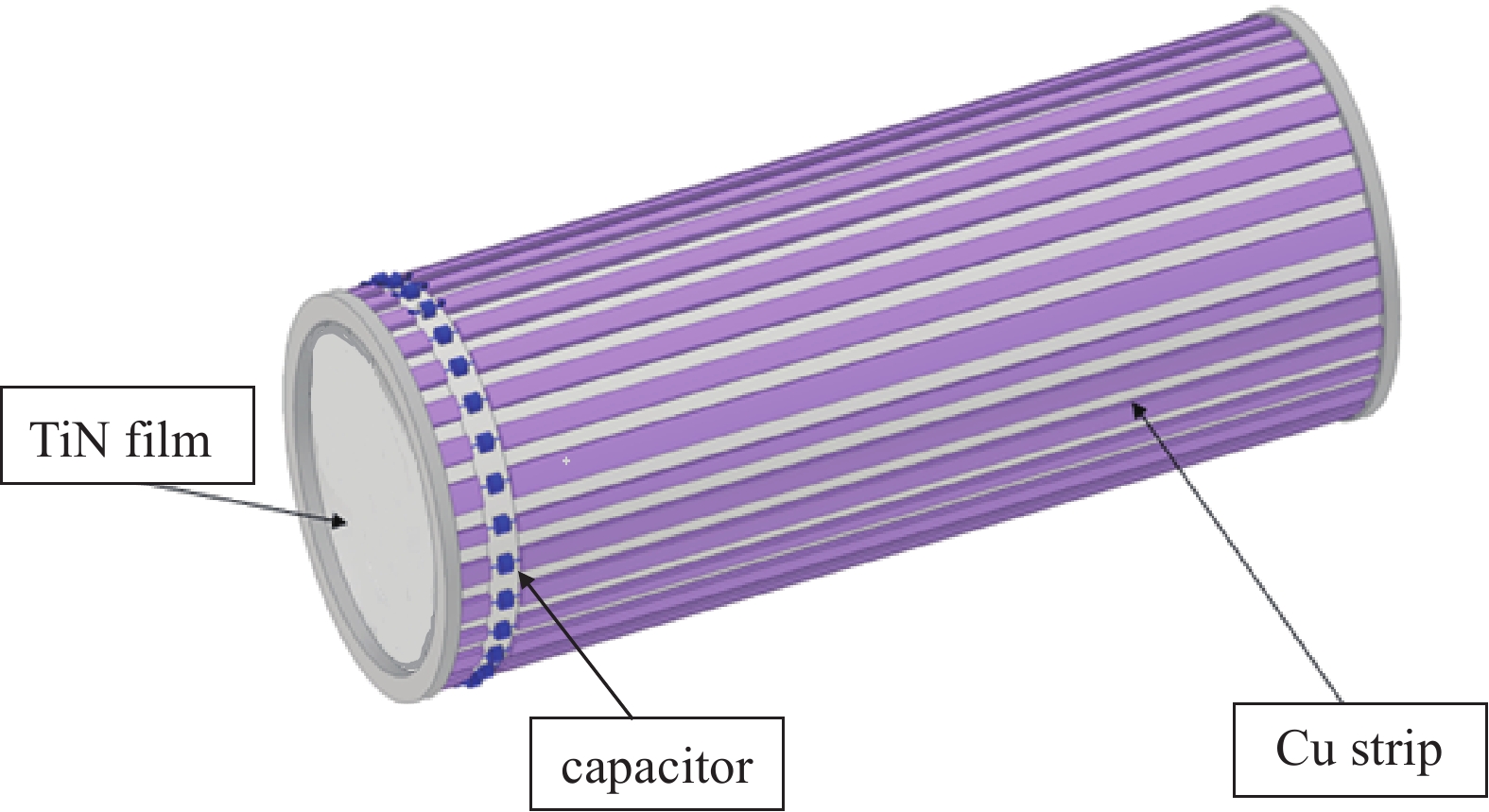
Background The rapid cycling synchrotron (RCS) requires the magnetic field to track the energy ramp, producing a strongly time-dependent magnetic environment. To control beam coupling impedance and suppress field leakage, an RCS typically uses ceramic vacuum chambers covered in an RF shielding layer. The shield consists of parallel metal strips aligned with the beam and terminated by capacitors at either end, which preserves a low beam impedance while suppressing eddy currents induced by the time-dependent magnetic field. Previous theoretical studies suggest that the impedance of such a structure has a negligible impact on the beam. However, impedance measurements of the China Spallation Neutron Source RCS ceramic chamber have revealed the presence of a transverse resonant impedance.Purpose As this observation has not been verified by independent methods.Methods The CST electromagnetic simulations are used to test its presence.Results A high-fidelity simulation model has been developed and benchmarked against measurements, showing close agreement with the measured impedance.Conclusions The comparison confirms the validity of the impedance characterization. Simulations spanning six ceramic-chamber geometries are then used to construct a comprehensive impedance model for the RCS, which provides a foundation for subsequent studies of beam dynamics and collective effects.-
Key words:
- beam coupling impedance /
- ceramic chamber /
- RF shield /
- resonance /
- high dynamic magnetic environment
-
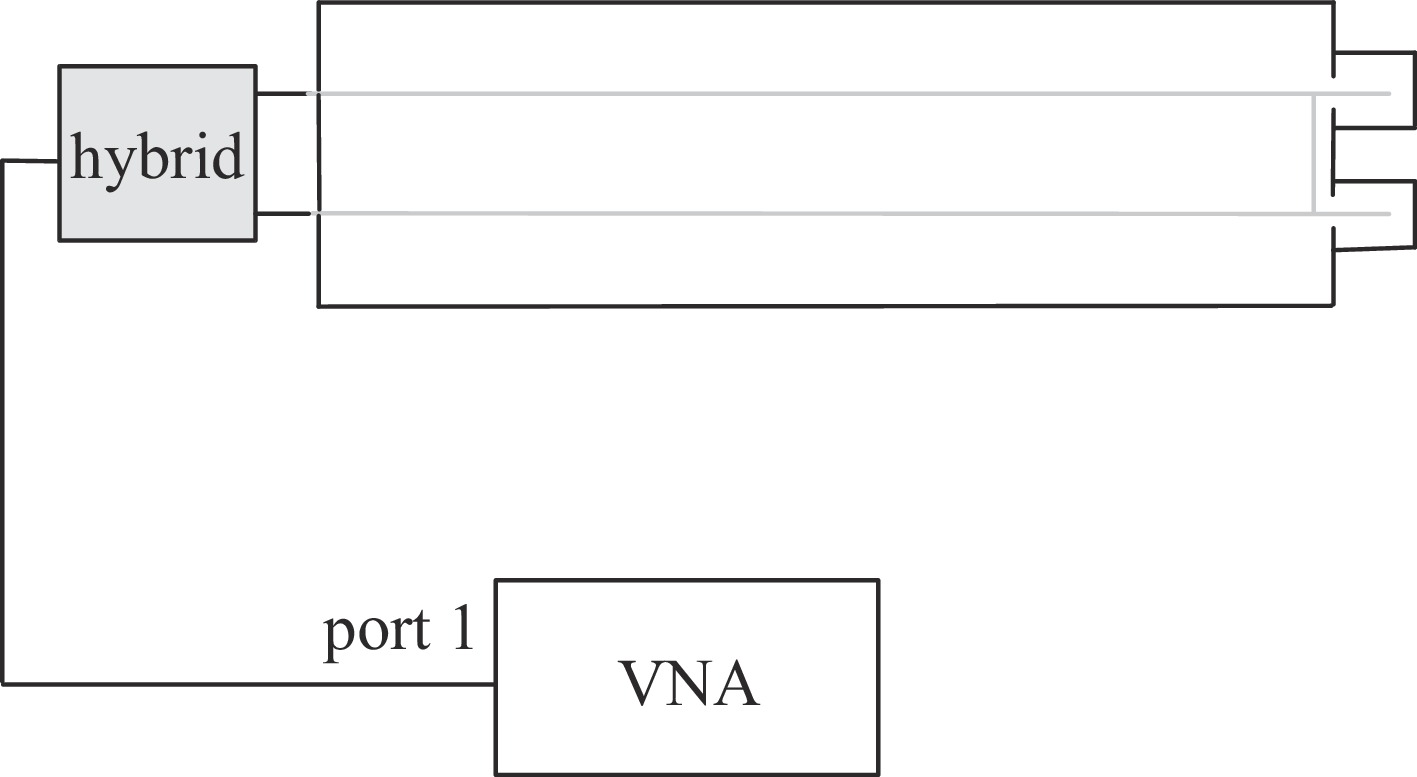
图 2 环路法阻抗测量原理图
Figure 2. Schematic setup of the transverse impedance measurement with one loop method
表 1 RCS陶瓷真空盒参数表
Table 1. Parameters of the RCS Ceramic Chamber
name shape length/m radiusa/mm thicknessb/mm number MB elliptic 66.6 218×135 15×8.5 24 QA circular 12.4 91.5 7.5 16 QB circular 24.6 124.5 7.5 16 QC circular 12.3 99.5 7.5 8 QD circular 9.2 115 7.5 8 INBc circular 4.4 80 7.5 4 Note:a It means horizontal × vertical size for MB with an elliptic cross-section;
b It means horizontal × vertical thickness for MB with an elliptic cross-section;
b There are two similar types of injection chambers, and simplifies as one here. 下载: 导出CSV
表 2 INB1陶瓷真空盒谐振阻抗模拟和测量阻抗比较
Table 2. Simulated and measured resonant impedance of the INB1
resontant freq/MHz Rs/(kΩ/m) Q Simulation 0.123 450 150 Measurement 0.123 290 40
下载: 导出CSV
-
[1] Zotter B. Longitudinal instabilities of charged particle beams inside cylindrical walls of finite thickness[J]. Particle Accelerators, 1970, 1: 311-326. [2] Danilov V V, Henderson S, Burov A, et al. An improved impedance model of metallic coatings[C]//Proceedings of the 8th European Particle Accelerator Conference. 2002: 1464-1466. [3] Roncarolo F, Caspers F, Kroyer T, et al. Comparison between laboratory measurements, simulations, and analytical predictions of the transverse wall impedance at low frequencies[J]. Physical Review Accelerators and Beams, 2009, 12: 084401. doi: 10.1103/PhysRevSTAB.12.084401 [4] Wang N, Qin Q. Resistive-wall impedance of two-layer tube[J]. Physical Review Accelerators and Beams, 2007, 10: 111003. doi: 10.1103/PhysRevSTAB.10.111003 [5] CST Studio Suite[EB/OL]. [2024-08-06]. http://www.cst.com. [6] Wei Jie, Chen Hesheng, Chen Yanwei, et al. China spallation neutron source: design, R&D, and outlook[J]. Nuclear Instruments and Methods in Physics Research Section A: Accelerators, Spectrometers, Detectors and Associated Equipment, 2009, 600(1): 10-13. [7] Wang Sheng, Fang Shouxian, Fu Shinian, et al. Introduction to the overall physics design of CSNS accelerators[J]. Chinese Physics C, 2019, 33(s2): 1-3. [8] 李青, 康文, 孙献静, 等. CSNS/RCS交流二极磁铁研制关键技术[J]. 强激光与粒子束, 2017, 29: 085105 doi: 10.11884/HPLPB201729.160498Li Qing, Kang Wen, Sun Xianjing, et al. Key technology of the development of the CSNS/RCS AC dipole magnet[J]. High Power Laser and Particle Beams, 2017, 29: 085105 doi: 10.11884/HPLPB201729.160498 [9] 齐欣, 张旌, 郝祖岳, 等. 中国散裂中子源磁铁电源系统[J]. 电力电子技术, 2014, 48(12): 8-10,24Qi Xin, Zhang Jing, Hao Zuyue, et al. Magnet power supply system for China spallation neutron source[J]. Power Electronics, 2014, 48(12): 8-10,24 [10] 许守彦. 中国散裂中子源快循环同步加速器中的空间电荷效应研究[D]. 北京: 中国科学院研究生院, 2011: 91-107Xu Shouyan. The study on the space charge effects of CSNS/RCS[D]. Beijing: University of Chinese Academy of Sciences, 2011: 91-107 [11] Dong Haiyi, Song Hong, Li Qi, et al. The vacuum system of the China spallation neutron source[J]. Vacuum, 2018, 154: 75-81. doi: 10.1016/j.vacuum.2018.04.046 [12] Huang Liangsheng, Xu Shouyan, Wang Sheng. The characteristic of the beam position growth in CSNS/RCS[C]//Proceedings of the 12th International Particle Accelerator Conference. 2021: 2073-2075. [13] Huang Liangsheng, Huang Mingyang, Xu Shouyan, et al. Intense beam issues in CSNS accelerator beam commissioning[C]//Proceedings of the 68th Adv. Beam Dyn. Workshop High-Intensity High-Brightness Hadron Beams. 2023: 16-22. [14] Huang Liangsheng. Source of instability in the RCS of CSNS[C]//Proceedings of the 6th ICFA Mini-Workshop on Space Charge. 2024: 9-11. [15] Huang Liangsheng, Wang Sheng, Xu Shouyan, et al. Source of instability in the rapid cycling synchrotron of the China spallation neutron source[J]. The European Physical Journal Plus, 2025, 140: 71. doi: 10.1140/epjp/s13360-025-05997-8 [16] Chao A W, Tigner M. Handbook of accelerator physics and engineering[M]. Singapore: World Scientific, 1999: 196-215. [17] Caspers F. Bench methods for beam-coupling impedance measurement[R]. CERN report, CERN PS/88-59, 1988. [18] Mostacci A, Caspers F, Iriso U. Bench measurements of low frequency transverse impedance[C]//Proceedings of the 2003 Particle Accelerator Conference. 2003: 1801-1803. -

 点击查看大图
图(6) / 表(2)
计量
- 文章访问数: 26
- HTML全文浏览量: 13
- PDF下载量: 0
- 被引次数: 0
