



Analysis and Research on Electromagnetic Coupling within PFN-Marx Generator
-
摘要: PFN-Marx发生器准方波输出特性与装置的紧凑性是一对矛盾。随着对装置紧凑性的更高要求,发生器叠加过程中PFN波传输产生的级间电磁耦合愈发明显,其对PFN的脉冲调制特性有显著的影响,进一步影响发生器的准方波输出特性。基于此问题,本文开展PFN-Marx发生器叠加过程中PFN的电磁耦合分析。首先,通过理论推导,分析波传输过程中PFN级内和级间的电磁耦合现象,并得出其计算公式;然后,建立典型的PFN-Marx发生器的3D模型进行场路协同仿真;最后,分别搭建单级、多级发生器进行实验验证。通过分析对比三种结果,提高对PFN-Marx发生器波传输过程中电磁耦合的认识,从而在设计中规避部分电磁耦合,提升PFN-Marx发生器方波输出能力。本文可以为PFN-Marx发生器的准方波输出和紧凑化提供技术参考。
-
关键词:
- 波传输过程 /
- 电磁耦合 /
- 场路协同仿真 /
- 脉冲形成网络 /
- PFN-Marx发生器
Abstract:Background The quasi-square wave output characteristic of PFN-Marx generator is a pair of contradictions with the compactness of the setup. With the higher requirement of the compactness of the setup, the inter stage electromagnetic coupling of PFN wave transmission becomes more and more obvious, which has a significant effect on the pulse modulation characteristics of PFN and further affects the quasi-square wave output characteristics of the generator.Purpose It is necessary to conduct an investigation into the electromagnetic coupling during the wave transmission process of the PFN-Marx generator and derive the corresponding calculation formulas. This allows for the avoidance of specific electromagnetic couplings during the design phase, ensuring both the quality of the output waveform and the compactness of the device.Methods This paper conducts electromagnetic coupling analysis of PFN during the discharging process of PFN Marx generator. Firstly, the electromagnetic coupling phenomenon in the PFN and between the PFNs are analyzed by theoretical derivation, and the calculation formulas are obtained. Then, the 3D model of the typical PFN Marx generator is built up for field circuit simulation. Finally, a single-stage generator and a multi-stage generator are built for experimental verification.Results The experimental results verify the theoretical analysis and simulation results, showing good consistency. The preliminary design optimization directions for the PFN-Marx generator can be outlined as follows:1. Maintain appropriate inter-wire spacing;2. Increase design redundancy to compensate for electromagnetic coupling;3. Keep the transmission lines neat and regular to minimize unnecessary electromagnetic coupling.Conclusions Based on the above results, we can improve the understanding of electromagnetic coupling in the wave transmission of PFN-Marx generator, so as to avoid partial electromagnetic coupling in design and improve the square wave output ability of PFN-Marx generator. This paper can provide technical reference for the development of quasi-square wave technology and compact technology of PFN-Marx generator. -
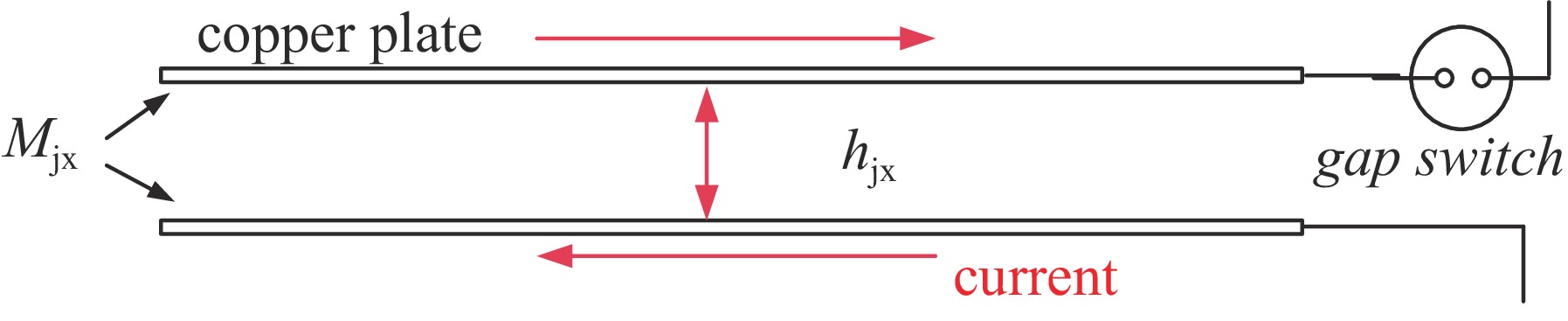
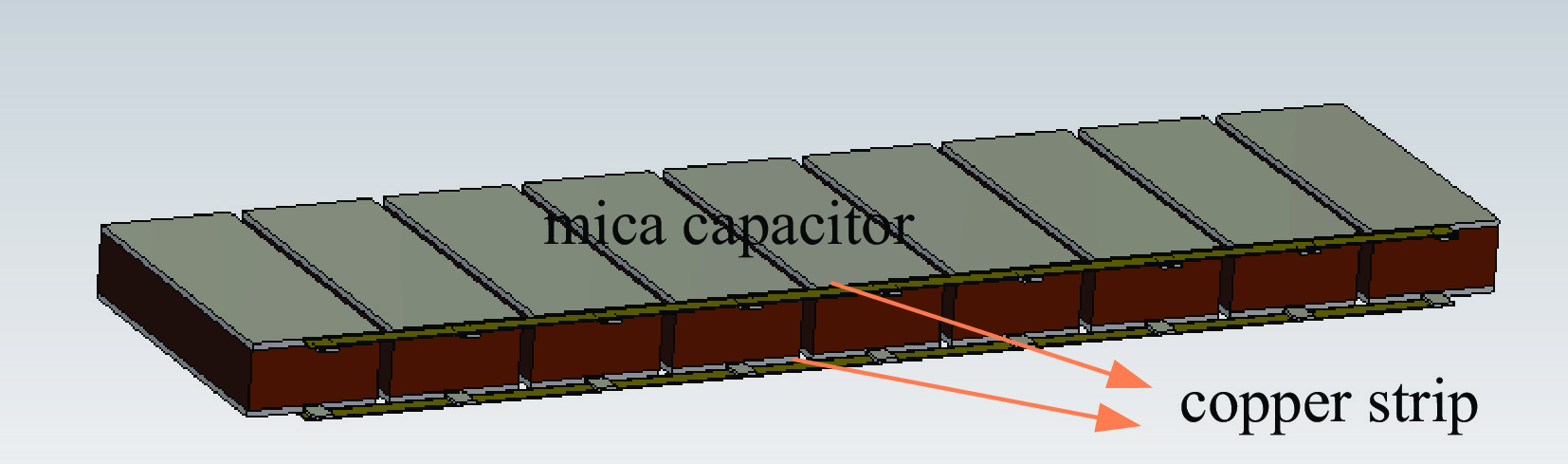
图 2 单级PFN中矩形铜带的位置的示意图
Figure 2. Schematic diagram of the position of copper strips in a single-stage PFN
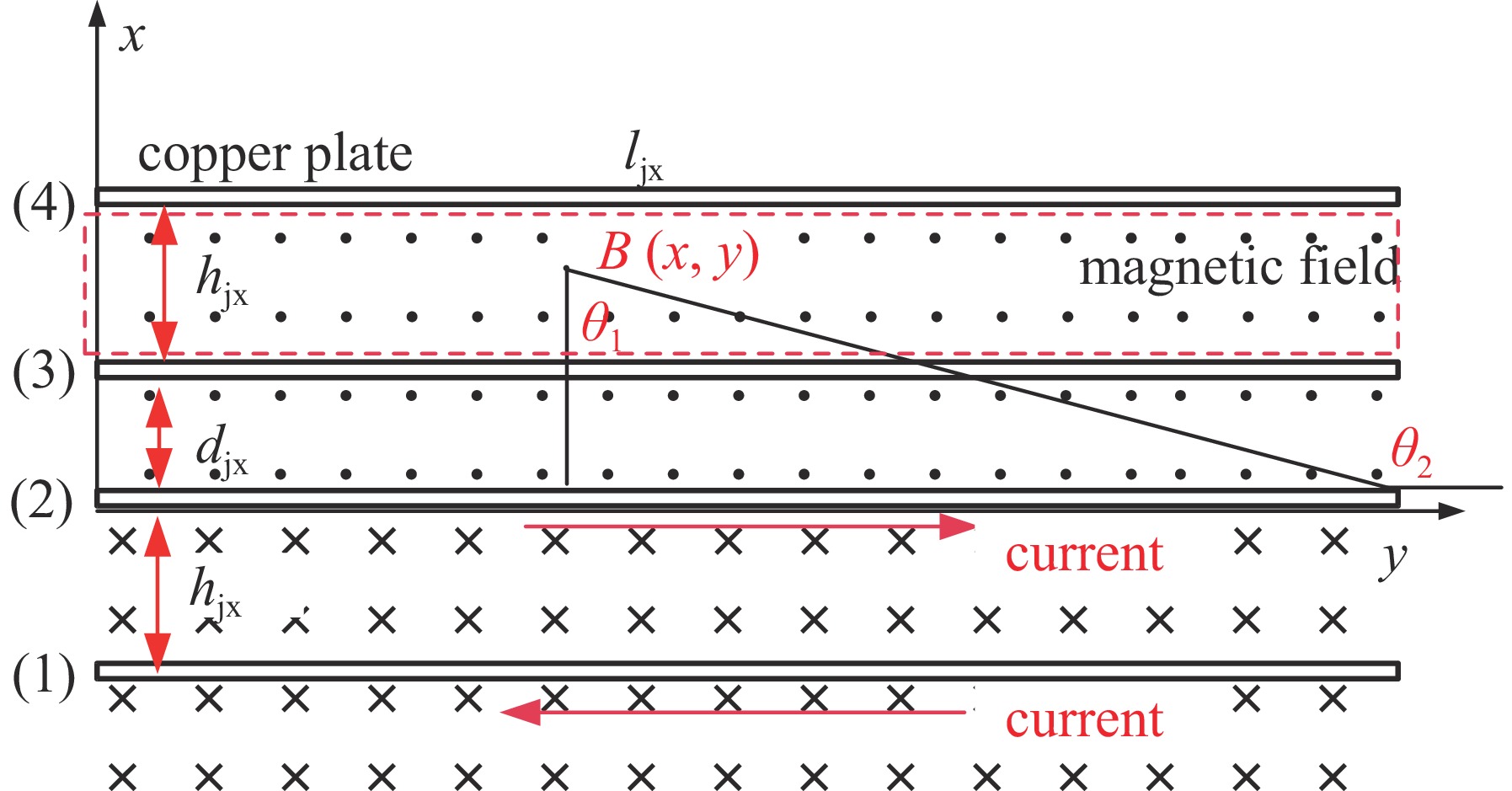
图 3 有限长铜带线外一点的磁场强度
Figure 3. Magnetic field intensity at an external point of a finite-length copper strip
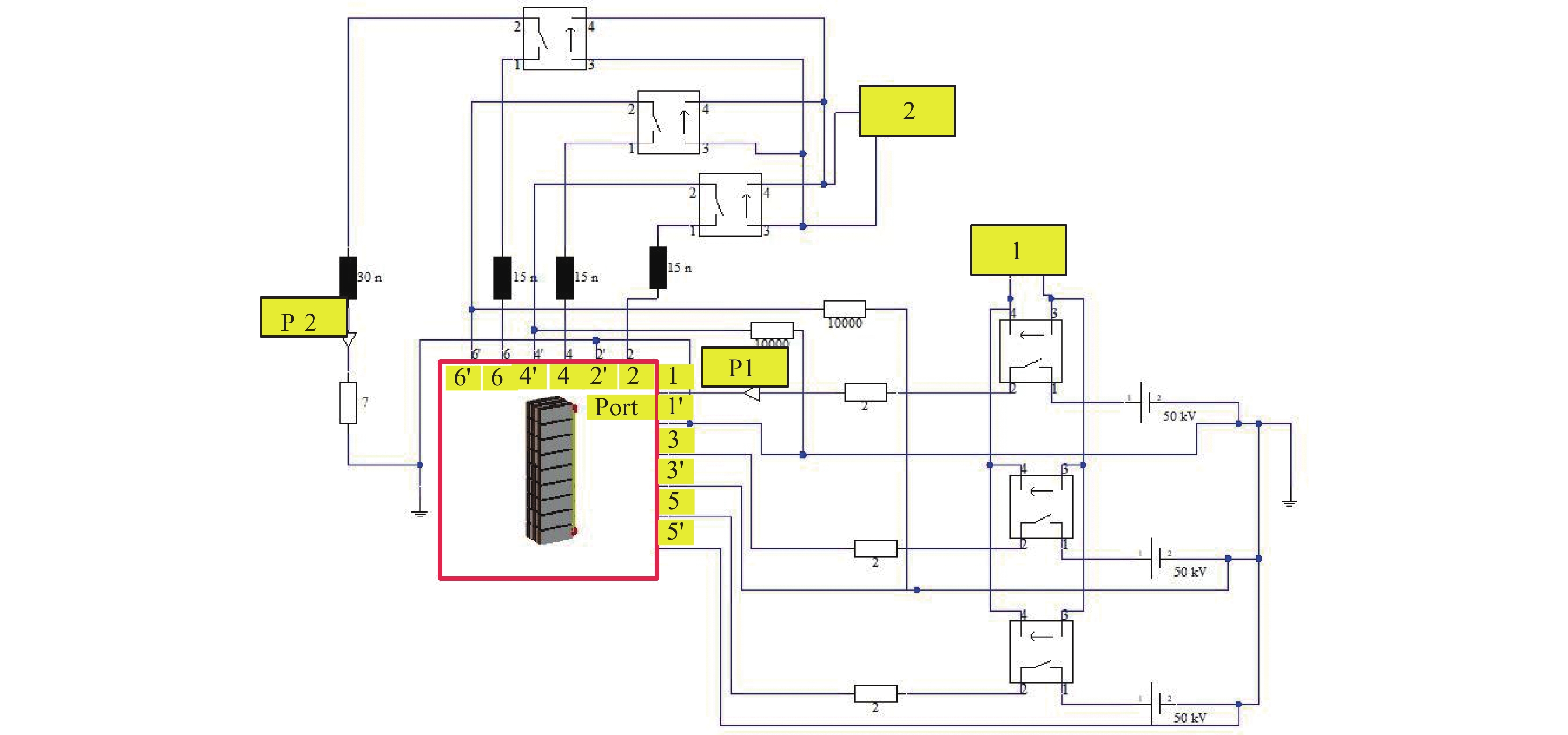
图 5 场路协同仿真的电路部分的示意图
Figure 5. The diagram of the electric circuit of the field-circuit simulation
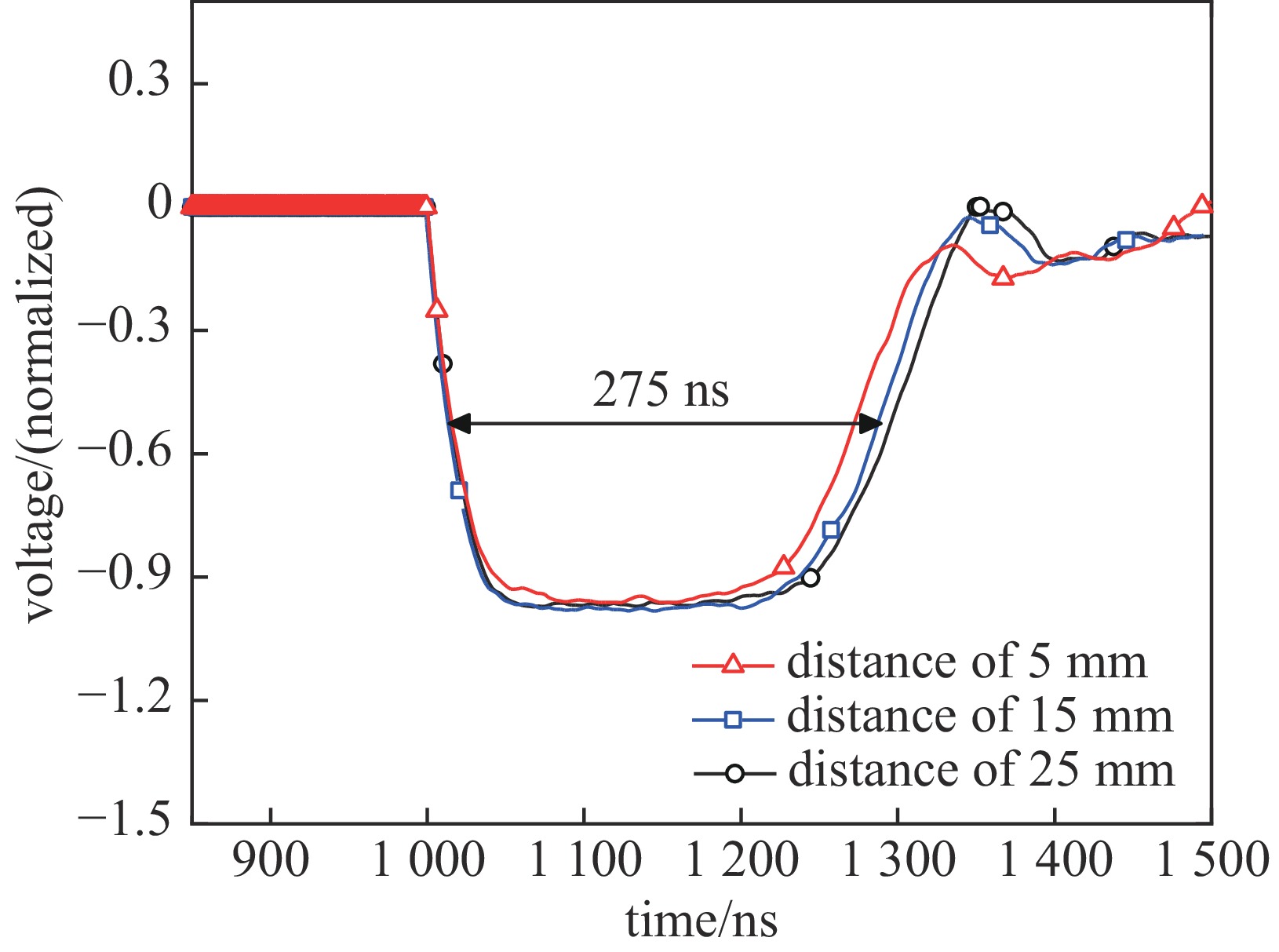
图 7 三种间距的仿真结果的负载波形
Figure 7. The simulation results of the load voltage waveform under three distance conditions
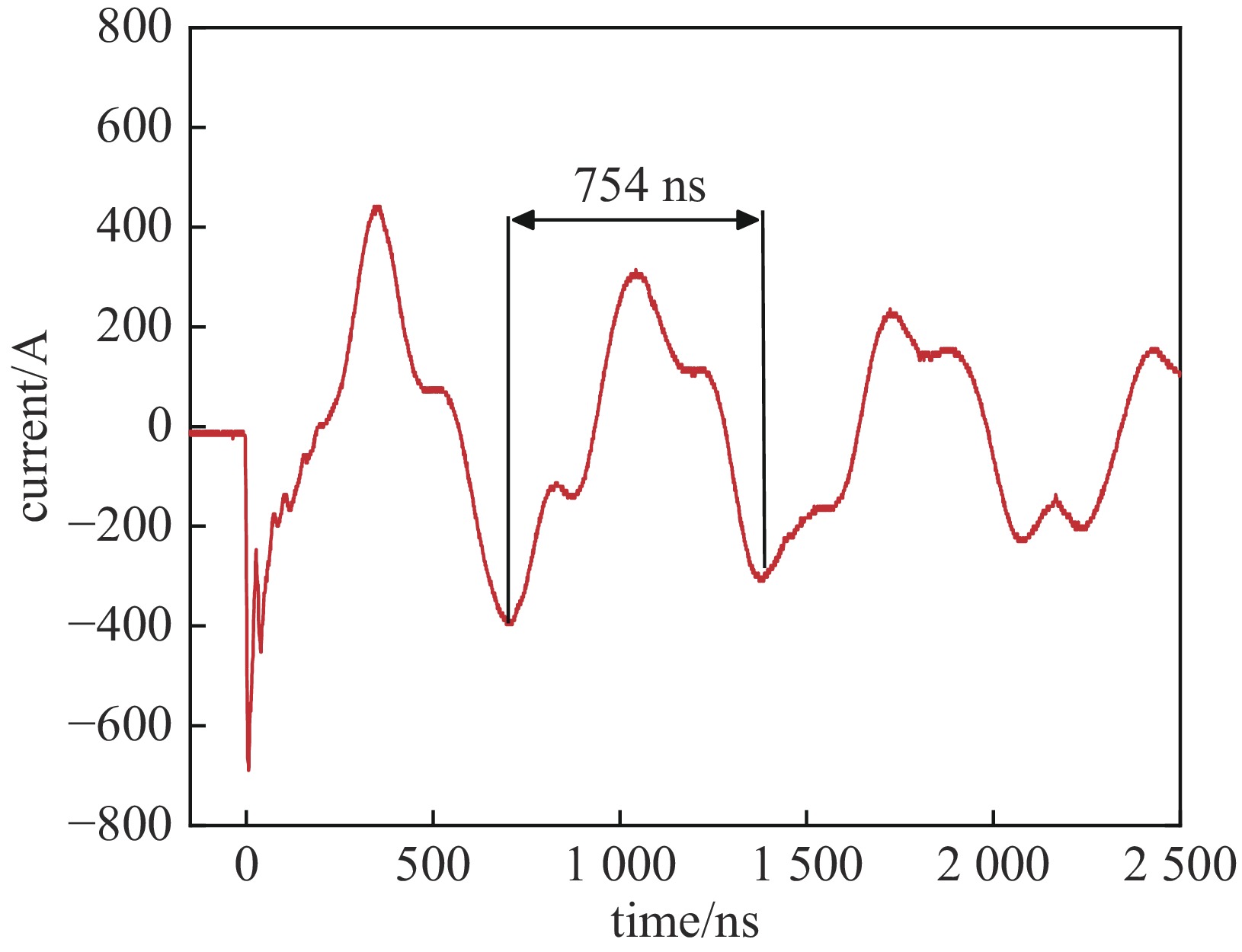
图 8 短路放电时负载上电流振荡波形
Figure 8. Oscillating current waveform of the load during short-circuit discharge
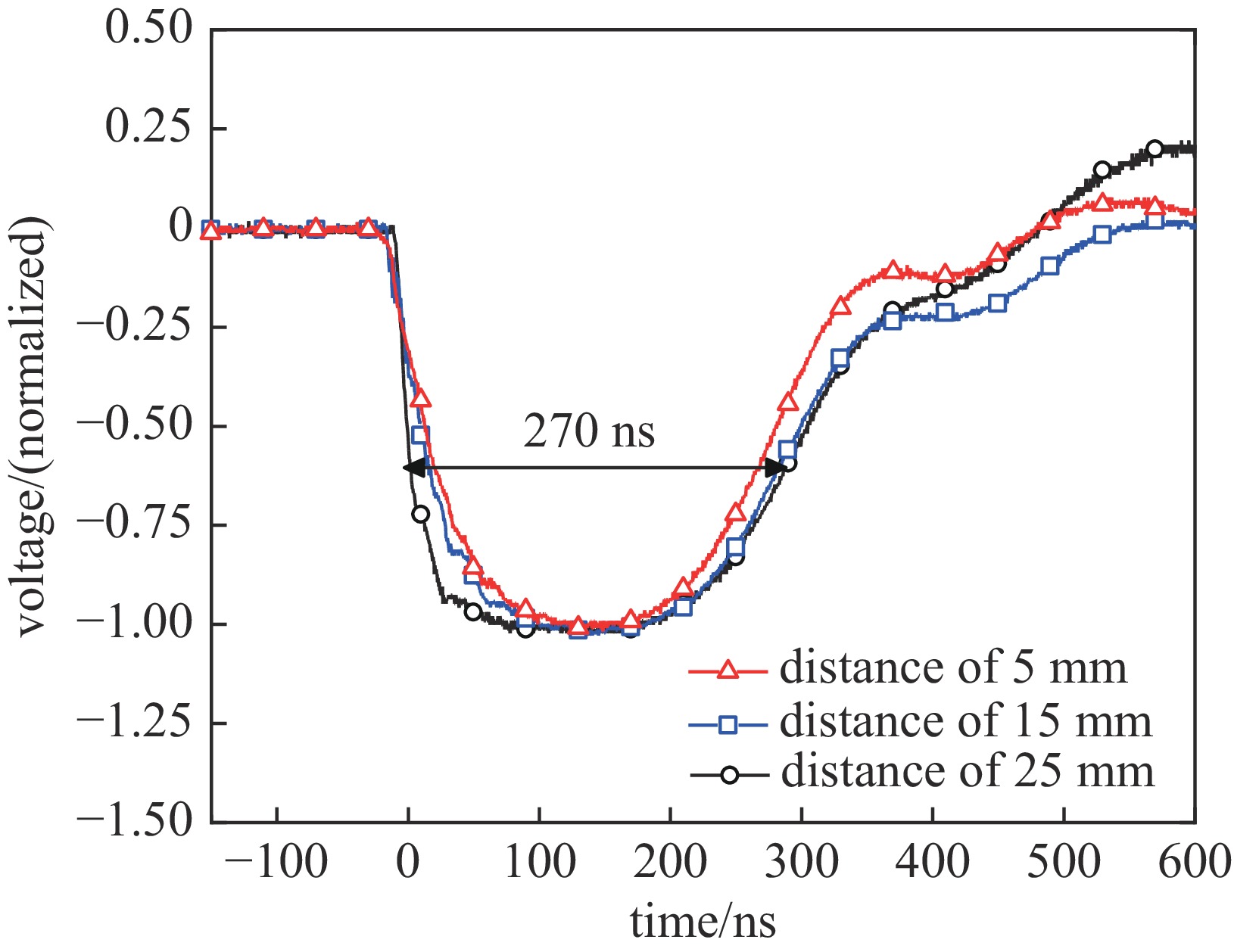
图 11 三种距离的PFN-Marx的负载波形对比
Figure 11. The experimental results of the load voltage waveform under three distance conditions
表 1 理论计算、仿真及实验结果对应的PFN参数
Table 1. PFN parameters corresponding to theoretical calculations, simulations, and experimental results
inductance of PFN/nH corresponding pulse width/ns distance of 5 mm distance of 15 mm distance of 25 mm distance of 5 mm distance of 15 mm distance of 25 mm theory 184 221 248 245 263 271 simulation 195 225 252 250 266 275 experiment 176 211 247 240 260 270  下载: 导出CSV
-
[1] Bluhm H. 脉冲功率系统的原理与应用[M]. 江伟华, 张弛, 译. 北京: 清华大学出版社, 2008: 1-45.Bluhm H. 脉冲功率系统的原理与应用[M]. 江伟华, 张弛, 译. 北京: 清华大学出版社, 2008: 1-45. (Bluhm H. Pulsed power systems: principles and applications[M]. Jiang Weihua, Zhang Chi, trans. Beijing: Tsinghua University Press, 2008: 1-45 [2] 曾正中. 实用脉冲功率技术引论[M]. 西安: 陕西科学技术出版社, 2003Zeng Zhengzhong. Introduction to practical pulse power technology[M]. Xi’an: Shaanxi Science and Technology Press, 2003 [3] 王莹. 高功率脉冲电源[M]. 北京: 原子能出版社, 1991. [4] 彭建昌, 苏建仓, 宋晓欣, 等. 40 GW重复频率脉冲驱动源研制进展[J]. 强激光与粒子束, 2010, 22(4): 712-716 doi: 10.3788/HPLPB20102204.0712Peng Jianchang, Su Jiancang, Song Xiaoxin, et al. Progress on a 40 GW repetitive pulsed accelerator[J]. High Power Laser and Particle Beams, 2010, 22(4): 712-716 doi: 10.3788/HPLPB20102204.0712 [5] Hammon J, Lam S K, Pomeroy S. A transportable 500 kV, high average power modulator with pulse length adjustable from 100 ns to 500 ns[C]//Proceedings of 1996 International Power Modulator Symposium. 1996: 157-160. [6] Mayes J R, Mayes M G, Lara M B. A novel Marx generator topology design for low source impedance[C]//Proceedings of 2005 IEEE Pulsed Power Conference. 2005: 684-687. [7] Mayes J R, Hatfield C W. Development of a sequentially switched Marx generator for HPM loads[C]//Proceedings of 2009 IEEE Pulsed Power Conference. 2009: 934-937. [8] Neuber A A, Chen Y J, Dickens J C, et al. A compact, repetitive, 500kV, 500 J, Marx generator[C]//Proceedings of 2005 IEEE Pulsed Power Conference. 2005: 1203-1206. [9] Parson J M, Lynn C F, Bragg J W B, et al. Rep-rate operation of a 300 kV, high-power microwave sealed-tube vircator[C]//Proceedings of 2014 IEEE International Power Modulator and High Voltage Conference. 2014: 326-328. [10] Lassalle F, Morell A, Loyen A, et al. Development and test of a 400-kV PFN Marx with compactness and rise time optimization[J]. IEEE Transactions on Plasma Science, 2018, 46(10): 3313-3319. doi: 10.1109/TPS.2018.2837344 [11] 伍友成, 冯传均, 付佳斌, 等. 基于PFN-Marx技术的紧凑型重频脉冲功率源[J]. 强激光与粒子束, 2024, 36: 055019 doi: 10.11884/HPLPB202436.230354Wu Youcheng, Feng Chuanjun, Fu Jiabin, et al. A compact PFN-Marx repetitive pulsed power source[J]. High Power Laser and Particle Beams, 2024, 36: 055019 doi: 10.11884/HPLPB202436.230354 [12] 刘宏伟. 紧凑型低阻抗准方波Marx发生器技术研究[D]. 北京: 中国工程物理研究院, 2017Liu Hongwei. Investigation of a compact low impedance Marx generator with quasi rectangular pulse output[D]. Beijing: Institute of Fluid Physics China Academy of Engineering Physics, 2017 [13] 宋法伦, 李飞, 龚海涛, 等. 高功率重复频率Marx型脉冲功率源小型化技术研究进展[J]. 强激光与粒子束, 2018, 30: 020201Song Falun, Li Fei, Gong Haitao, et al. Research progress on miniaturization of high power repetition frequency Marx type pulse power source[J]. High Power Laser and Particle Beams, 2018, 30: 020201 [14] Song Falun, Zhang Beizhen, Li Chunxia, et al. Development and testing of a three-section pulse-forming network and its application to Marx circuit[J]. Laser and Particle Beams, 2019, 37(4): 408-414. doi: 10.1017/S0263034619000673 [15] 李志强, 杨建华, 张建德, 等. 固态化脉冲形成网络Marx脉冲发生器[J]. 强激光与粒子束, 2014, 26: 065004 doi: 10.11884/HPLPB201426.065004Li Zhiqiang, Yang Jianhua, Zhang Jiande, et al. Solid state pulsed forming network Marx generator[J]. High Power Laser and Particle Beams, 2014, 26: 065004 doi: 10.11884/HPLPB201426.065004 [16] Zhang Haoran, Li Zhiqiang, Zhang Zicheng, et al. Investigation on the generation of high voltage quasi-square pulses with a specific two-node PFN-Marx circuit[J]. Review of Scientific Instruments, 2020, 91: 024702. doi: 10.1063/1.5126760 [17] Zhang Haoran, Shu Ting, Liu Shifei, et al. A compact modular 5 GW pulse PFN-Marx generator for driving HPM source[J]. Electronics, 2021, 10: 545. doi: 10.3390/electronics10050545 [18] 杨双, 孙晶晶, 李典耕, 等. 高效率高阻抗层叠Blumlein线固态脉冲发生器研究[J]. 现代应用物理, 2024, 15: 030401Yang Shuang, Sun Jingjing, Li Diangeng, et al. Blumlein lines solid-state pulse generator using high-efficiency and high-resistance stacked[J]. Modern Applied Physics, 2024, 15: 030401 [19] 崔光曦, 李俊娜, 陈旭良, 等. 一种基于Marx发生器的纳秒脉冲实验平台[J]. 现代应用物理, 2022, 13: 040402Cui Guangxi, Li Junna, Chen Xuliang, et al. A nanosecond pulse experimental platform based on Marx generator[J]. Modern Applied Physics, 2022, 13: 040402 [20] Qiu Xudong, Su Jiancang, Li Yongdong, et al. Theoretical investigation on double-matched Marx generators[J]. IEEE Transactions on Power Electronics, 2024, 39(7): 8342-8352. doi: 10.1109/TPEL.2024.3389996 [21] 卡兰塔罗夫, 采依特林. 电感计算手册[M]. 陈汤铭, 译. 北京: 机械工业出版社, 1992Kantarov L T. Handbook of inductance calculation[M]. Chen Tangming, trans. Beijing: China Machine Press, 1992 -

 点击查看大图
计量
- 文章访问数: 14
- HTML全文浏览量: 8
- PDF下载量: 2
- 被引次数: 0
