



Design of windows for multi-scale turbulence collective scattering diagnostic system on HL-3 Tokamak
-
摘要: 高性能等离子体运行下的多尺度湍流与输运研究是磁约束聚变研究中的重要课题。HL-3托卡马克实验装置的等离子体参数范围决定了远红外激光相干散射是多尺度湍流实验研究所需的最佳诊断手段。本文将基于诊断系统的整体设计参数,详细介绍HL-3托卡马克上的远红外激光相干散射诊断系统的窗口设计。多尺度湍流相干散射诊断系统与HL-3装置相关的窗口界面为6号与12号中平面窗口。这是两个大型复合窗口,其中6号复合窗口上高于中平面100 mm的CF100法兰窗口为主激光入射窗口,12号复合窗口上垂直排列的三个CF165法兰窗口为主激光和散射光的出射窗口。窗口的设计主要需要考虑窗口的透过率、尺寸、真空密封与安全的要求。对于入射窗口的设计,其透过率与窗口材料、厚度有关,窗口的尺寸由高斯光束传播特性决定,窗口的厚度与尺寸设定还需要考虑真空密封与安全要求。出射窗口在设计中除了需要考虑以上因素,还需要重点考虑诊断的物理需求。窗口的高度尺寸与诊断系统的波数测量范围密切相关;同时,受磁场与运行模式影响,对于不同的散射角度,散射光在水平方向上存在角度偏移,窗口的宽度设计作出了相应的调整。Abstract:
Background The study of multi-scale turbulence and related anomalous transport under high-performance plasma operation remains an important topic in the research of magnetic confinement fusion. The parameter range of plasmas in the tokamak experiment determines that far-infrared laser collective scattering is the optimal diagnostic method for multi-scale turbulence diagnostics.Purpose This paper will discuss the overall design parameters of the diagnostic system and provide a detailed introduction to the design of the windows for the multi-scale turbulence collective scattering (MSTCS) diagnostic system on the HL-3 tokamak.Methods The laser beam entrance window of the MSTCS diagnostic system is located in the mid-plane port #6 of the HL-3 tokamak, and the scattered light beams exit from the windows in the mid-plane port #12. The design aspects of the windows include the material selection, clear aperture calculation, window thickness design, mechanical design, and surface quality requirements. Several inter-related factors need to be considered in the design process. These include the diagnostic wavenumber range, wavenumber resolution, wavenumber purity of the scattering data, laser beam transmission coefficients, and the requirements for vacuum sealing and safety.Results On the basis of these considerations, a corresponding design scheme was formulated. The technical details of the analysis and design process as well as the design results will be presented.Conclusions The MSTCS diagnostic system has been successfully installed on HL-3, and preliminary experimental data confirm the vacuum safety and optical performance of the diagnostic windows, thereby validating the overall design.-
Key words:
- collective scattering /
- plasma turbulence /
- far-infrared laser
-
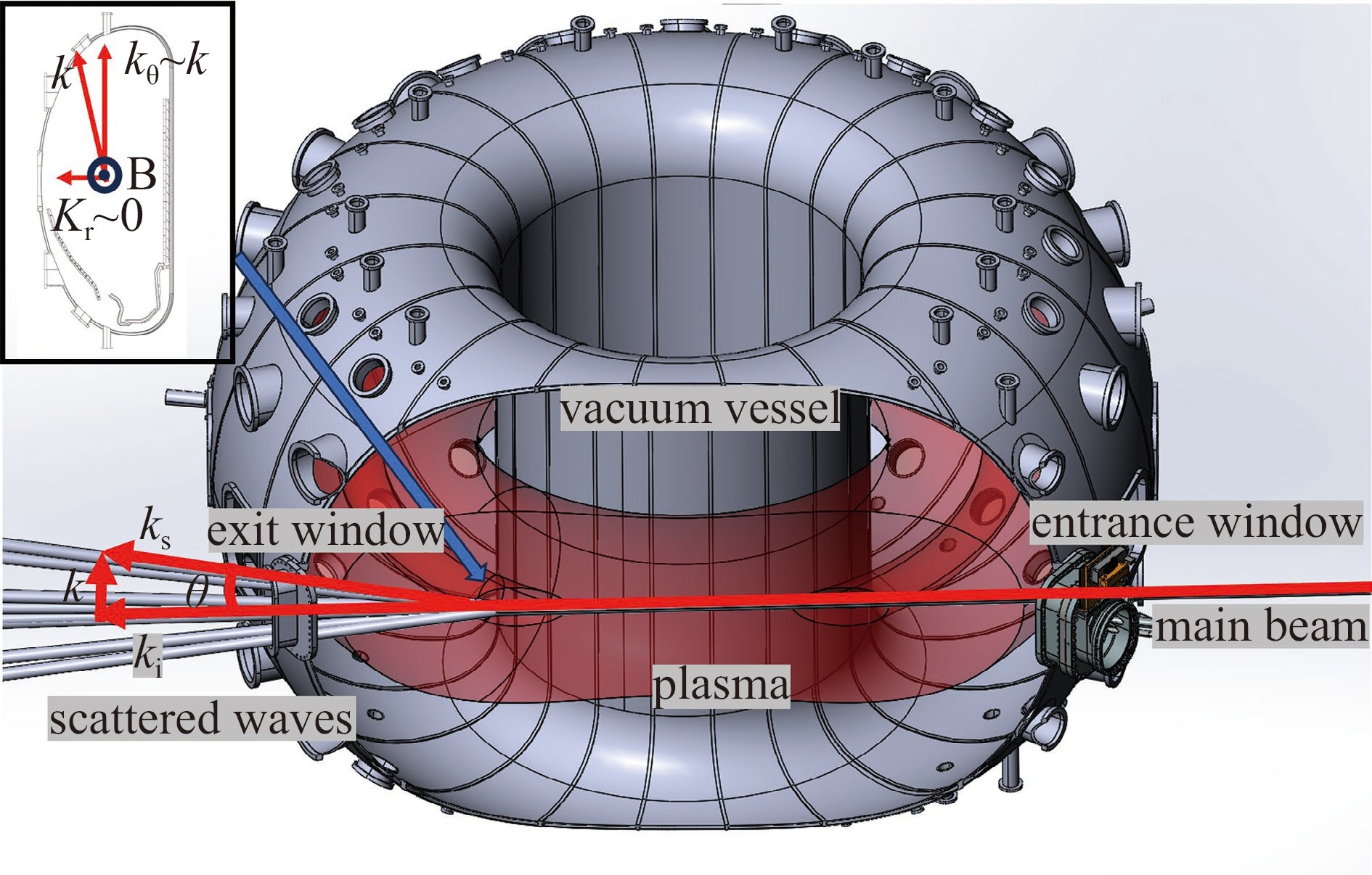
图 1 多尺度湍流相干散射诊断系统在HL-3装置的整体设计方案示意图。插图示意的是散射点处湍流波矢主要分量及其和磁场方向的垂直关系
Figure 1. Schematic diagram of the overall design of MSTCS diagnostic system on HL-3. The inset depicts the correlation between the wave vector components and the magnetic field at the scattering point
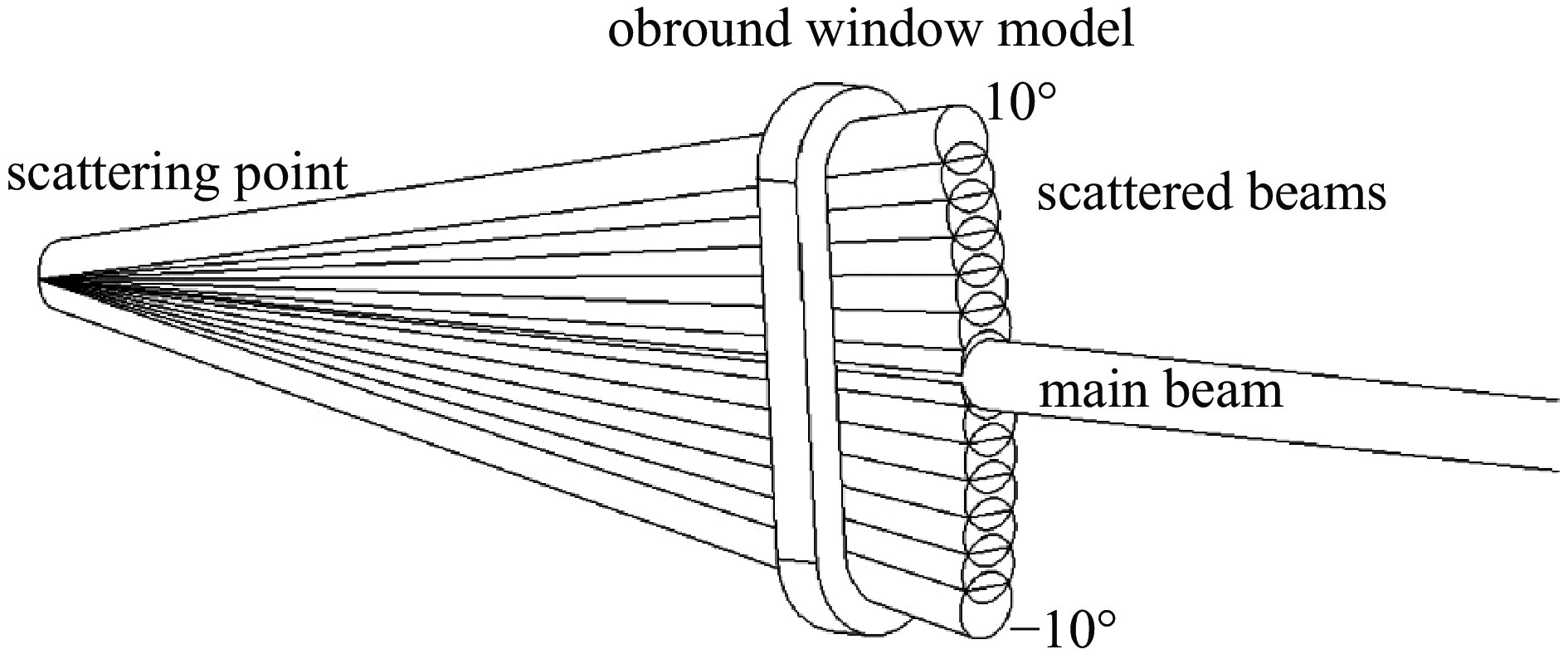
图 2 相干散射诊断系统的出射窗口(忽略宽度方向的设计需求)与散射光分布模型
Figure 2. The exit window and the scattered light distribution of MSTCS diagnostic system. (the width spreading is disregarded)
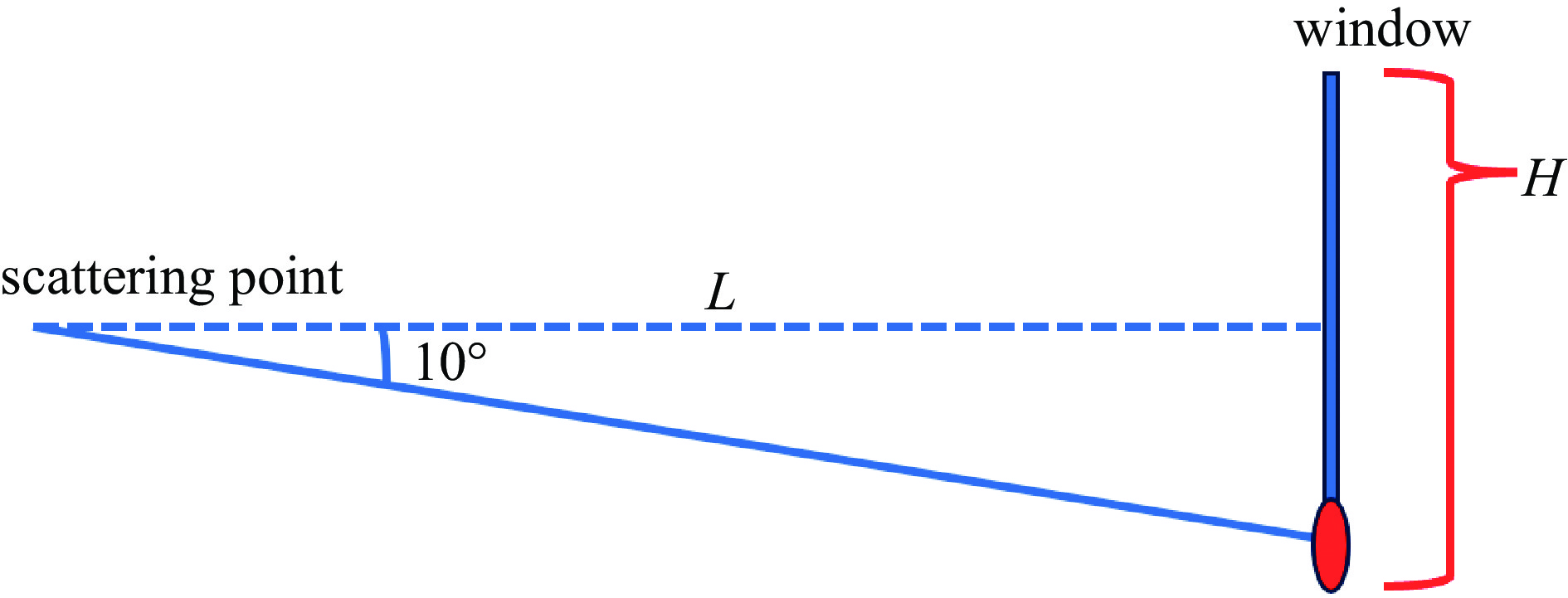
图 3 相干散射诊断系统出射窗口高度计算模型
Figure 3. Computational model for determining the exit window height
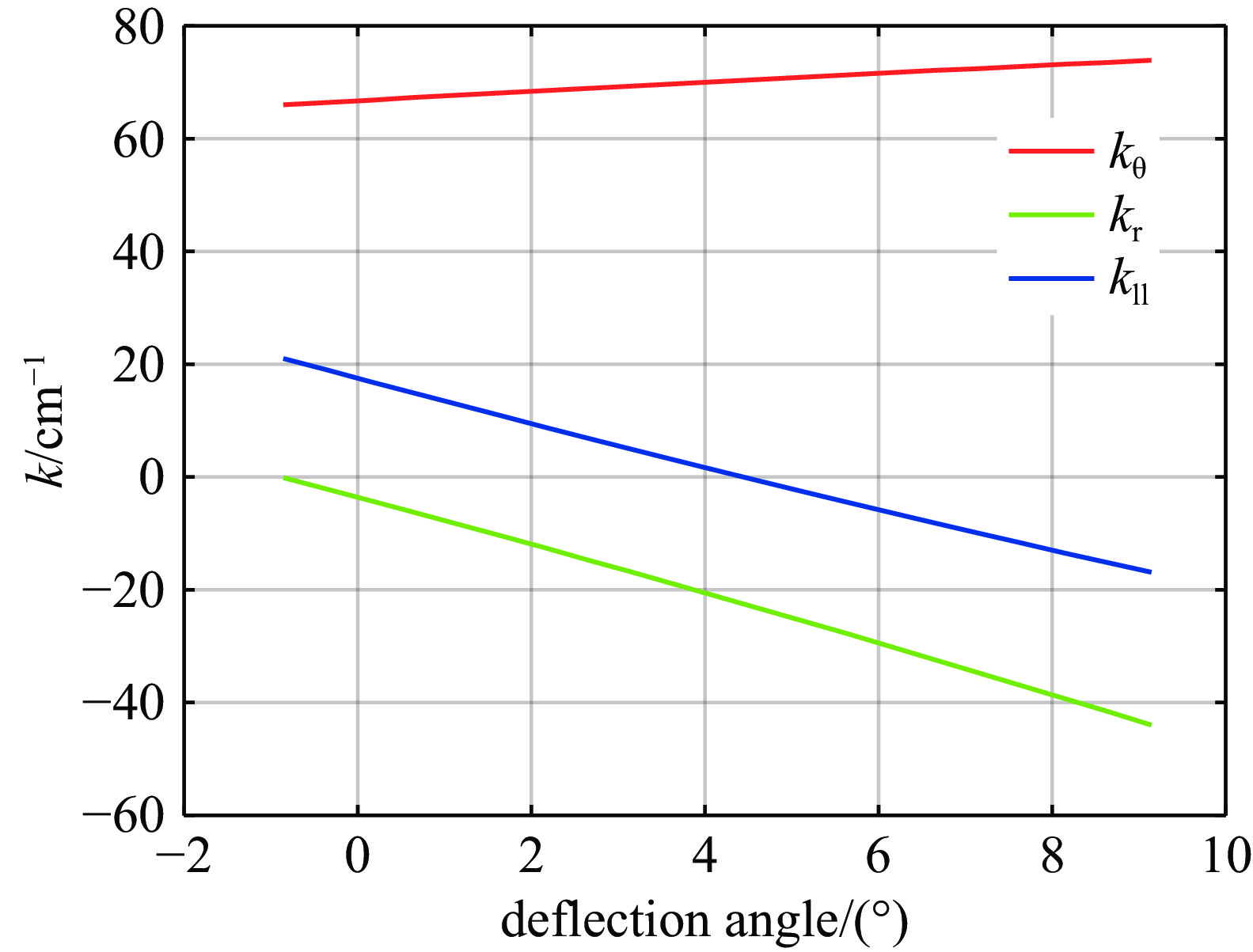
图 4 当归一化半径为0.5,散射角为10°时,散射光水平偏转角与测量波失在各方向的分量关系曲线
Figure 4. Relationship between horizontal deflection angle of scattered light and wave vector components. (r/a=0.5, scattering angle=10°)
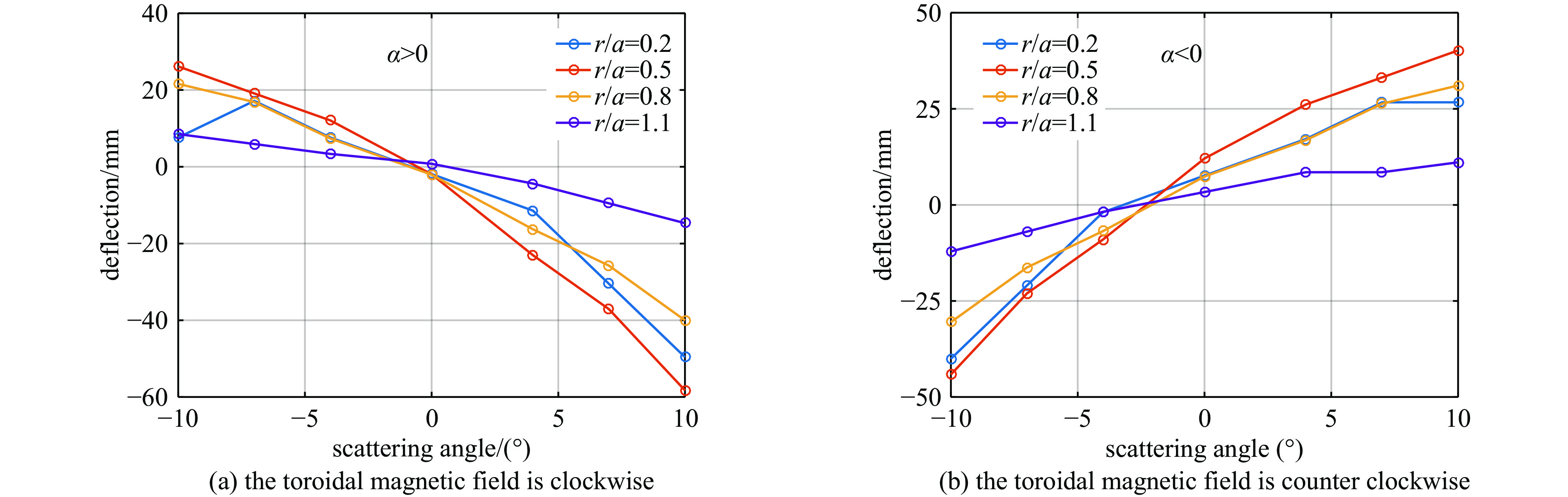
图 5 当环向磁场为顺时针方向时,窗口上的散射光最大正偏移26 mm,负偏移58 mm;当环向磁场为逆时针方向时,窗口上的散射光最大正偏移 40 mm,负偏移44 mm
Figure 5. When the toroidal magnetic field is clockwise, the maximum positive and negative offsets of the scattered light on the window are +26 mm and −58 mm, respectively (a). When the field is counter clockwise, the corresponding offsets are +40 mm and -44 mm (b)
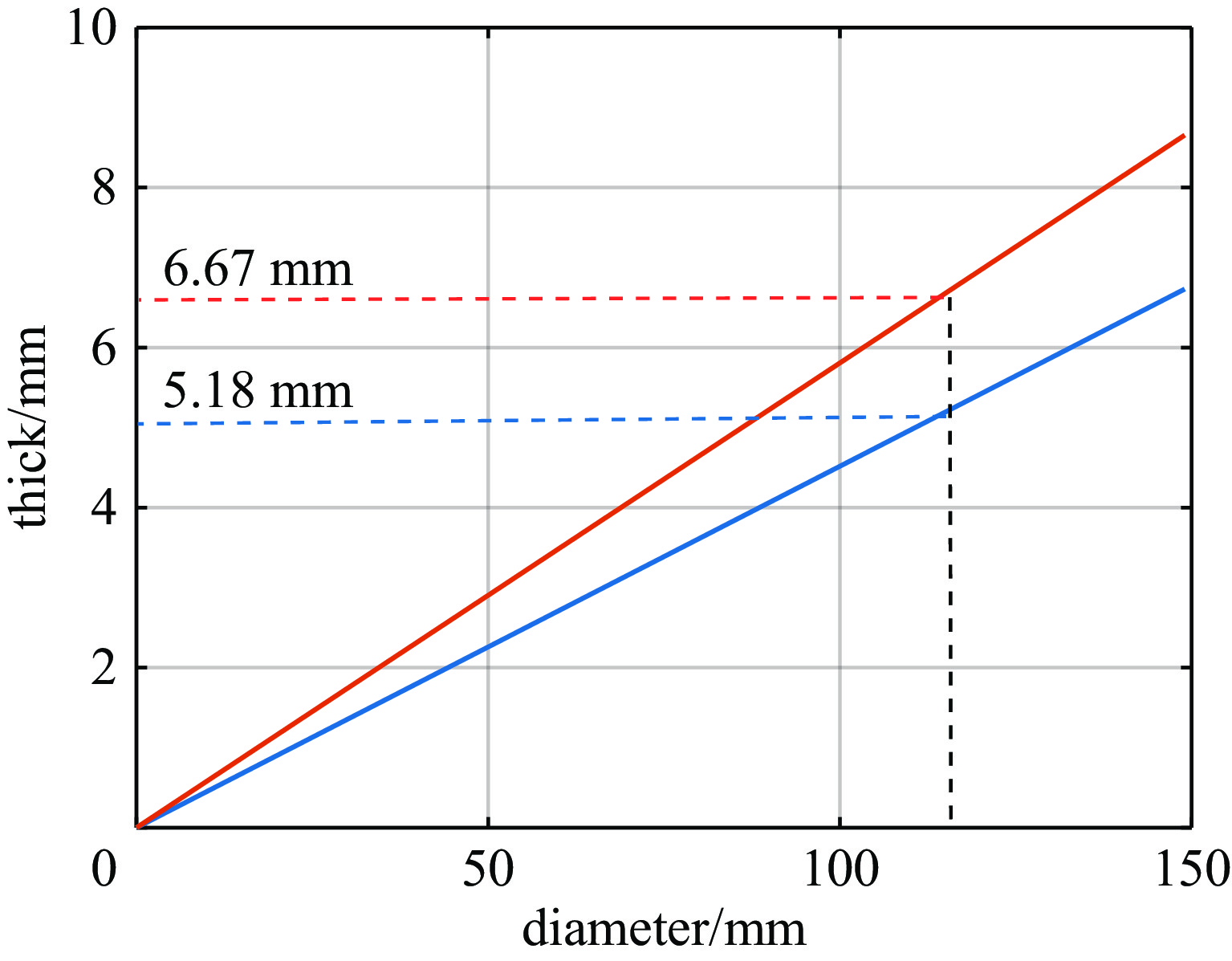
图 6 对于圆形石英晶体窗口,当窗口边缘固定安装时(蓝色曲线),以及窗口边缘简支安装时(红色曲线),窗口安全厚度与窗口直径的变化关系
Figure 6. The relationship between the safe thickness and the diameter of a circular quartz crystal window under two mounting conditions: simply supported edge installation (red curve) and fixed edge installation (blue curve)
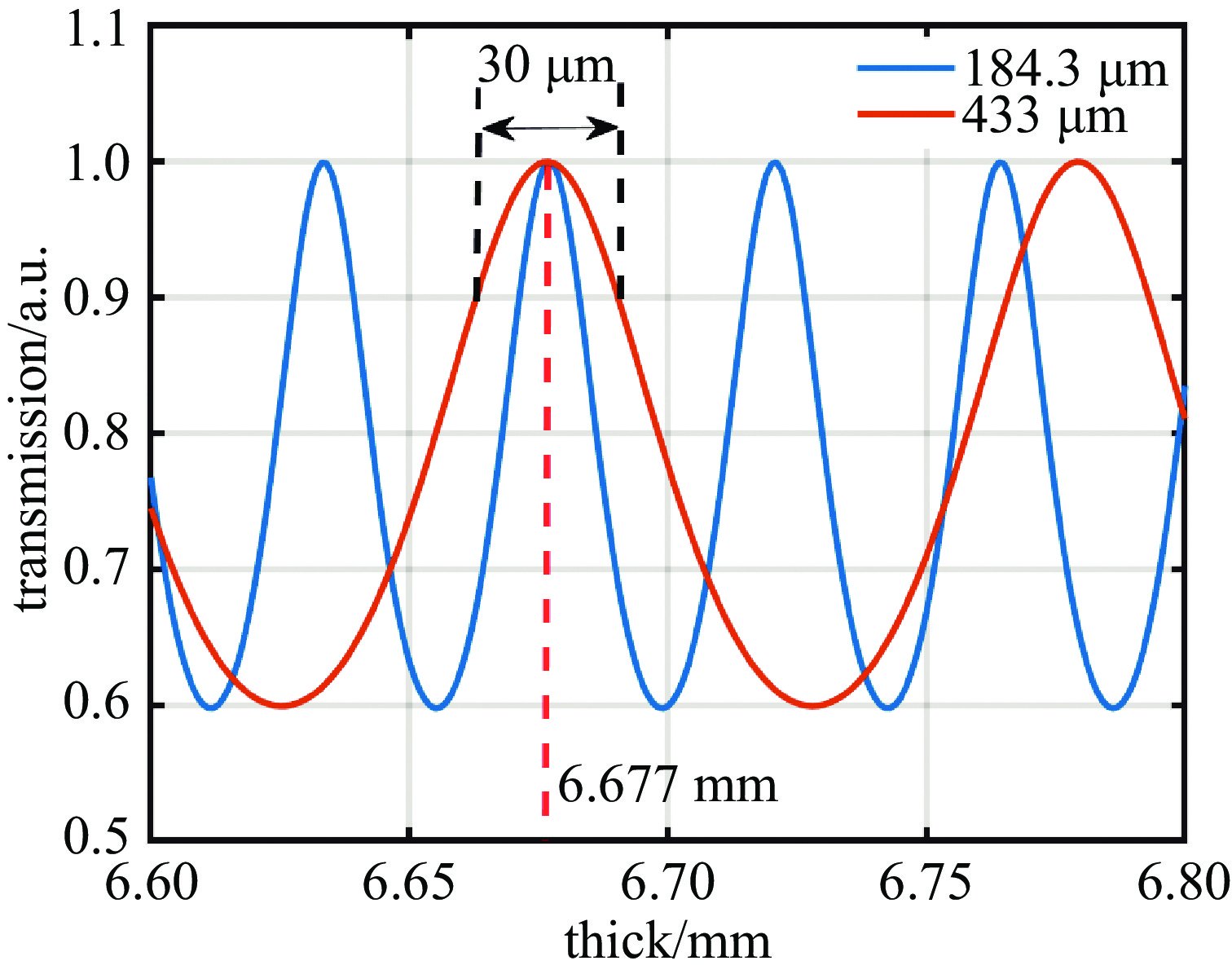
图 7 相干散射诊断系统入射窗口厚度与窗口透过率关系,考虑184.3 $ \text{μm} $和433 $ \text{μm} $的两个波长透过率的情况,以及加工误差选择
Figure 7. The relationship between the thickness of the entrance window and its optical transmittance, analyzed for wavelengths of 184.3 µm and 433 µm, and accounting for the selection of fabrication tolerances
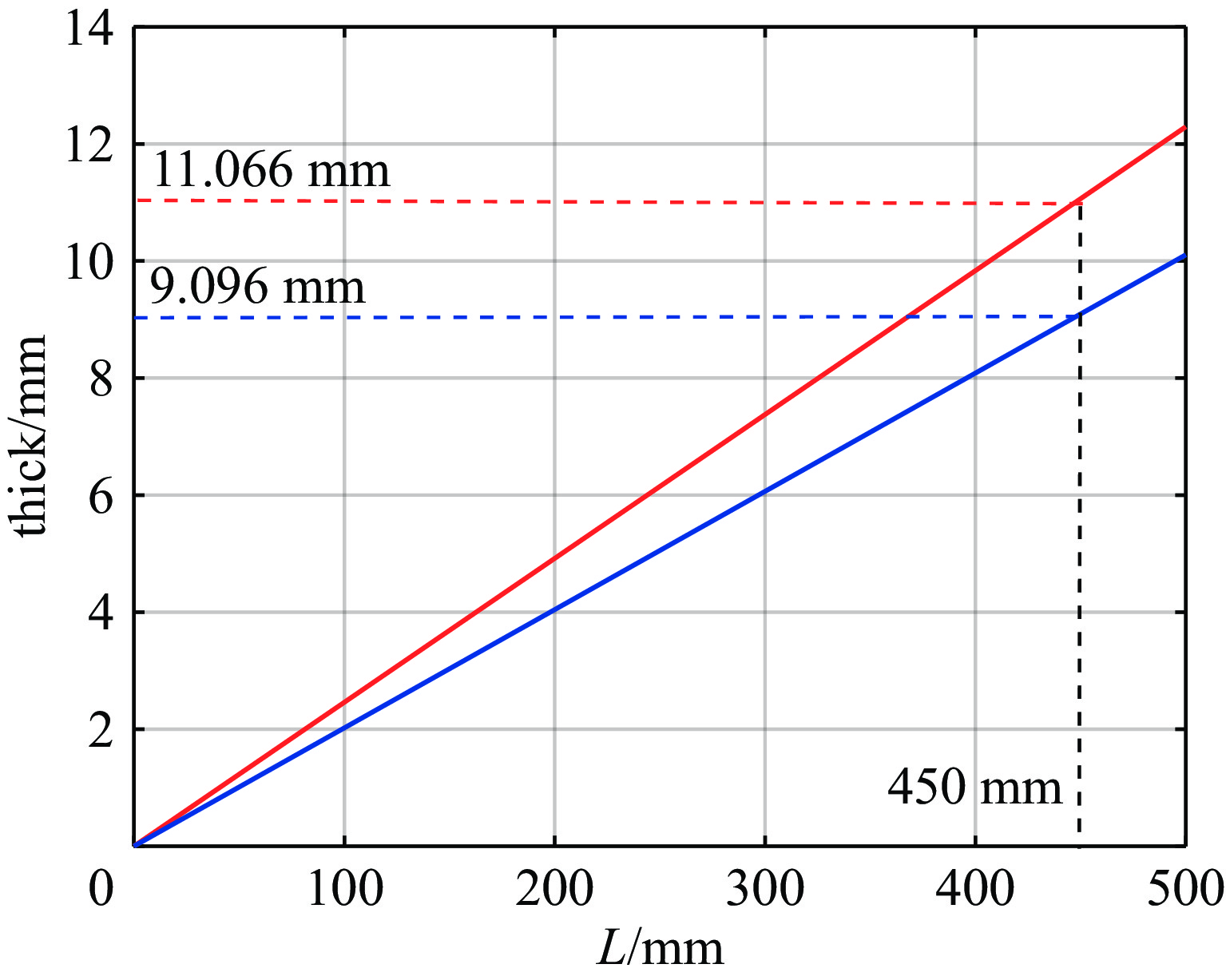
图 8 对于跑道型高阻硅窗口,当窗口边缘固定安装时(蓝色曲线),以及窗口边缘简支安装时(红色曲线),窗口安全厚度与尺寸L(沿对称轴方向的最大外形尺寸)的变化关系
Figure 8. The relationship between the safe thickness and L (maximum dimension along the symmetry axis) of a race track high-resistivity float-zone silicon window under two mounting conditions: simply supported edge installation (red curve) and fixed edge installation (blue curve)
-
[1] Wesson J, Campbell D J. Tokamaks[M]. 4th ed. Oxford: Oxford University Press, 2011. [2] Schmitz L, Holland C, Rhodes T L, et al. Reduced electron thermal transport in low collisionality H-mode plasmas in DIII-D and the importance of TEM/ETG-scale turbulence[J]. Nuclear Fusion, 2012, 52: 023003. doi: 10.1088/0029-5515/52/2/023003 [3] Luhmann Jr N C, Peebles W A. Instrumentation for magnetically confined fusion plasma diagnostics[J]. Review of Scientific Instruments, 1984, 55(3): 279-331. doi: 10.1063/1.1137760 [4] Mazzucato E. Small-scale density fluctuations in the adiabatic toroidal compressor[J]. Physical Review Letters, 1976, 36(14): 792-794. doi: 10.1103/PhysRevLett.36.792 [5] Schmitz L, Holland C, Rhodes T L, et al. Reduced electron thermal transport in low collisionality H-mode plasmas in DIII-D and the importance of TEM/ETG-scale turbulence[J]. Nuclear Fusion, 2012, 52: 023003. doi: 10.1088/0029-5515/52/2/023003 [6] Ren Y, Belova E, Gorelenkov N, et al. Recent progress in understanding electron thermal transport in NSTX[J]. Nuclear Fusion, 2017, 57: 072002. doi: 10.1088/1741-4326/aa4fba [7] Devynck P, Garbet X, Laviron C, et al. Localized measurements of turbulence in the TORE SUPRA tokamak[J]. Plasma Physics and Controlled Fusion, 1993, 35(1): 63-75. doi: 10.1088/0741-3335/35/1/005 [8] Saleh B E A, Teich M C, Slusher R E. Fundamentals of photonics[J]. Physics Today, 1992, 45: 87. [9] Sun Haiyin. Thin lens equation for a real laser beam with weak lens aperture truncation[J]. Optical Engineering, 1998, 37(11): 2906-2913. doi: 10.1117/1.601877 [10] Howard N T, Holland C, White A E, et al. Multi-scale gyrokinetic simulations: comparison with experiment and implications for predicting turbulence and transport[J]. Physics of Plasmas, 2016, 23: 056109. doi: 10.1063/1.4946028 [11] Mazzucato E. Detection of short-scale turbulence in the next generation of tokamak burning plasma experiments[J]. Plasma Physics and Controlled Fusion, 2006, 48(12): 1749-1763. doi: 10.1088/0741-3335/48/12/005 [12] Liu X, Domier C W, Dannenberg J, et al. The national spherical torus experiment-upgrade poloidal high-k scattering system pitch angle design modifications[J]. Review of Scientific Instruments, 2022, 93: 103509. doi: 10.1063/5.0099912 [13] Baumeister III T, Avallone T, Baumeister E A. Marks’ standard handbook for mechanical engineers[M]. 8th ed. New York: McGraw Hill, 1978: 53. [14] Koller D, Kerr A R, Ediss G A, et al. Design and fabrication of quartz vacuum windows with matching layers for millimeter-wave receivers[C]//Proceedings of the 12th International Symposium on Space Terahertz Technology. 2001: 410-415. [15] Bréhat F, Wyncke B. Measurement of the optical constants of crystal quartz at 10 K and 300 K in the far infrared spectral range: 10-600 cm−1[J]. International Journal of Infrared and Millimeter Waves, 1997, 18(9): 1663-1679. doi: 10.1007/BF02678278 [16] Dai Jianming, Zhang Jiangquan, Zhang Weili, et al. Terahertz time-domain spectroscopy characterization of the far-infrared absorption and index of refraction of high-resistivity, float-zone silicon[J]. Journal of the Optical Society of America B, 2004, 21(7): 1379-1386. doi: 10.1364/JOSAB.21.001379 -

 下载:
下载:
 点击查看大图
计量
- 文章访问数: 16
- HTML全文浏览量: 6
- PDF下载量: 0
- 被引次数: 0
