



Simulation investigation of Ku-band coaxial relativistic magnetron with axial- output
-
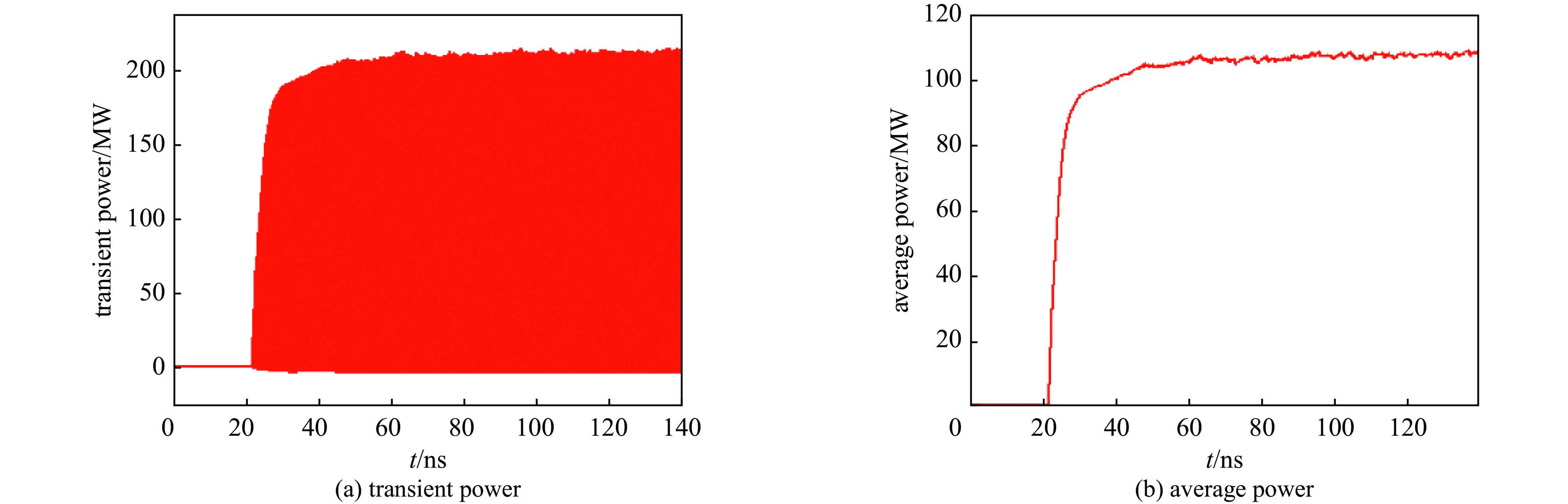
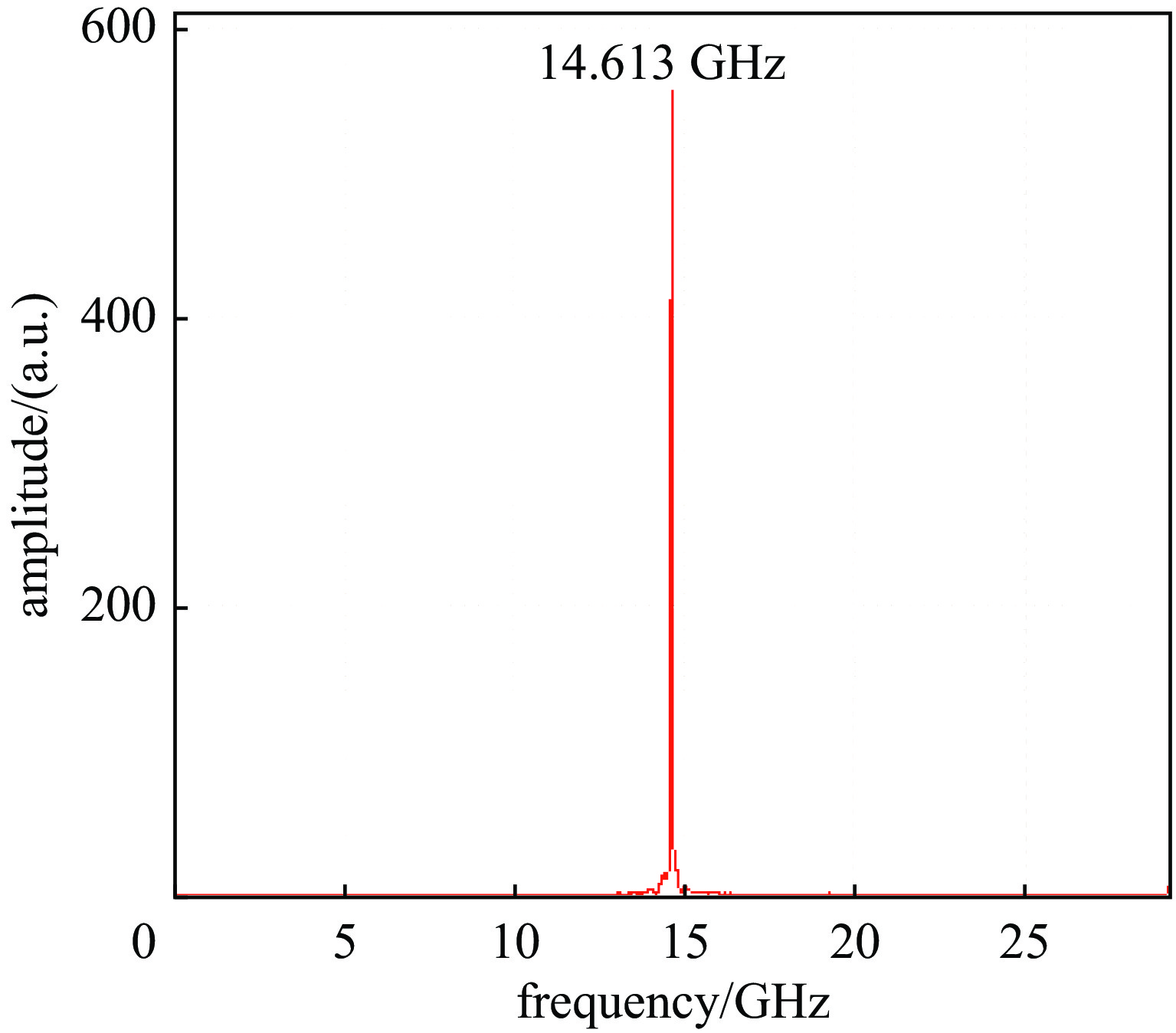
摘要: 现阶段,对相对论磁控管的研究还主要集中在频率较低的L、S等波段,而对高频段相对论磁控管的研究却鲜有报道。为了拓展相对论磁控管的工作频段,本文设计了一种Ku波段同轴相对论磁控管,该管子采用内腔为18腔的同轴磁控管结构,并采用同轴轴向输出技术,在电压180 kV、电流1.4 kA、工作磁场0.4 T的条件下,三维PIC仿真得到108 MW的仿真功率,工作频率14.613 GHz,功率转换效率约43%,同轴输出波导输出口监测到的微波模式为TE01模。仿真结果表明该器转换效率高,引导磁场低,结构紧凑,有利于系统的轻小型化。Abstract:
Background With the development of pulse power technology and plasma physics, high-power microwave technology has rapidly developed, giving rise to various types of high-power microwave sources. Among them, the relativistic magnetron stands out as one of the most promising high-power microwave sources due to its high power conversion efficiency, compact structure, and tunable frequency.At present, the investigations of the relativistic magnetron mainly focus on microwave generation mechanism, operation and radiation characteristics at the relative low frequency band, such as L-band and S-band. The operating characteristics of relativistic magnetron at higher frequencies are scarcely studied.Purpose A Ku-band coaxial relativistic magnetron (RM) is designed in this paper to broaden working frequency range of this type of High Power Microwave (HPM) source, further expanding its application scope.Methods A coaxial magnetron structure with 18 inner cavities is applied in this tube. A Particle-in-cell (PIC) simulation has been carried out with the coaxial-axial-output.Results The high power microwave with power of 108MW was detected at 14.613 GHz with power conversion efficiency of about 43% when the applied voltage was 180 kV, the current was 1.4 kA, the inducing magnetic field was about 0.4 T, and the mode of output microwave in coaxial-waveguide is TE01 mode.Conclusions The simulation results show that the presented tube has a relative high conversion efficiency with low guiding magnetic field and more compact structure, which is convenient to decrease the volume and weight of the system.-
Key words:
- high power microwave /
- coaxial relativistic magnetron /
- axial- output /
- Ku-band /
- TE01 mode
-
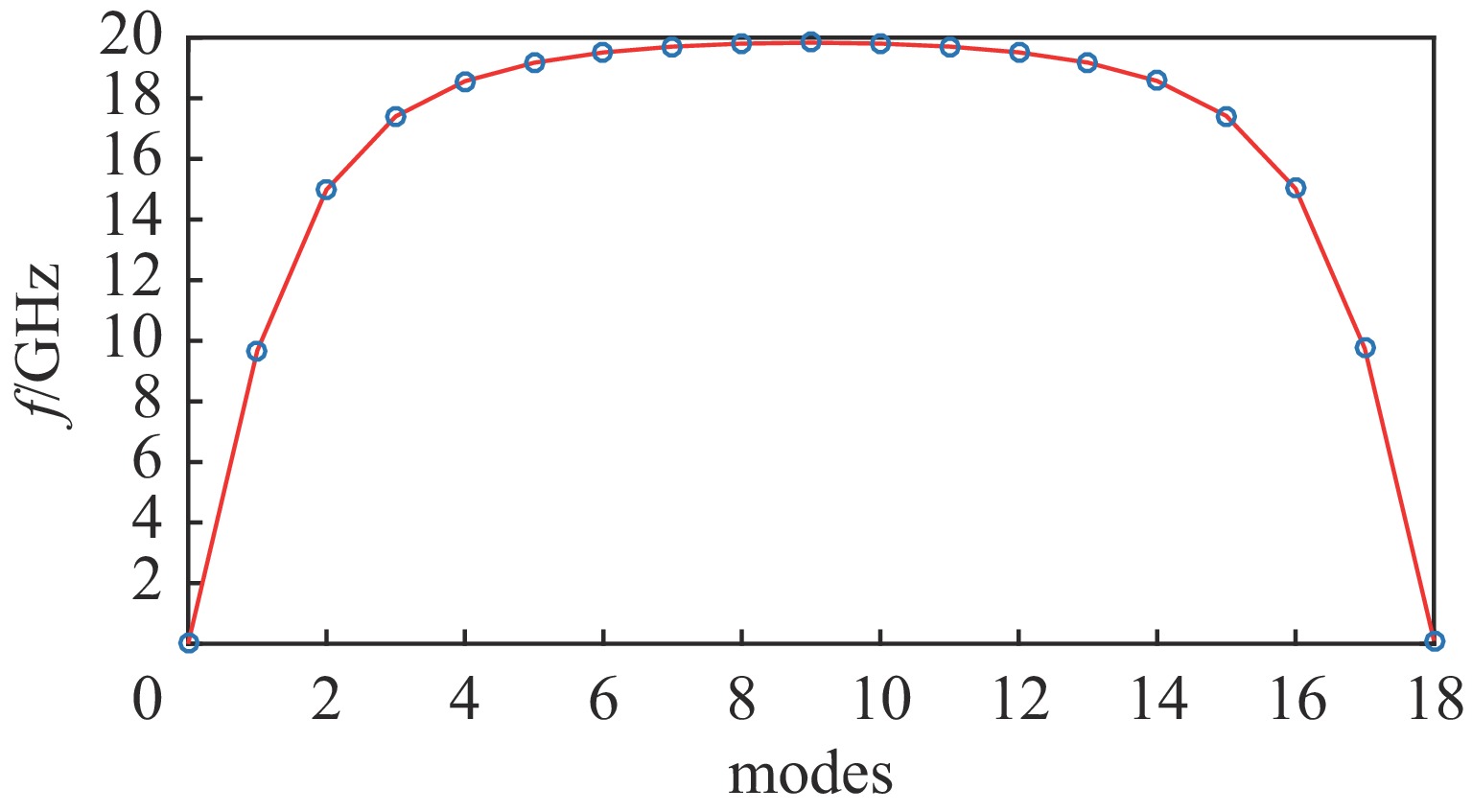
图 1 Ku波段同轴相对论磁控内腔色散曲线
Figure 1. Dispersion curve for Ku-band coaxial relativistic magnetron
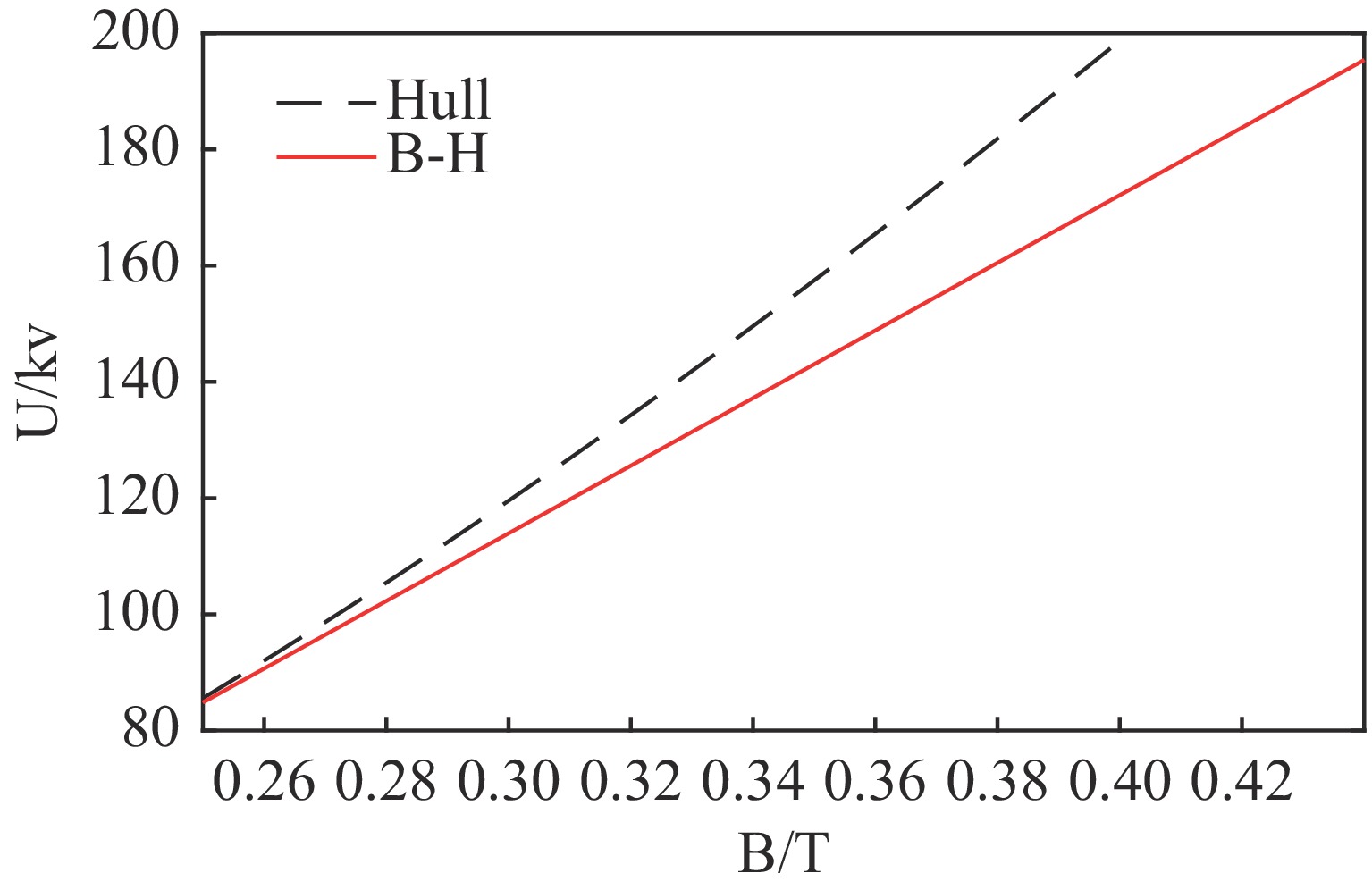
图 3 Ku波段同轴相对论磁控管工作曲线
Figure 3. B-H condition curve and Hull cutoff curve for Ku-band coaxial relativistic magnetron
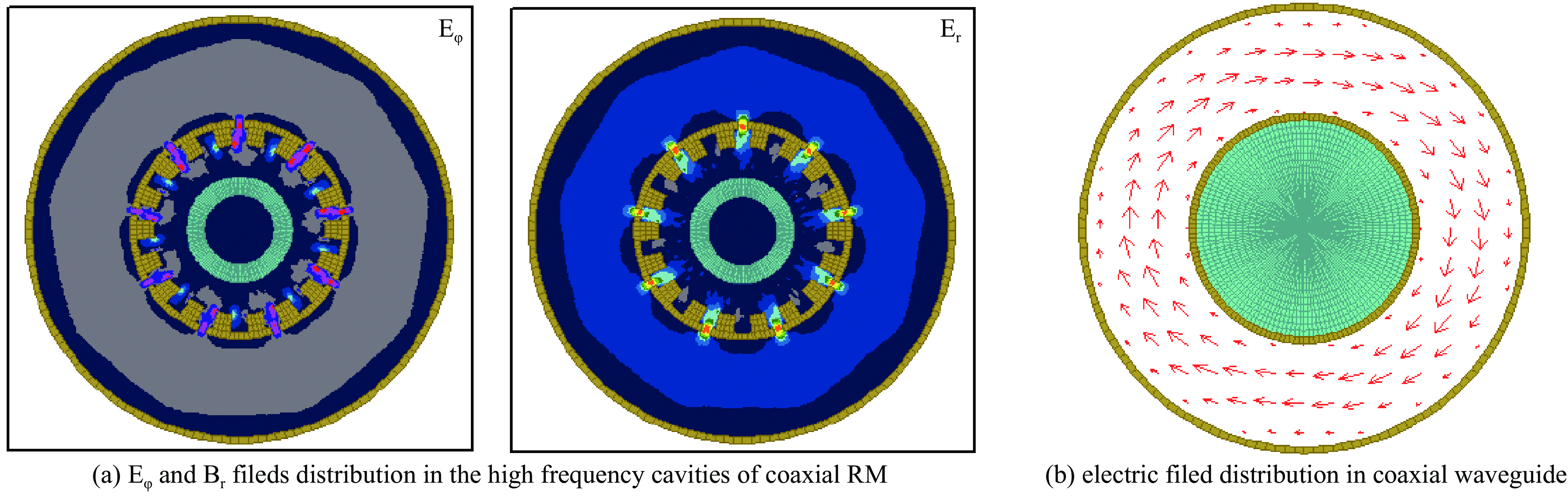
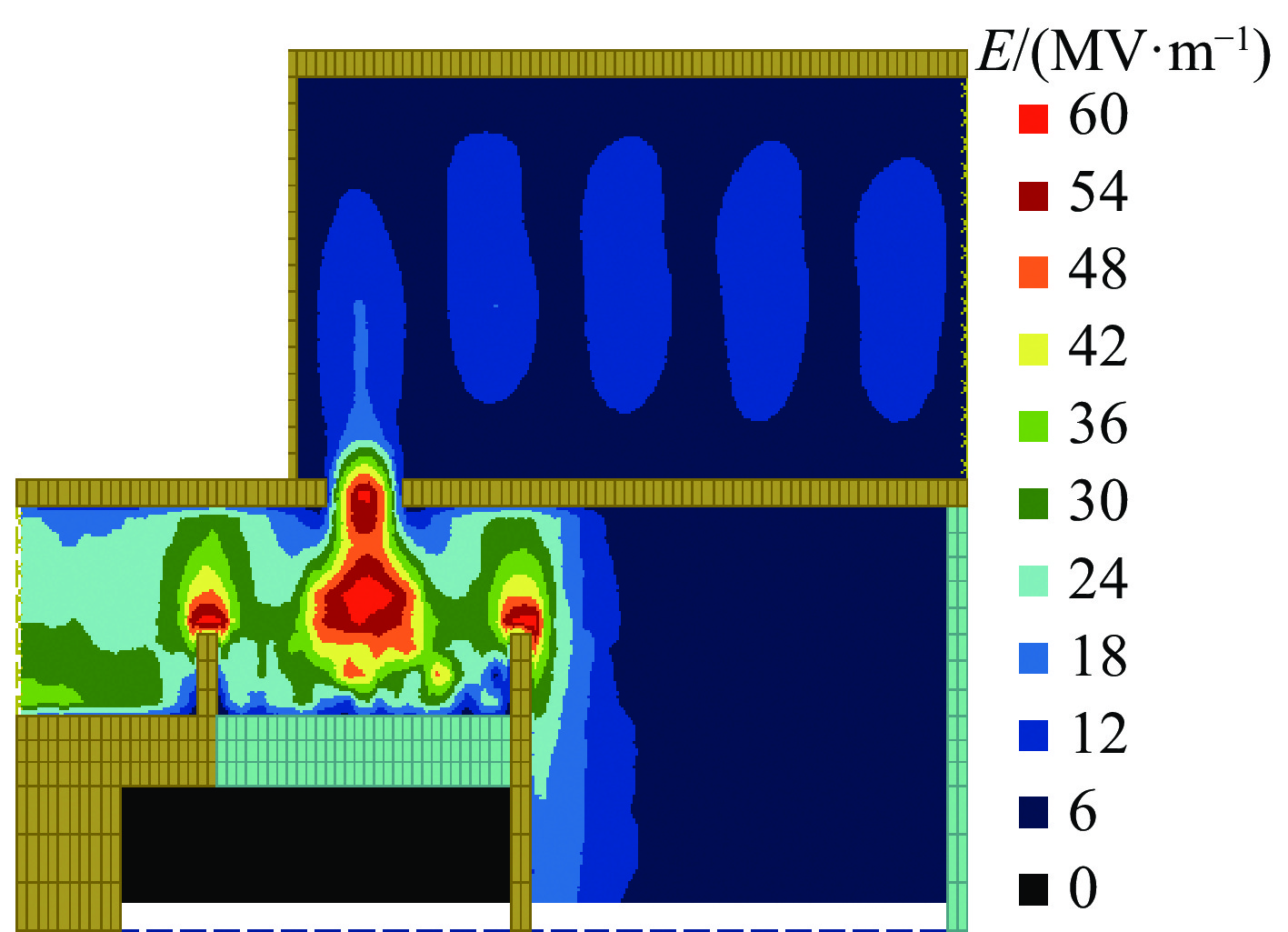
图 9 同轴磁控管高频腔内及同轴波导内的场分布
Figure 9. the filed distribution of the transverse section in coaxial RM
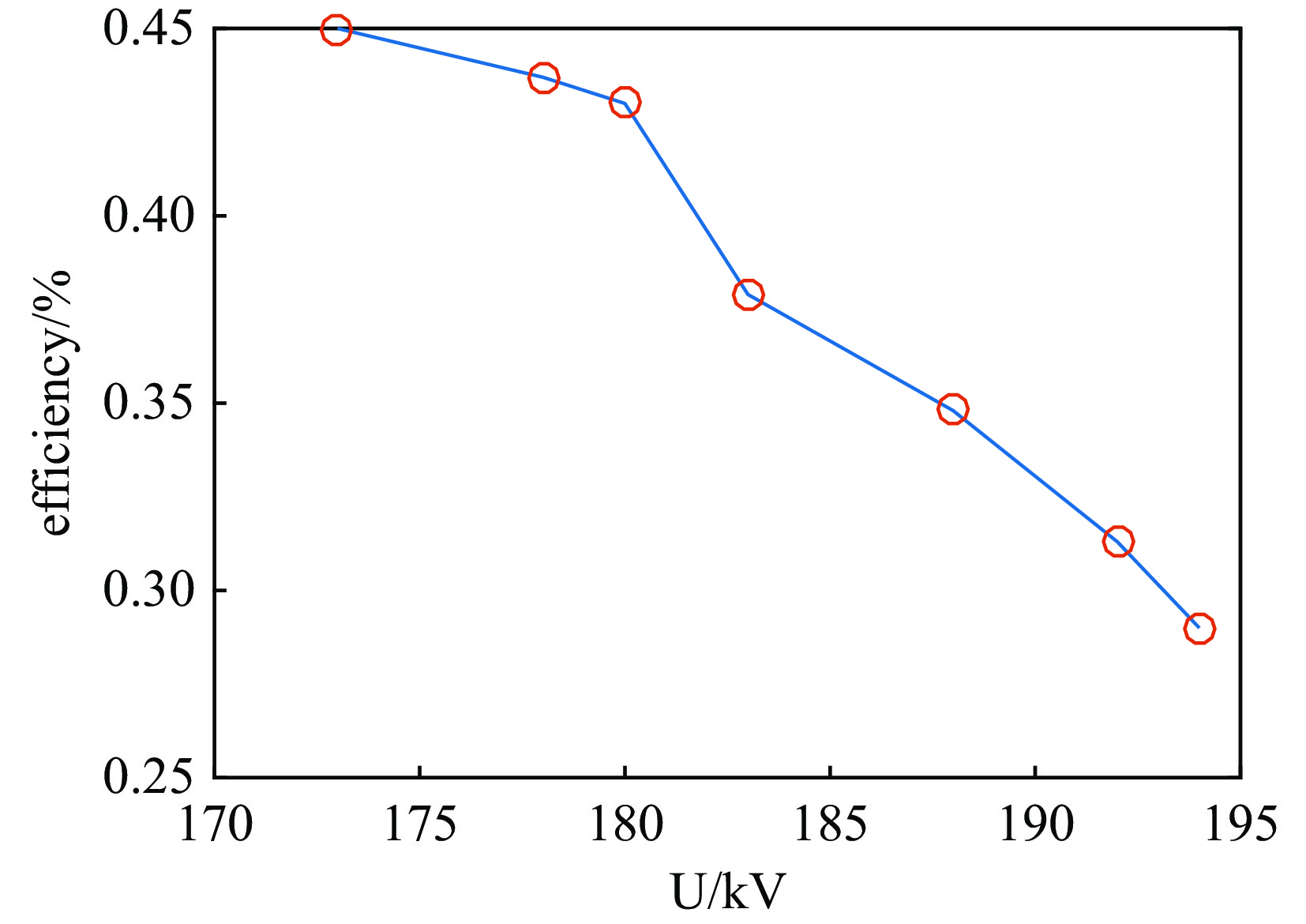
图 10 0.4 T磁场下不同电压的输出功率转换效率
Figure 10. Output power conversion efficiency with different voltages when the magnetic field is 0.4 T
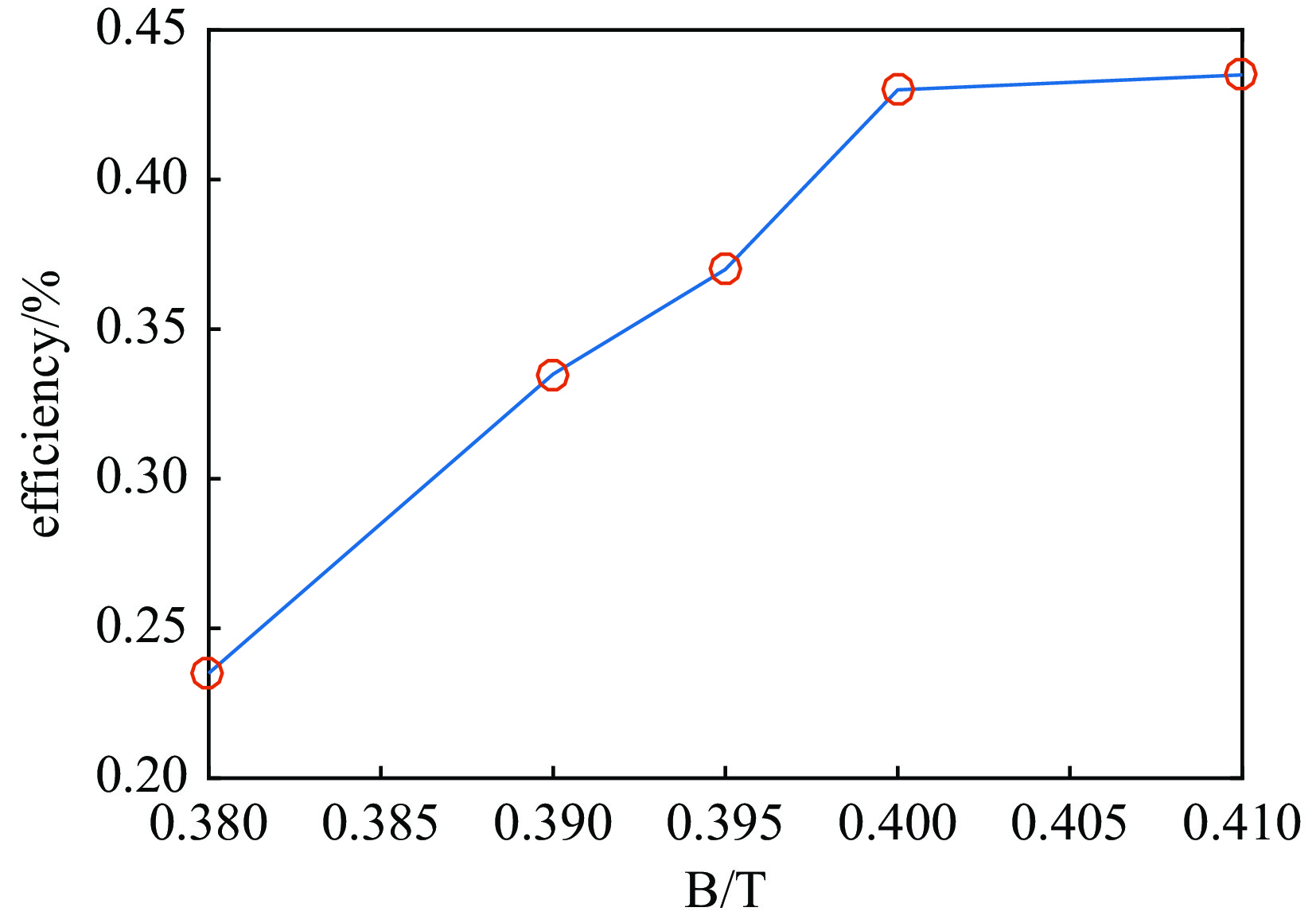
图 11 180 kV电压下不同磁场的输出功率转换效率
Figure 11. Output power conversion efficiency with different magnetic field when the voltage is 180 kV
表 1 ku 波段相对论磁控管主要结构参数
Table 1. Brief dimension parameters of Ku-band coaxial RM
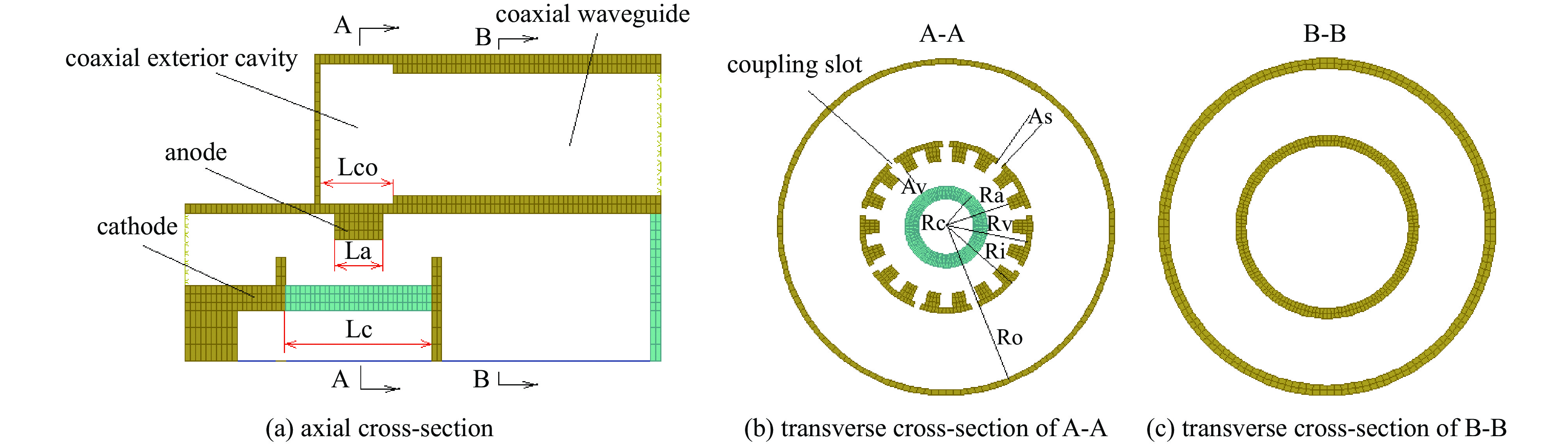
Rc/mm Ra/mm Rv/mm Ri/mm Ro/mm Lc/mm La/mm Lco/mm Av/° As/° 9 14 17.9 19 32 30 10 15 10 5  下载: 导出CSV
-
[1] Bluhm H. 脉冲功率系统的原理与应用[M]. 江伟华, 张弛, 译. 北京: 清华大学出版社, 2008.Bluhm H. 脉冲功率系统的原理与应用[M]. 江伟华, 张弛, 译. 北京: 清华大学出版社, 2008. (Bluhm H. Pulsed power systems: principles and applications[M]. Jiang Weihua, Zhang Chi, trans. Beijing: Tsinghua University Press, 2008 [2] 刘锡三. 高功率脉冲技术[M]. 北京: 国防工业出版社, 2005Liu Xisan. High pulsed power technology[M]. Beijing: National Defense Industry Press, 2005 [3] 徐家鸾, 金尚宪. 等离子体物理学[M]. 北京: 原子能出版社, 1981Xu Jialuan, Jin Shangxian. The physics of plasma[M]. Beijing: Atomic Energy Press, 1981 [4] 禹化龙, 伍尚慧. 美军定向能武器反无人机技术进展[J]. 国防科技, 2019, 40(6): 42-47 doi: 10.13943/j.issn1671-4547.2019.06.09Yu Hualong, Wu Shanghui. Progress and development trend analysis on US directed energy weapons against unmanned aerial vehicles[J]. National Defense Technology, 2019, 40(6): 42-47 doi: 10.13943/j.issn1671-4547.2019.06.09 [5] 张邦楚, 廖剑, 匡宇, 等. 美国无人机集群作战的研究现状与发展趋势[J]. 航空兵器, 2020, 27(6): 7-12Zhang Bangchu, Liao Jian, Kuang Yu, et al. Research status and development trend of the United States UAV swarm battlefield[J]. Aero Weaponry, 2020, 27(6): 7-12 [6] 冯奇, 傅镇波. 高功率微波武器典型场景应用分析[J]. 中国电子科学研究院学报, 2021, 16(9): 916-920 doi: 10.3969/j.issn.1673-5692.2021.09.010Feng Qi, Fu Zhenbo. Application analysis of HPM weapon in typical scenarios[J]. Journal of China Academy of Electronics and Information Technology, 2021, 16(9): 916-920 doi: 10.3969/j.issn.1673-5692.2021.09.010 [7] Lei Lurong, Qin Fen, Xu Sha, et al. Preliminary experimental investigation of a compact high-efficiency relativistic magnetron with low guiding magnetic field[J]. IEEE Transactions on Plasma Science, 2019, 47(1): 209-213. doi: 10.1109/TPS.2018.2879820 [8] Liu Zhenbang, Huang Hua, Lei Lurong, et al. Investigation of an X-band gigawatt long pulse multi-beam relativistic klystron amplifier[J]. Physics of Plasmas, 2015, 22: 093105. doi: 10.1063/1.4929920 [9] Wu Yang. Suppression of high order mode oscillation in a C-band long pulse high efficiency relativistic backward wave oscillator[J]. Physics of Plasmas, 2023, 30: 093303. doi: 10.1063/5.0159268 [10] Qin Fen, Wang Dong, Xu Sha, et al. A magnetically insulated transmission line oscillator with metal array cathode[J]. IEEE Transactions on Plasma Science, 2016, 44(5): 738-742. doi: 10.1109/TPS.2016.2547962 [11] Benford J. History and future of the relativistic magnetron[C]//International Conference on the Origins and Evolution of the Cavity Magnetron. 2010: 40-45. [12] Andreev D, Kuskov A, Schamiloglu E. Review of the relativistic magnetron[J]. Matter and Radiation at Extremes, 2019, 4: 067201. doi: 10.1063/1.5100028 [13] Fuks M, Schamiloglu E. Rapid start of oscillations in a magnetron with a “transparent” cathode[J]. Physical Review Letters, 2005, 95: 205101. doi: 10.1103/PhysRevLett.95.205101 [14] Daimon M, Jiang W. Modified configuration of relativistic magnetron with diffraction output for efficiency improvement[J]. Applied Physics Letters, 2007, 91: 191503. doi: 10.1063/1.2803757 [15] Fuks M I, Schamiloglu E. 70% Efficient relativistic magnetron with axial extraction of radiation through a horn antenna[J]. IEEE Transactions on Plasma Science, 2010, 38(6): 1302-1312. doi: 10.1109/TPS.2010.2042823 [16] Hoff B W, Greenwood A D, Mardahl P J, et al. All cavity-magnetron axial extraction technique[J]. IEEE Transactions on Plasma Science, 2012, 40(11): 3046-3051. doi: 10.1109/TPS.2012.2217758 [17] Liu Meiqin, Fuks M I, Schamiloglu E, et al. Operation characteristics of A6 relativistic magnetron using single-stepped cavities with axial extraction[J]. IEEE Transactions on Plasma Science, 2014, 42(10): 3344-3348. doi: 10.1109/TPS.2014.2352353 [18] Xu Sha, Lei Lurong, Qin Fen, et al. Compact, high power and high efficiency relativistic magnetron with L-band all cavity axial extraction[J]. Physics of Plasmas, 2018, 25: 083301. doi: 10.1063/1.5041860 [19] Qin Fen, Xu Sha, Lei Lurong, et al. A compact relativistic magnetron with lower output mode[J]. IEEE Transactions on Electron Devices, 2019, 66(4): 1960-1964. doi: 10.1109/TED.2019.2898446 [20] Qin Fen, Zhang Yong, Xu Sha, et al. A frequency-agile relativistic magnetron with axial tuning[J]. IEEE Electron Device Letters, 2020, 41(5): 781-783. doi: 10.1109/LED.2020.2984096 [21] Qin Fen, Xu Sha, Zhang Yong, et al. A cross-band tunable relativistic magnetron with all cavity axial extraction[J]. IEEE Transactions on Electron Devices, 2023, 70(3): 1283-1287. doi: 10.1109/TED.2023.3238387 [22] 周传明, 刘国治, 刘永贵, 等. 高功率微波源[M]. 北京: 原子能出版社, 2007: 254Zhou Chuanming, Liu Guozhi, Liu Yonggui, et al. High power microwave source[M]. Beijing: Atomic Energy Press, 2007: 254 [23] Vintizenko I. Relativistic magnetrons[M]. Boca Raton: CRC Press, 2019: 55. [24] 电子管设计手册编辑委员会. 磁控管设计手册[M]. 北京: 国防工业出版社, 1979Electronic Tube Design Handbook Editorial Committee. Magnetron design handbook[M]. Beijing: National Defense Industry Press, 1979 [25] Fan Yuwei, Liu Jing, Zhong Huihuang, et al. Theoretical investigation of the fundamental mode frequency of A6 magnetron[J]. Journal of Applied Physics, 2009, 105: 083310. doi: 10.1063/1.3116202 [26] 张克潜, 李德杰. 微波与光电子学中的电磁理论[M]. 2版. 北京: 电子工业出版社, 2001Zhang Keqian, Li Dejie. Electromagnetic theory for microwave and optoelectronics[M]. 2nd ed. Beijing: Publishing House of Electronics Industry, 2001 [27] 裘家琪, 陈怀璧, 唐传祥. 衰减瓷对同轴磁控管起振过程的影响[J]. 强激光与粒子束, 2012, 24(12): 2889-2892 doi: 10.3788/HPLPB20122412.2889Qiu Jiaqi, Chen Huaibi, Tang Chuanxiang. Effect of attenuator on oscillating process of coaxial magnetrons[J]. High Power Laser and Particle Beams, 2012, 24(12): 2889-2892 doi: 10.3788/HPLPB20122412.2889 [28] 张洁熹, 李泉凤, 韩运生, 等. 同轴磁控管永磁磁路的模拟及实验[J]. 清华大学学报(自然科学版), 2008, 48(8): 1248-1251 doi: 10.3321/j.issn:1000-0054.2008.08.006Zhang Jiexi, Li Quanfeng, Han Yunsheng, et al. Permanent magnetic circuits in a coaxial magnetron of medical linear accelerators[J]. Journal of Tsinghua University (Science and Technology), 2008, 48(8): 1248-1251 doi: 10.3321/j.issn:1000-0054.2008.08.006 [29] 郎建东, 谢磊, 秦向荣, 等. 用于小型加速器的高频同轴磁控管研究进展[C]//中国电子学会真空电子学分会第二十一届学术年会论文集. 2018Lang Jiandong, Xie Lei, Qin Xiangrong, et al. Research progress on High frequency coaxial magnetron for compact accelerators[C]//Proceedings of the 21st Academic Annual Conference of the Vacuum Electronics Branch of the Chinese Institute of Electronics. 2018 [30] Palevsky A, Bekefi G, Drobot A T, et al. High power relativistic magnetrons: experiments and simulation[C]//3rd International Topical Conference on High-Power Electron and Ion Beam Research & Technology. 1979: 759-768. -

 点击查看大图
计量
- 文章访问数: 15
- HTML全文浏览量: 8
- PDF下载量: 0
- 被引次数: 0
