



Study of the Ground-Induced Radioactive Environment Caused by Intense Pulsed Neutrons
-
摘要: 强脉冲中子在地面产生的感生放射性γ辐射场受到源位置、地面介质组分的影响,呈现不同的分布特点,进而对人员造成不同程度的辐射危害。为评估不同场景(包括源位置与地面介质组成)下的感生放射性γ辐射环境水平,支撑强脉冲辐射环境研究与相关人员防护策略制定,基于大气分层模型,通过基于蒙卡的地面感生放射性两步计算方法计算了不同土壤条件下,感生放射性的剂量分布及典型位置剂量率随时间的变化规律,拟合给出了不同核素剂量贡献公式。通过对三种典型土壤的模拟计算,给出了核素活化系数以快速评估土壤中原子活化数,并通过单位质量剂量贡献评估了土壤中各种核素的平均剂量贡献;提出了土壤的安全驻留指数与安全驻留距离两个指标以在不同时间尺度下评价不同土壤条件下的强脉冲中子感生放射性环境的安全性。结果表明,源高度
1000 m以下,剂量随源高度呈指数变化规律,且活化系数随水平投影距变化明显;单位质量Mn元素具有最高的剂量贡献,低Al土壤的土壤安全驻留指数更高,且Mn、Na元素含量高的土壤安全驻留距离更短。基于以上结果,计算了用于评价感生放射性在不同时间尺度对人员的安全影响的土壤安全指数与安全驻留距离参数,为后续差异化的安全策略提供数据支持。Abstract:Background The spatial distribution of the neutron-induced gamma radiation field generated within the ground medium by intense pulsed neutrons is critically dependent on the neutron source location and the chemical composition of the soil. These distributional variations give rise to differential radiological hazards for personnel.Purpose The objective of this study is to quantitatively assess the environmental levels of neutron-induced gamma radiation across diverse scenarios—specifically incorporating variations in neutron source location and ground medium composition—to facilitate research on intense pulsed neutron radiation environments and to inform evidence-based development of radiation protection protocols for personnel.Methods Based on an atmospheric stratification model, a two-step Monte Carlo simulation methodology was implemented to quantify the dose distribution of neutron-induced radioactivity within the ground medium and the temporal evolution of dose rates at representative locations across diverse soil compositions. Subsequently, empirical formulas characterizing the dose contributions of individual radionuclides were derived through curve-fitting analysis. Numerical simulations were performed for three representative soil compositions to derive nuclide-specific activation coefficients, facilitating rapid estimation of activated atom populations within the soil matrix. The average dose contributions of individual radionuclides were quantitatively evaluated based on dose contribution per unit mass. Furthermore, two novel safety metrics—the Soil Safety Residence Index and Safety Residence Distance —were proposed to systematically assess the safety of the induced radioactivity environment caused by intense pulsed neutron under varying soil conditions across multiple temporal scales.Results Results demonstrate that, for neutron source heights below1000 m, the dose exhibits an exponential dependence on source altitude, while the activation coefficient shows pronounced variation with horizontal projection distance. Manganese (Mn) was identified as the element contributing the highest dose per unit mass. Soils with low aluminum (Al) content yielded a higher Soil Safety Residence Index, whereas soils enriched in manganese (Mn) and sodium (Na) exhibited shorter Safety Residence Distances, indicating elevated radiological risk under equivalent exposure conditions.Conclusions This study confirms that the spatial distribution and temporal evolution of the gamma radiation field generated by intense pulsed neutrons are governed by source geometry and the chemical composition of the soil medium. Manganese (Mn) is identified as the predominant radionuclide contributing to dose per unit mass, underscoring the imperative for enhanced radiological protection protocols in manganese-enriched soil environments. Moreover, the Soil Safety Residence Index and Residence Distance serve as rapid, quantitative metrics to inform appropriate radiation protection strategies for personnel across diverse soil conditions.-
Key words:
- Monte-Carlo /
- Induced radioactivity /
- Neutron activation /
- Radiation protection
-
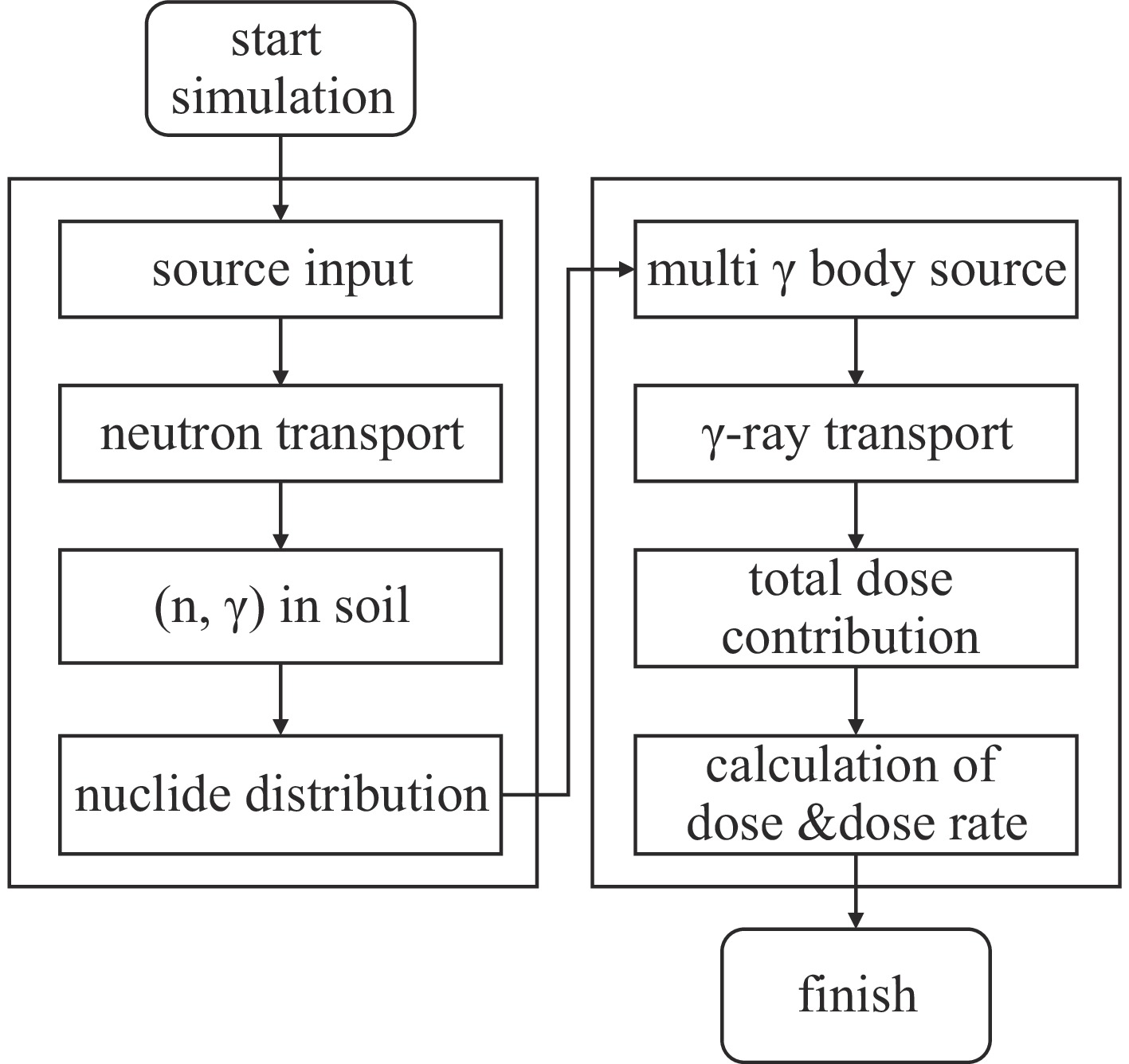
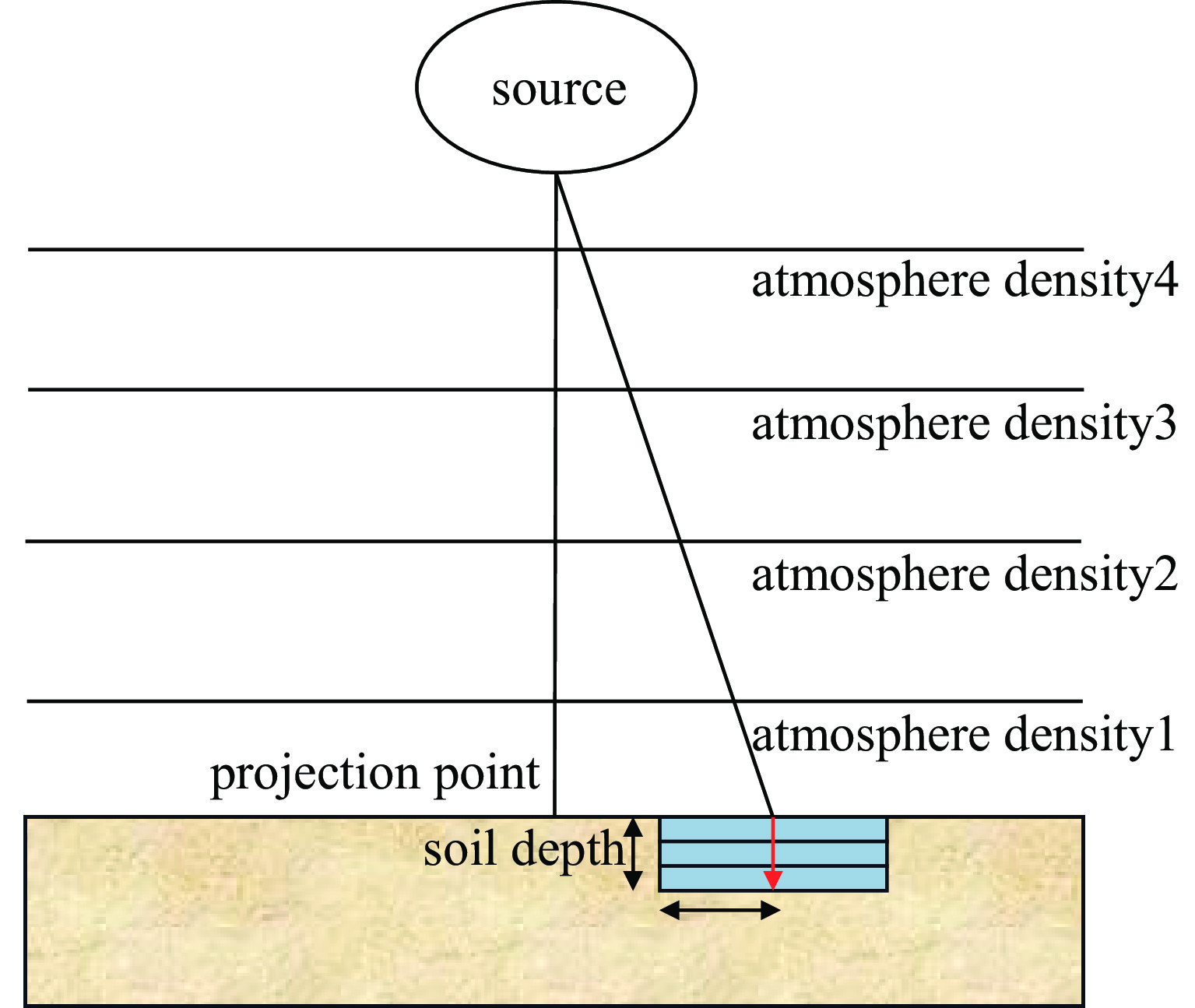
图 1 地面感生放射性两步法计算流程图
Figure 1. Flow chart of two-step method for induced radioactivity on the ground
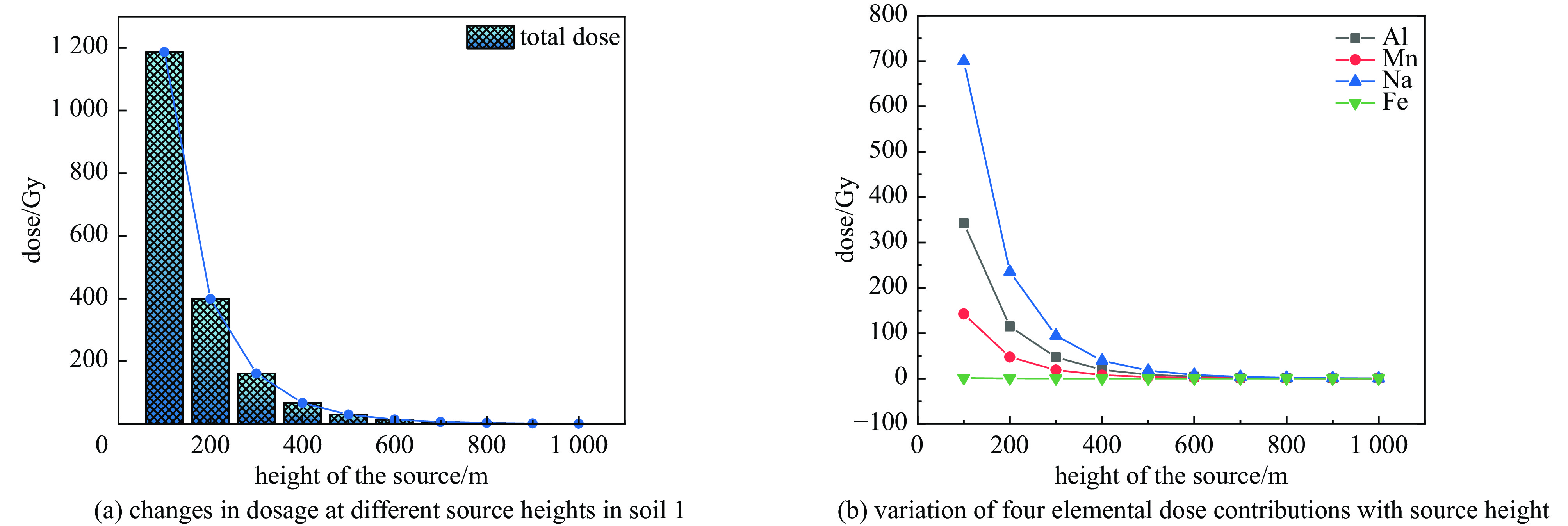
图 4 土壤1中,总剂量与各元素剂量贡献随源高度的变化
Figure 4. Variation of total dose and contribution of each element dose with source height in soil 1
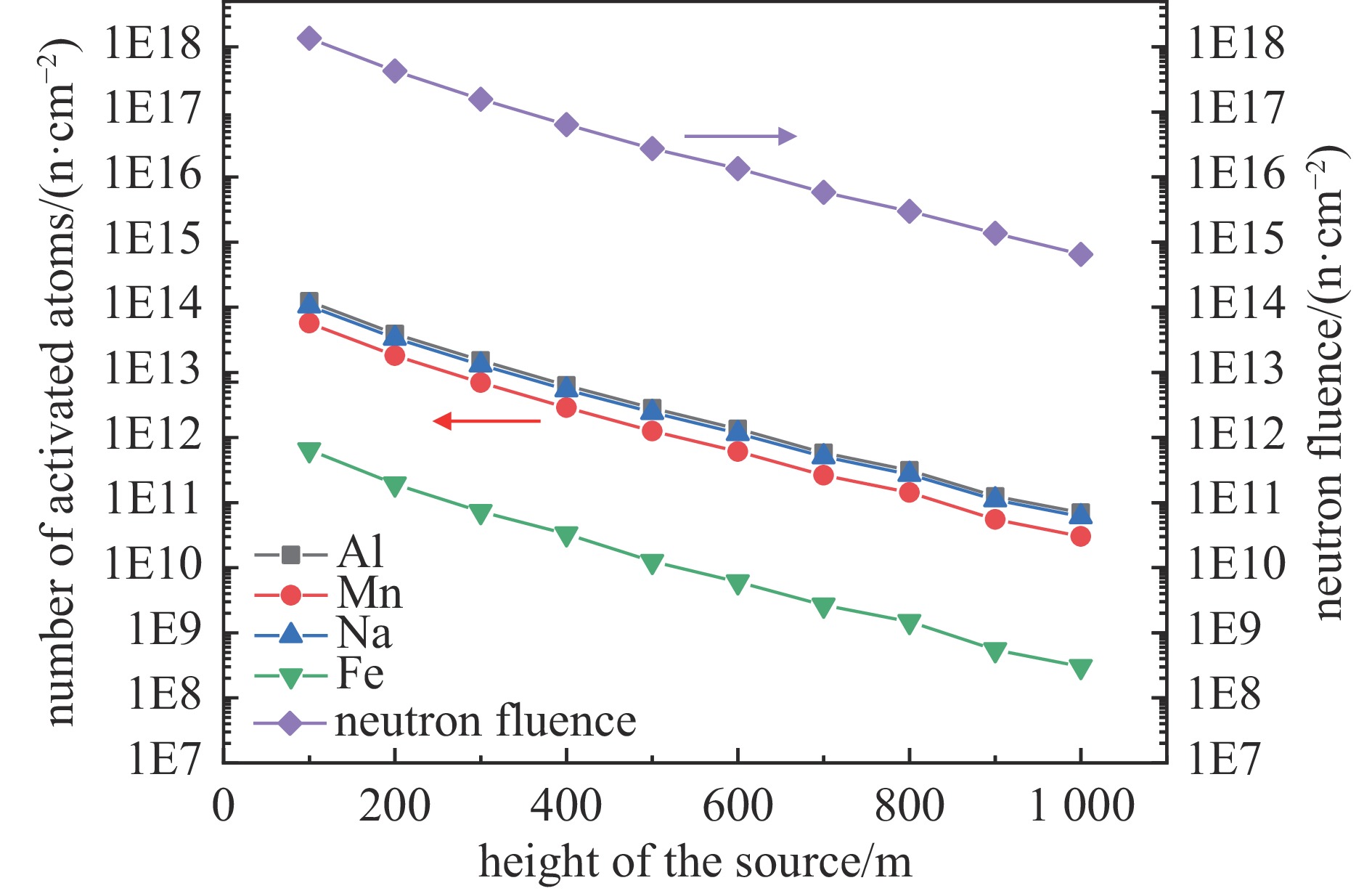
图 5 土壤1中,活化原子数与中子注量随源高度的变化
Figure 5. Variation of activation atom number and neutron fluence with source height in Soil 1
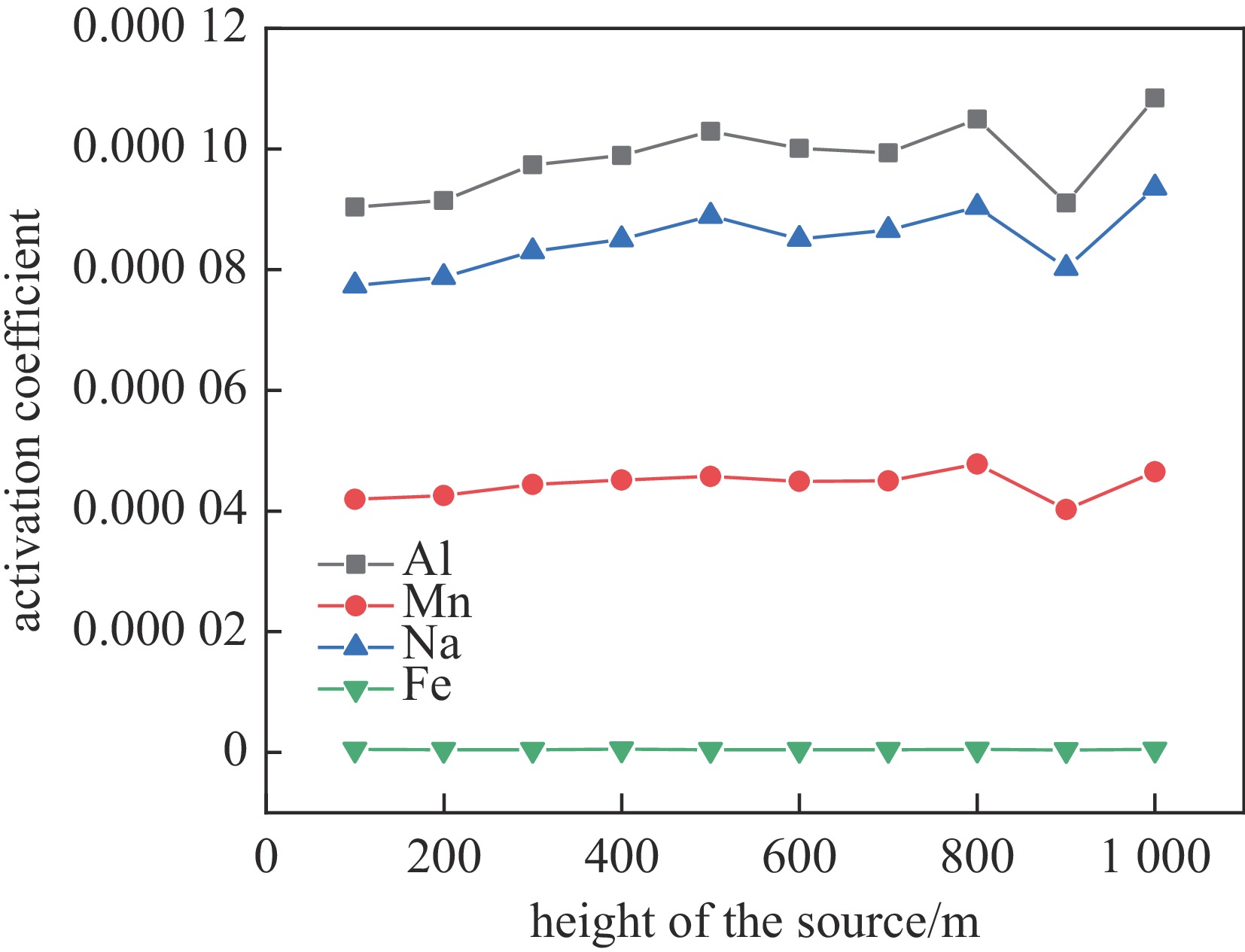
图 6 活化系数随源高度变化的曲线
Figure 6. Curves showing the variation of activation coefficients with source height
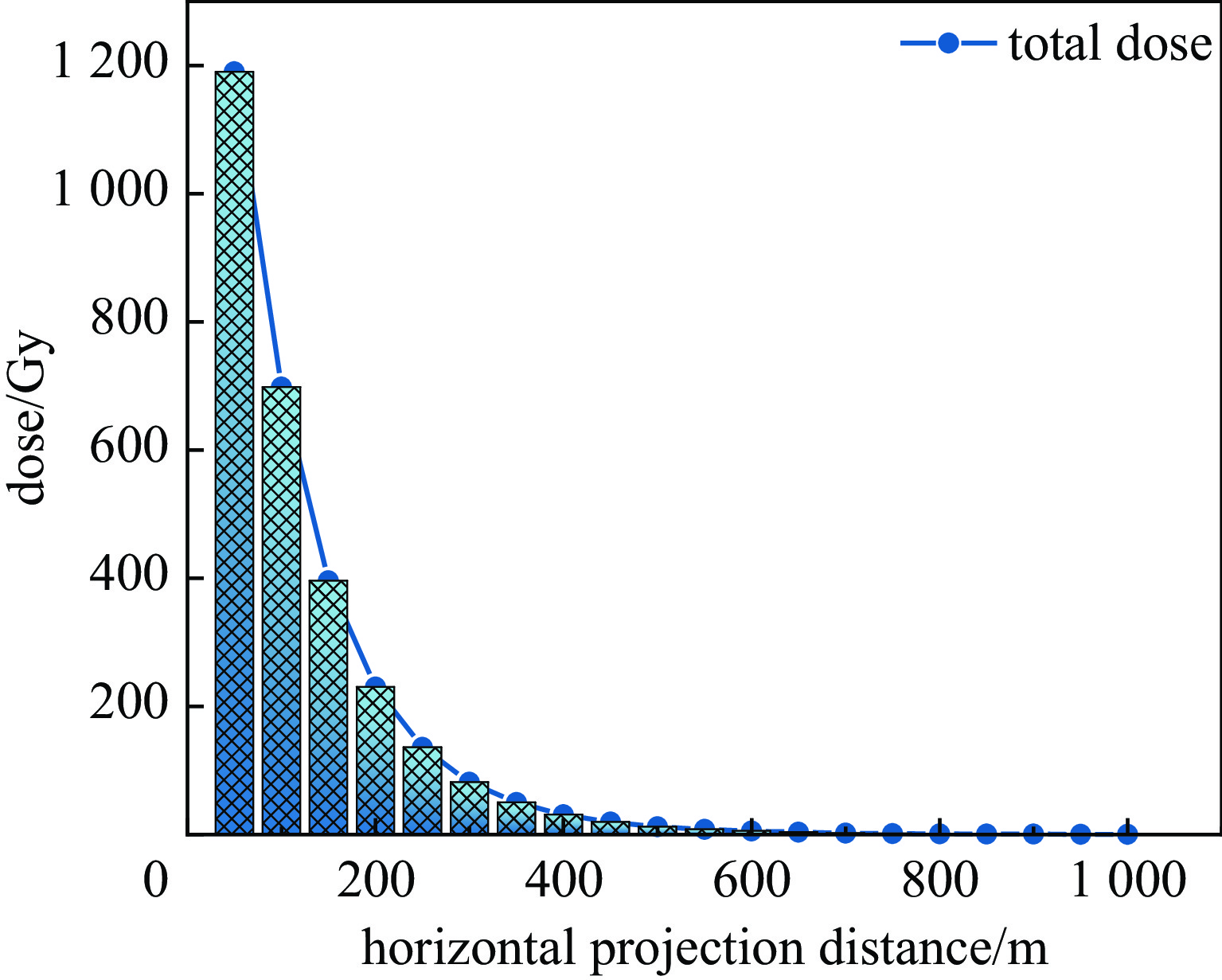
图 7 土壤1中,总剂量随水平投影距的变化
Figure 7. Total dose as a function of horizontal projection distance in Soil 1
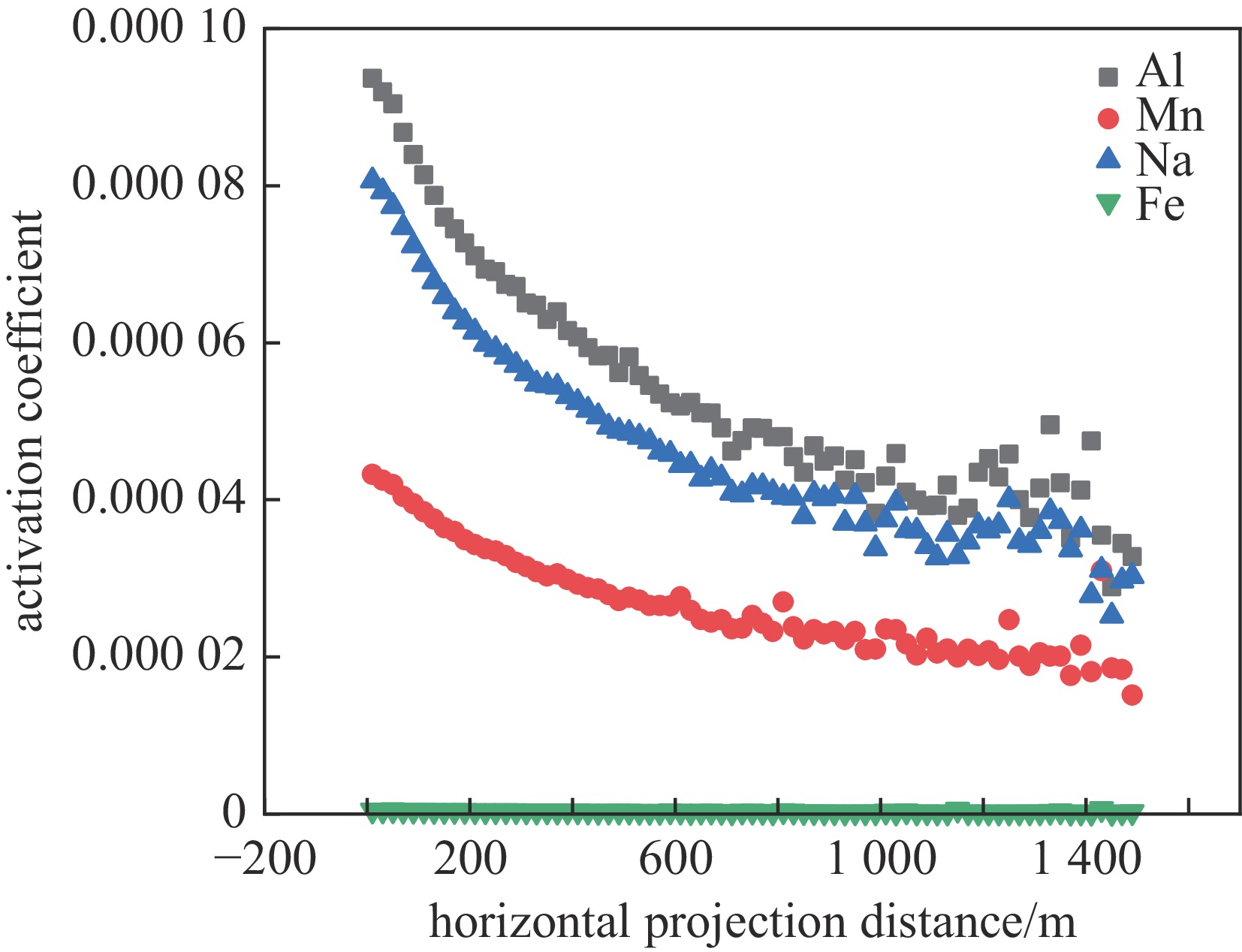
图 8 四种元素活化系数随水平投影距的变化
Figure 8. Variation of activation coefficients of four elements with horizontal projection distance
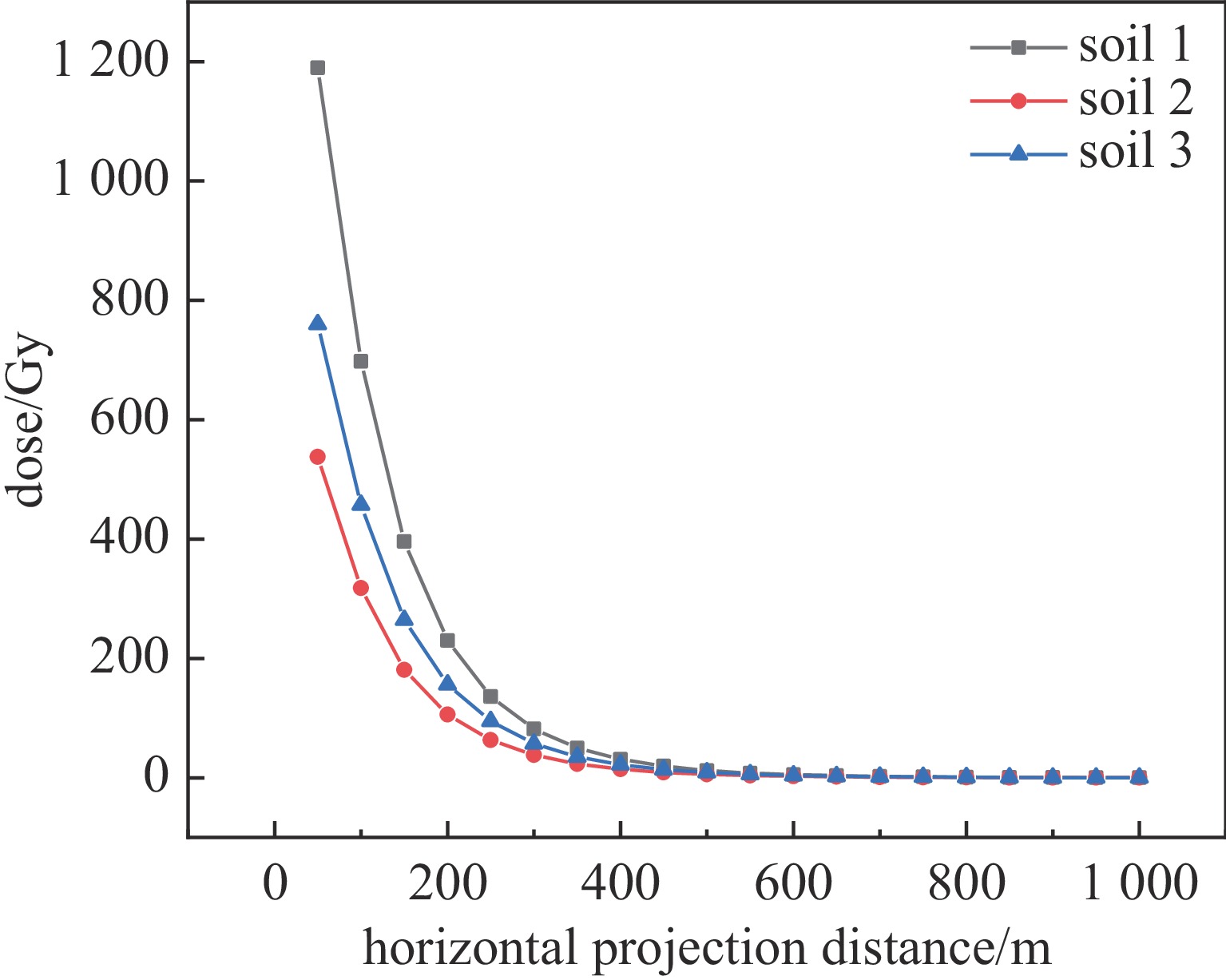
图 9 三种土壤中感生放射性剂量随水平投影距的变化
Figure 9. Variation of induced radioactive dose with horizontal projection distance in three soil types
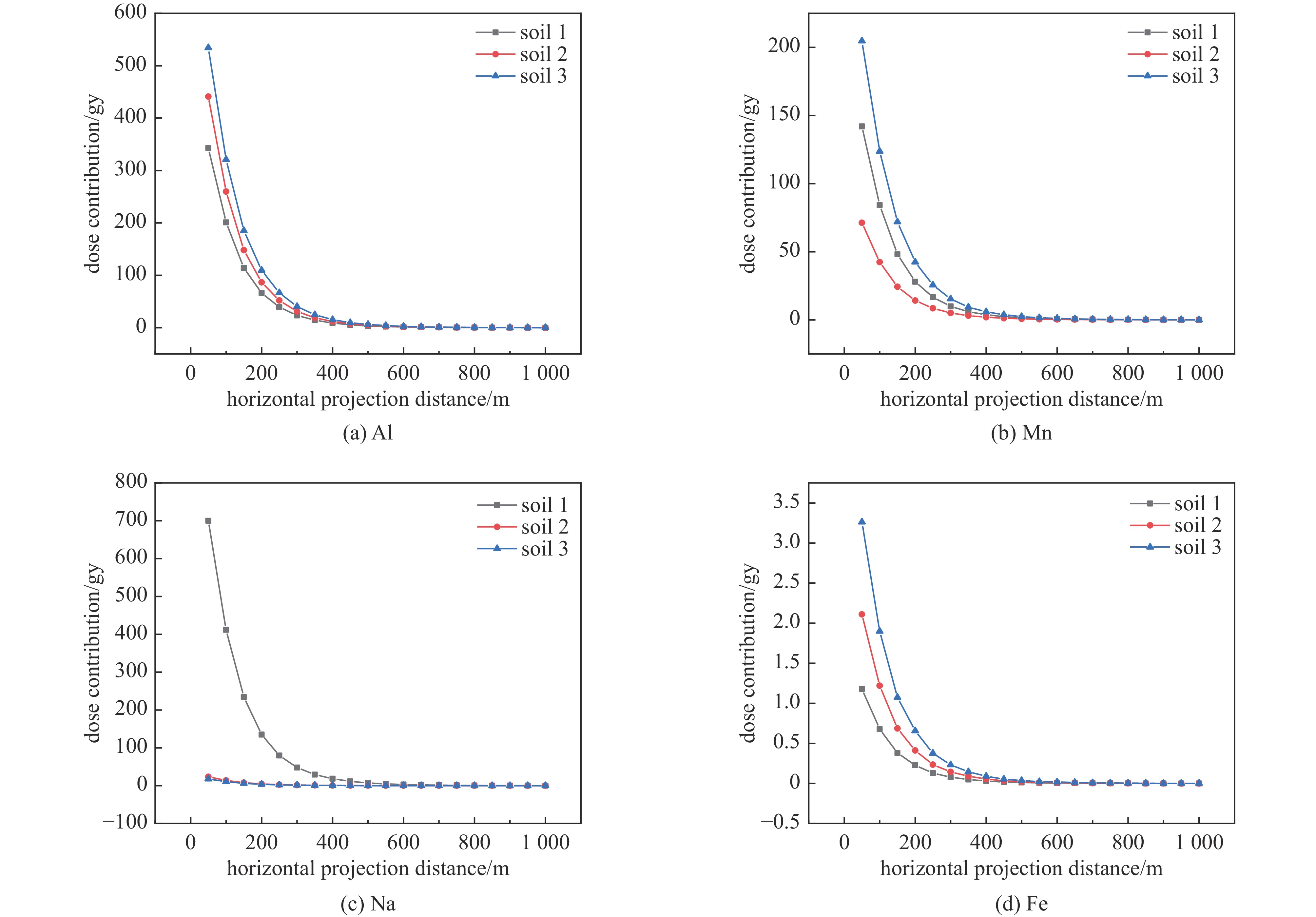
图 10 四种元素在不同水平投影距处的剂量贡献
Figure 10. Dose contributions of four elements at different horizontal projection distances
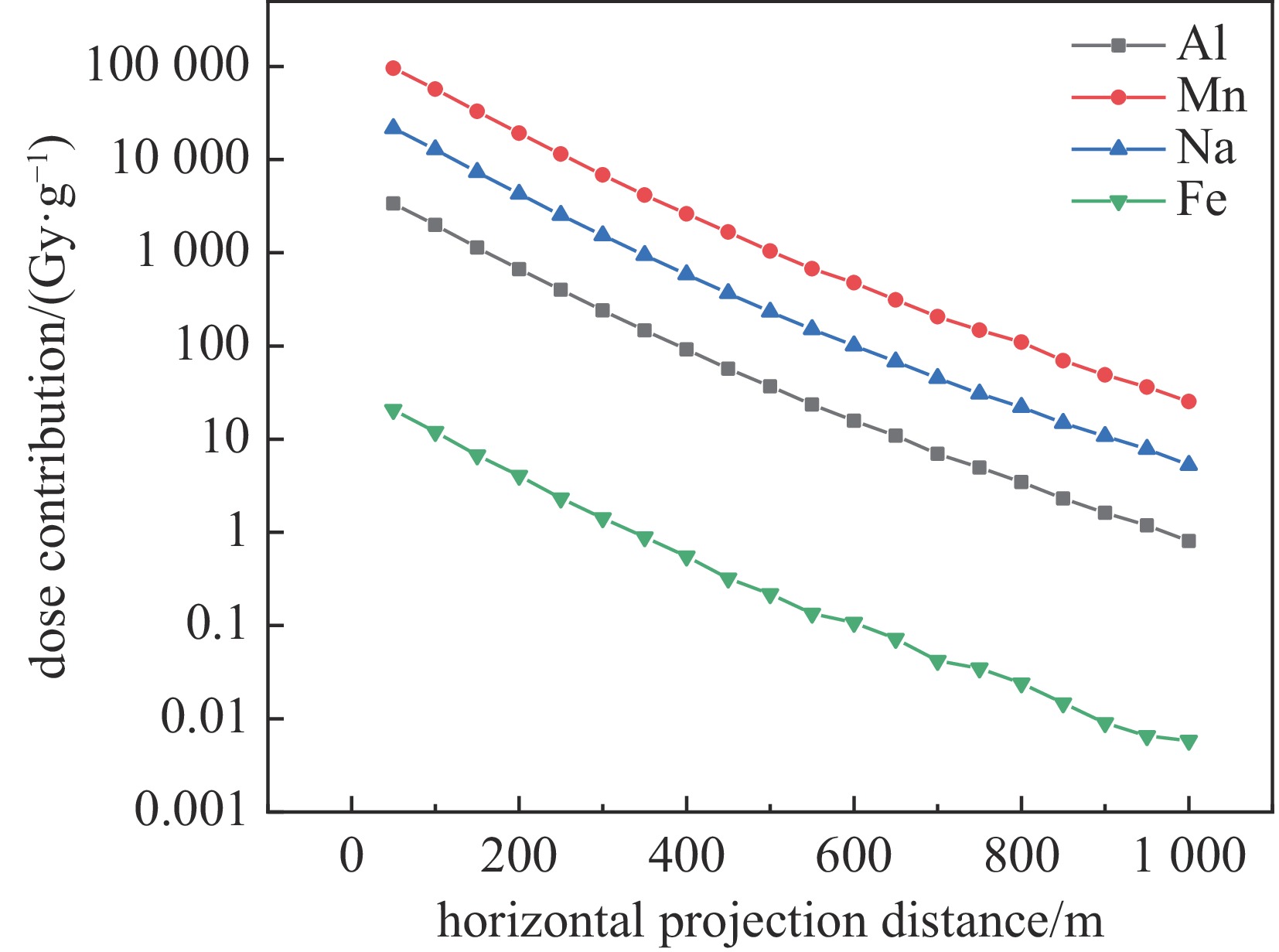
图 11 单位质量核素在土壤中的平均剂量贡献
Figure 11. Average dose contribution per unit mass of radionuclides in soil
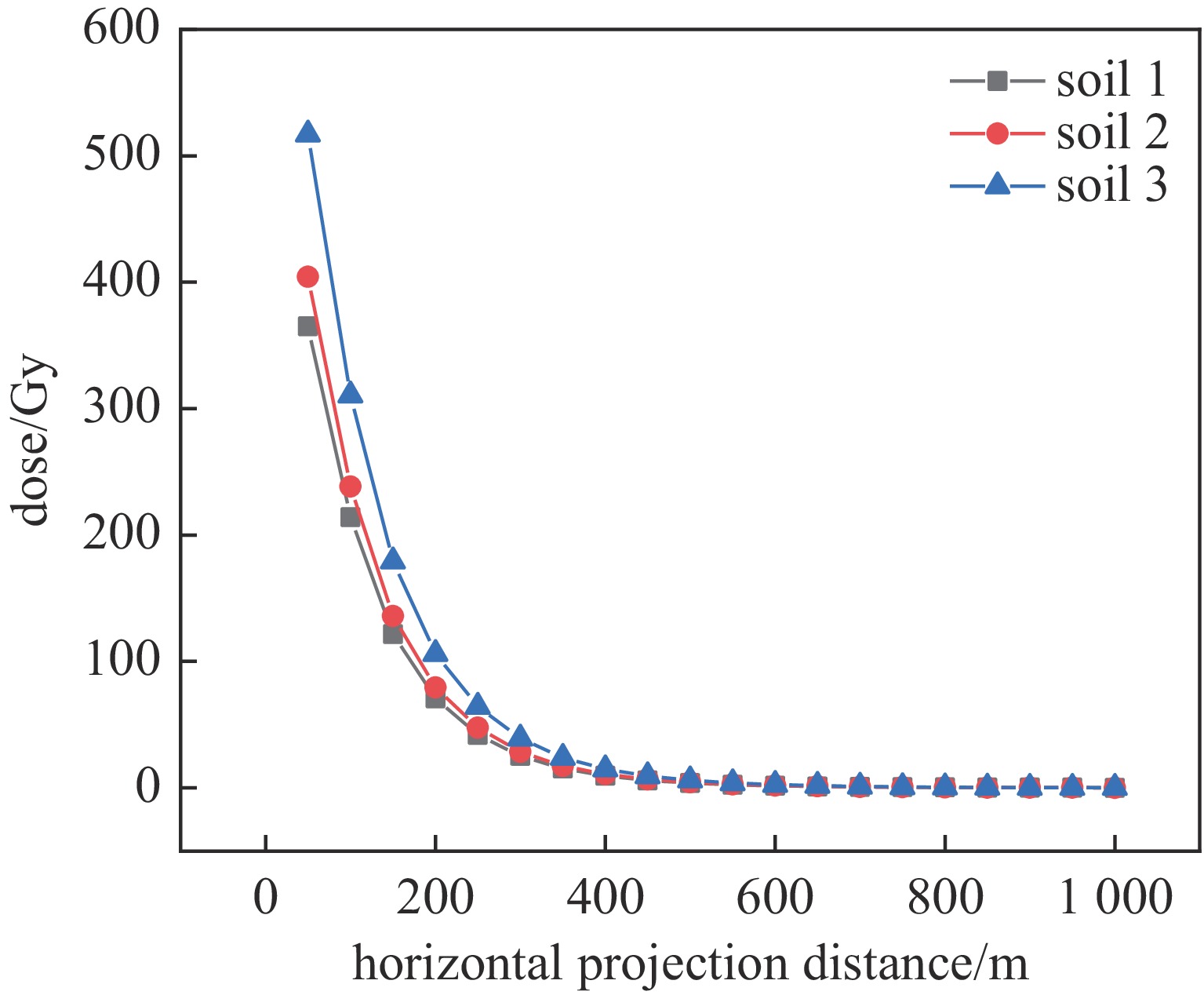
图 12 源高度100m时,脉冲中子产生1h后剂量率随水平投影距的变化
Figure 12. Variation of dose rate with ground zero projection distance at 1 hour after the pulse neutron emission, for a source height of 100 m
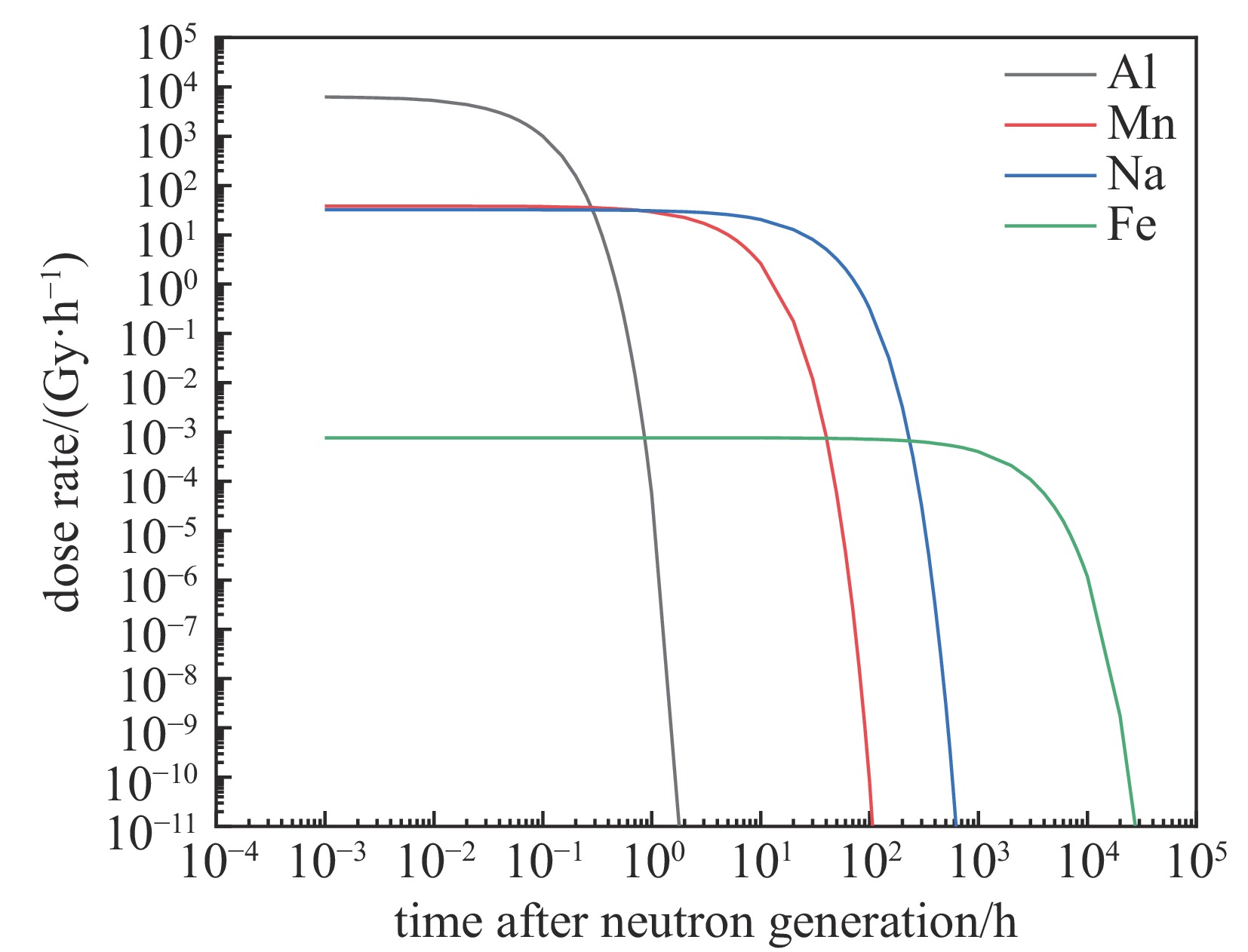
图 13 中子发生后各元素剂量率贡献随时间的变化
Figure 13. Variation of dose rate contributions from individual elements over time following the neutron pulse
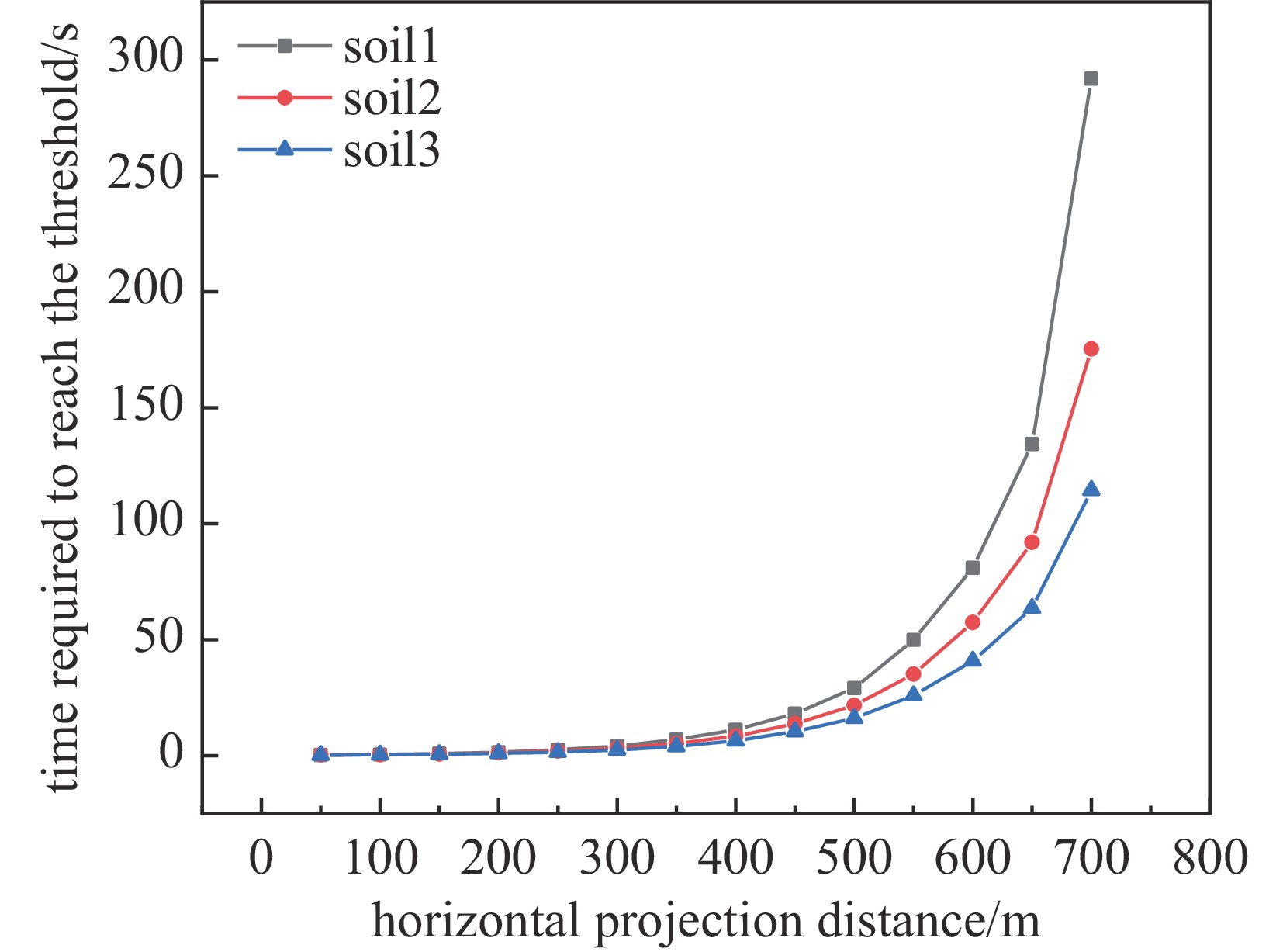
图 14 源高度100m,中子发生后土壤1不同水平距离处达到安全阈值所需要的时间
Figure 14. Time required for Soil 1 at different horizontal distances from the ground zero to reach the safety threshold after the neutron pulse, with a source height of 100 m
表 1 土壤成分的核素性质
Table 1. The nuclide properties of soil components
Target nucleus element Activated element Atomic weight A Abundance a/10−2 27Al 28Al 27 100 55Mn 56Mn 55 100 23Na 24Na 23 100 58Fe 59Fe 58 0.31  下载: 导出CSV
Nuclide Half-life/h Decay constantλ/h−1 Energy/MeV Yield 28Al 0.038 18.3 1.78 1.000 56Mn 2.579 0.269 1.68 1.404 24Na 15.03 0.046 4.12 1.998 59Fe 1068 6.4×10⁻⁴ 1.19 0.997
下载: 导出CSV
表 3 不同土壤类型的物质组分
Table 3. Composition of different soil types
soil type composition Mn×10−2 Na2O×10−2 Al2O3×10−2 TFe2O3×10−2 FeO×10−2 Soil 1 0.092 2.67 11.70 4.22 0.78 Soil 2 0.051 0.1 16.88 9.80 0.19 Soil 3 0.19 0.1 27.39 18.03 1.46
下载: 导出CSV
表 4 不同土壤类型的元素占比
Table 4. The proportion of elements in different soils
Soil Type Element Al(%) Mn(%) Na(%) Fe(%) Soil 1 6.190 0.092 1.981 3.561 Soil 2 8.936 0.051 0.074 7.007 Soil 3 14.501 0.19 0.074 13.757
下载: 导出CSV
表 5 总剂量与各元素剂量贡献的系数
Table 5. Coefficients of total dose and dose contributions from individual elements
total dose dose contribution-Al dose contribution-Mn dose contribution-Na dose contribution-Fe a 3410.78 983.39 413.91 2009.92 3.622 b 93.92 94.03 93.04 94.06 88.30
下载: 导出CSV
表 6 不同元素的活化系数参数
Table 6. Activation coefficient parameters for different elements
Index element in soil Al Mn Na Fe A0 3.62E-5 1.88E-5 3.07E-5 2.38E-7 λ 5.76E-5 2.46E-5 4.96E-5 2.43E-7 D 468.41 482.95 481.18 390.58
下载: 导出CSV
表 7 不同土壤的安全驻留指数
Table 7. Safety indices for different soil types
soil 1 soil 2 soil 3 soil safety residence index k 0.67 0.19 0.15
下载: 导出CSV
表 8 不同土壤在不同源强度下的安全驻留距离
Table 8. Safe standoff distances for different soil types under various source intensities
source intensity safety residence distance/m soil 1 soil 2 soil 3 0.3 700 600 650 1 850 750 850 1.5 950 850 900
下载: 导出CSV
-
[1] 武祯, 李君利, 曾志, 等. 电子直线加速器的感生放射性计算方法[J]. 清华大学学报(自然科学版), 2005, 45(6): 813-816 doi: 10.16511/j.cnki.qhdxxb.2005.06.025Wu Zhen, Li Junli, Zeng Zhi, et al. Calculating method for induced radioactivity in an electron linac[J]. Journal of Tsinghua University (Science and Technology), 2005, 45(6): 813-816 doi: 10.16511/j.cnki.qhdxxb.2005.06.025 [2] 黄孟, 朱剑钰, 伍钧, 等. 基于JMCT软件的中子活化数值模拟程序的开发和检验[J]. 强激光与粒子束, 2022, 34: 026016 doi: 10.11884/HPLPB202234.210356Huang Meng, Zhu Jianyu, Wu Jun, et al. Development and test of neutron activation simulation program based on JMCT software[J]. High Power Laser and Particle Beams, 2022, 34: 026016 doi: 10.11884/HPLPB202234.210356 [3] 苑旭东, 马辉强, 陈珍平, 等. 基于R2S方法的反应堆结构材料活化剂量计算研究[J]. 核动力工程, 2021, 42(5): 103-109 doi: 10.13832/j.jnpe.2021.05.0103Yuan Xudong, Ma Huiqiang, Chen Zhenping, et al. Study on activation-induced dose calculation of reactor structural materials[J]. Nuclear Power Engineering, 2021, 42(5): 103-109 doi: 10.13832/j.jnpe.2021.05.0103 [4] 李雷鸣, 江书益, 陈珍平, 等. 核反应堆结构材料网格精细活化分析研究[J]. 核技术, 2022, 45: 080601Li Leiming, Jiang Shuyi, Chen Zhenping, et al. Mesh-based activation analysis for structural materials in nuclear reactor[J]. Nuclear Techniques, 2022, 45: 080601 [5] 商鹏, 黄流兴, 牛胜利, 等. 核爆炸地面感生放射性辐射环境的蒙特卡罗模拟[J]. 现代应用物理, 2022, 13: 010201 doi: 10.12061/j.issn.2095-6223.2022.010201Shang Peng, Huang Liuxing, Niu Shengli, et al. Monte Carlo simulation of ground environment of induced radioactivity radiation produced by neutrons of nuclear explosion[J]. Modern Applied Physics, 2022, 13: 010201 doi: 10.12061/j.issn.2095-6223.2022.010201 [6] 王韬, 荆晓兵, 庞建, 等. 低能质子束产生感生放射性的蒙特卡罗模拟[J]. 强激光与粒子束, 2012, 24(12): 2979-2982 doi: 10.3788/HPLPB20122412.2979Wang Tao, Jing Xiaobing, Pang Jian, et al. Monte Carlo simulation of induced radioactivity for low-energy proton beam[J]. High Power Laser and Particle Beams, 2012, 24(12): 2979-2982 doi: 10.3788/HPLPB20122412.2979 [7] 王韬, 张开志, 荆晓兵. 低能质子回旋加速器内部束流测量探头的感生放射性[J]. 强激光与粒子束, 2011, 23(2): 485-489 doi: 10.3788/HPLPB20112302.0485Wang Tao, Zhang Kaizhi, Jing Xiaobing. Induced radioactivity in interior beam probe for low-energy proton cyclotron[J]. High Power Laser and Particle Beams, 2011, 23(2): 485-489 doi: 10.3788/HPLPB20112302.0485 [8] 王韬, 庞建, 赵良超, 等. 回旋加速器束测探头感生放射性实验研究[J]. 强激光与粒子束, 2013, 25(7): 1779-1782 doi: 10.3788/HPLPB20132507.1779Wang Tao, Pang Jian, Zhao Liangchao, et al. Experimental investigation on induced radioactivity in beam probe for compact cyclotron[J]. High Power Laser and Particle Beams, 2013, 25(7): 1779-1782 doi: 10.3788/HPLPB20132507.1779 [9] 宋钢, 朱建国, 陈英民, 等. 质子加速器治疗系统感生放射性辐射场分布[J]. 中国辐射卫生, 2013, 22(3): 305-307 doi: 10.13491/j.cnki.issn.1004-714x.2013.03.005Song Gang, Zhu Jianguo, Chen Yingmin, et al. Distribution of induced radioactive radiation field in proton accelerator treatment system[J]. Chinese Journal of Radiological Health, 2013, 22(3): 305-307 doi: 10.13491/j.cnki.issn.1004-714x.2013.03.005 [10] Khasanov S, Yang Bo, Su Youwu, et al. Induced radioactivity at particle accelerators: a short review[J]. Radiation Detection Technology and Methods, 2021, 5(4): 481-492. doi: 10.1007/s41605-021-00292-3 [11] 贺新福, 王传珊, 罗文芸, 等. 利用MONTE CARLO方法分析高能电子加速器中中子引起的感生放射性——微观分析[J]. 上海大学学报(自然科学版), 2007, 13(1): 68-72 doi: 10.3969/j.issn.1007-2861.2007.01.015He Xinfu, Wang Chuanshan, Luo Wenyun, et al. Analyzing the induced radiation of high energy electron accelerator with the Monte Carlo method—microcosmic analysis[J]. Journal of Shanghai University (Natural Science), 2007, 13(1): 68-72 doi: 10.3969/j.issn.1007-2861.2007.01.015 [12] 杨博. 强流重离子加速器装置(HIAF)感生放射性及其影响研究[D]. 兰州: 中国科学院近代物理研究所, 2023: 158-175Yang Bo. Study on induced radioactivity and its effects of High Intensity heavy-ion Accelerator Facility[D]. Lanzhou: Institute of Modern Physics, Chinese Academy of Sciences, 2023: 158-175 [13] 乔登江. 核爆炸物理概论(下册)[M]. 北京: 国防工业出版社, 2003Qiao Dengjiang. General principles to the physics of nuclear burst (Vol. 2)[M]. Beijing: National Defense Industry Press, 2003 [14] 卢希庭. 原子核物理[M]. 2版. 北京: 原子能出版社, 2000Lu Xiting. Nuclear physics[M]. 2nd ed. Beijing: Atomic Energy Press, 2000 [15] 朱国英, 陈红红. 电离辐射防护基础与应用[M]. 上海: 上海交通大学出版社, 2016Zhu Guoying, Chen Honghong. Basics and application for protection against lonizing radiation[M]. Shanghai: Shanghai Jiaotong University Press, 2016 -

 点击查看大图
计量
- 文章访问数: 50
- HTML全文浏览量: 21
- PDF下载量: 13
- 被引次数: 0
