



Research progress on hohlraum energy deficit in inertial confinement fusion
-
摘要: 在间接驱动的激光惯性约束聚变中,对靶丸处X射线驱动强度的精确计算是精准预言氘氚燃料靶丸内爆性能的基础。这需要利用辐射流体模拟程序,对激光到X射线转换和腔壁X光吸收损失等过程进行精确模拟。然而,自美国国家点火装置(NIF)的点火攻关计划启动以来,辐射流体模拟程序预测的靶丸处X射线驱动强度持续高于实验测量值,即普遍存在的黑腔能量亏损现象。尽管NIF开展了大量实验研究并持续优化其辐射流体模拟模型,但这一挑战性的黑腔能量亏损问题至今未能得到彻底解决,成为实现高增益惯性约束聚变的关键障碍之一。本文将系统介绍NIF黑腔能量亏损问题上的关键研究进展,并对NIF与我国在靶丸处辐射流强度表征的方法展开介绍。Abstract: In indirect-drive laser inertial confinement fusion (ICF), the precise calculation of X-ray drive intensity at the capsule is crucial for accurately predicting the implosion performance of deuterium-tritium fuel capsules. Achieving this requires detailed radiation-hydrodynamic simulations that accurately capture processes such as laser-to-X-ray conversion and X-ray absorption losses at the hohlraum walls. However, since the inception of the National Ignition Campaign at the National Ignition Facility (NIF), radiation-hydrodynamic simulations have consistently overestimated the experimentally measured X-ray drive flux intensity at the capsule, reflecting the widespread presence of hohlraum energy deficits. Although extensive experimental studies have been conducted at NIF along with continuous optimization of its radiation-hydrodynamic simulation models, the challenging issue of hohlraum energy deficit remains unresolved, constituting one of the critical barriers to achieving high-gain inertial confinement fusion. This paper systematically reviews the critical research developments regarding hohlraum energy deficit at NIF and introduces the methods adopted by NIF and China for characterizing the X-ray radiation flux intensity at the capsule.
-
Key words:
- inertial confinement fusion /
- hohlraum /
- energy deficit /
- radiation flux /
- research progress
-
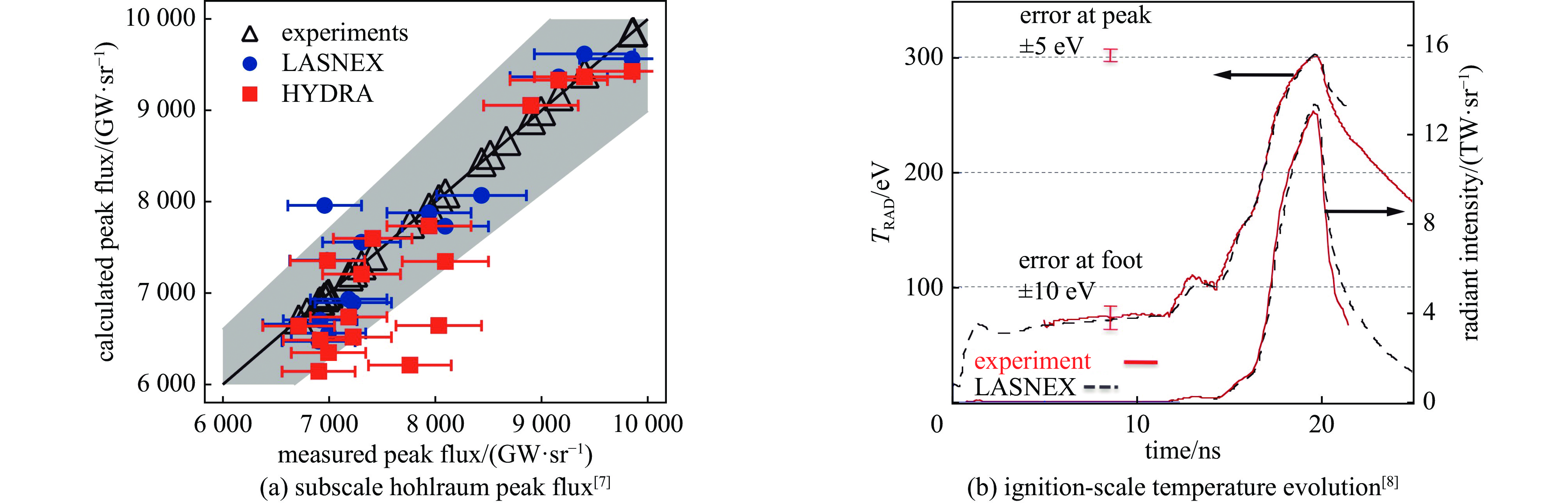
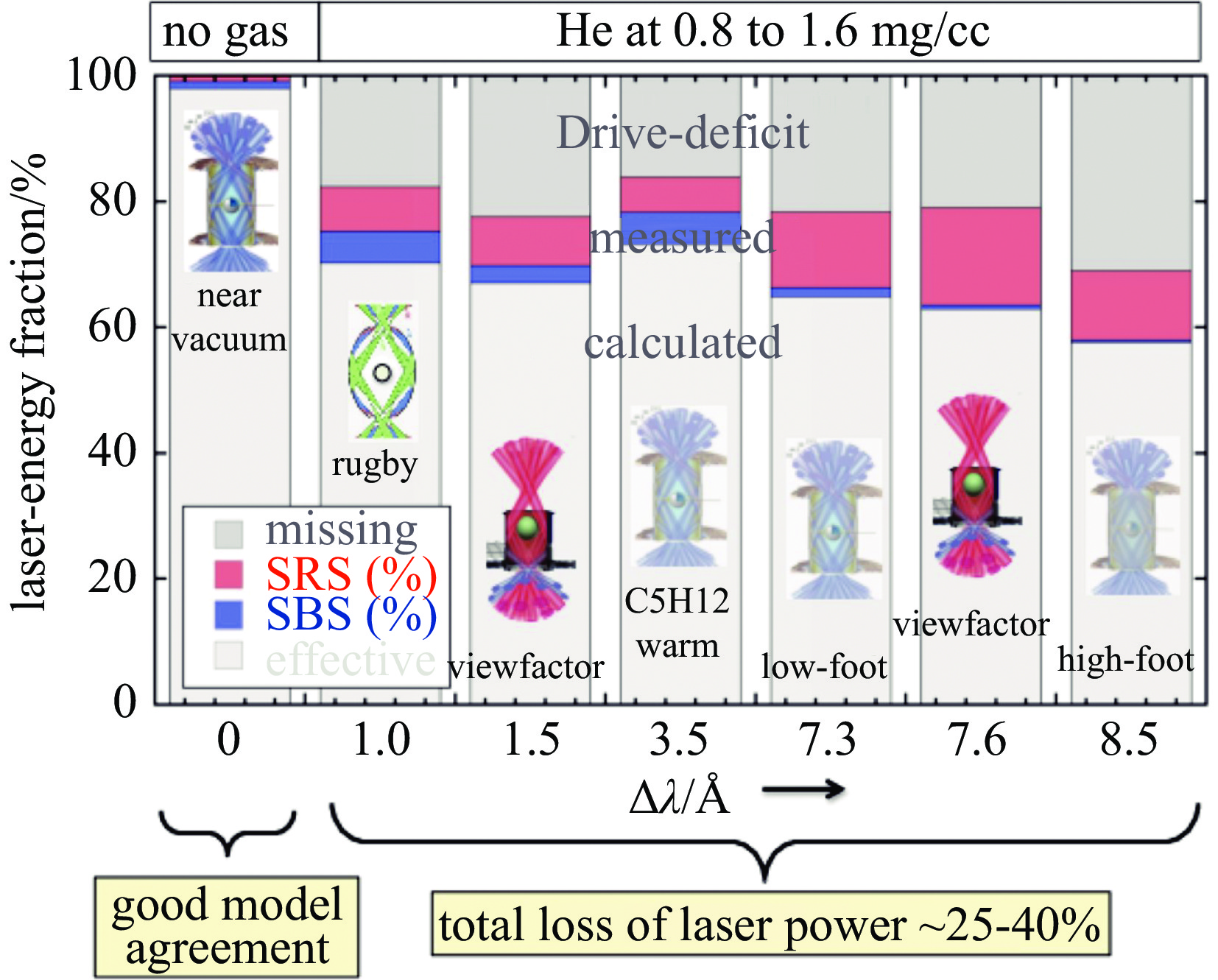
图 1 早期NIC实验辐射流测量结果与模拟值的一致性对比
Figure 1. Agreement between measured radiation fluxes and simulations at subscale and ignition-scale energies in early NIC experiments
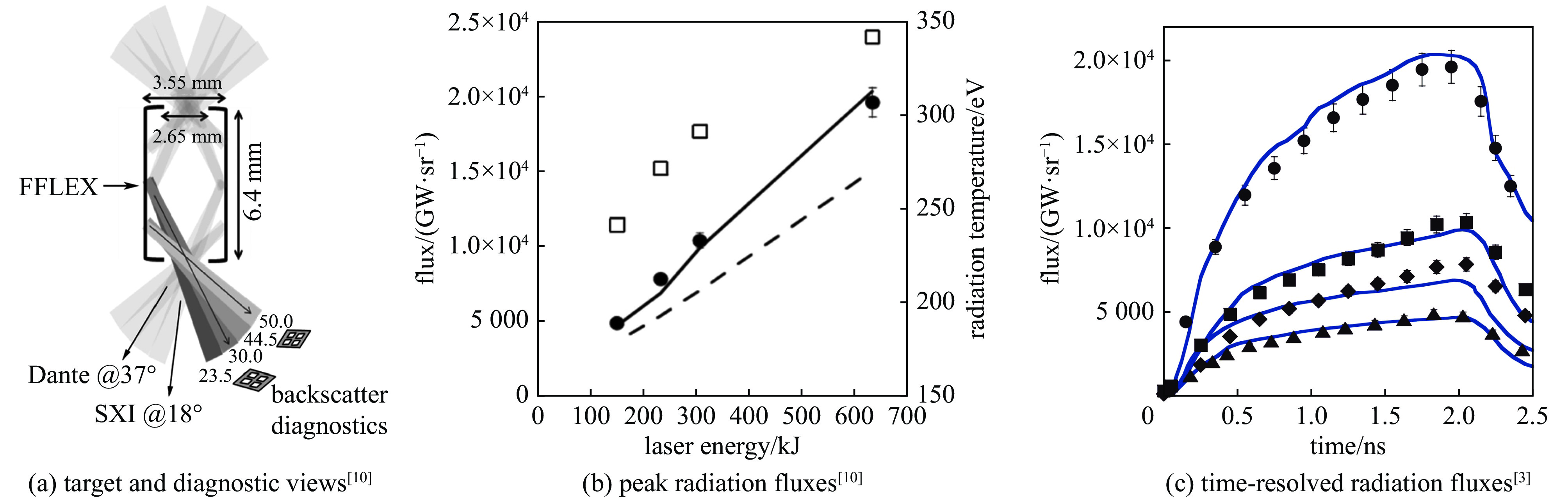
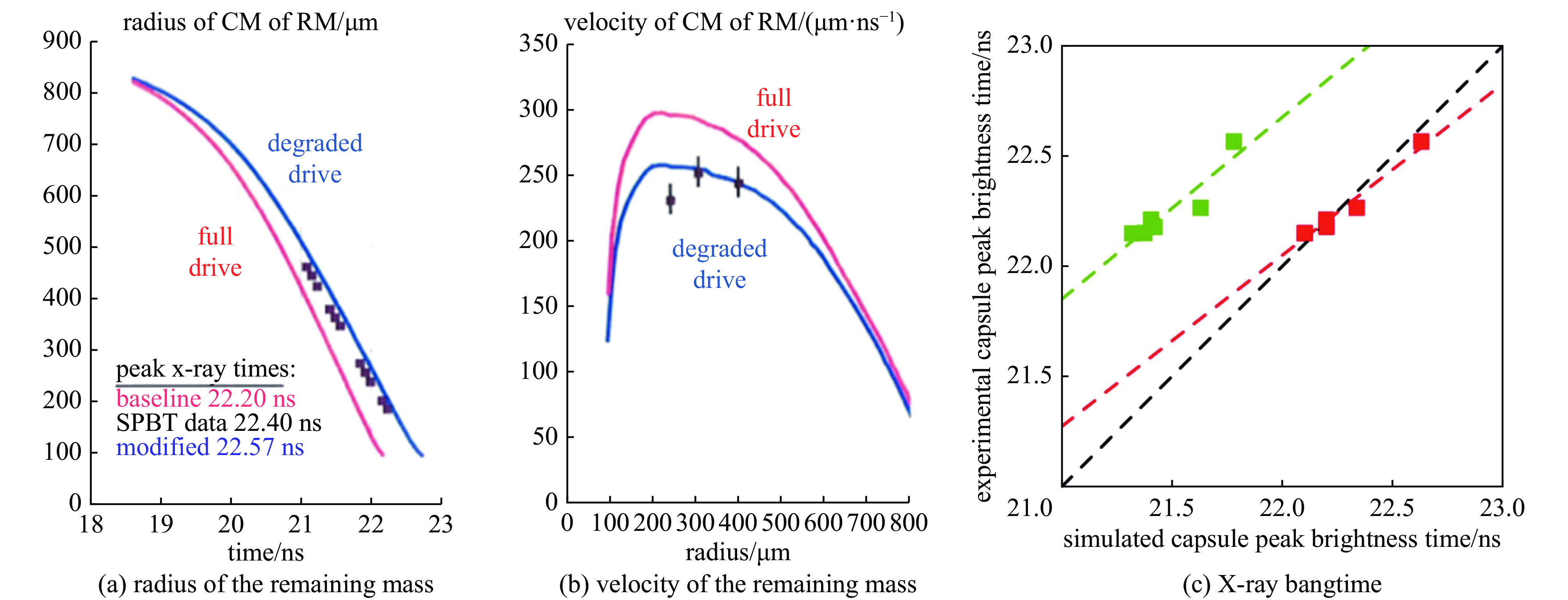
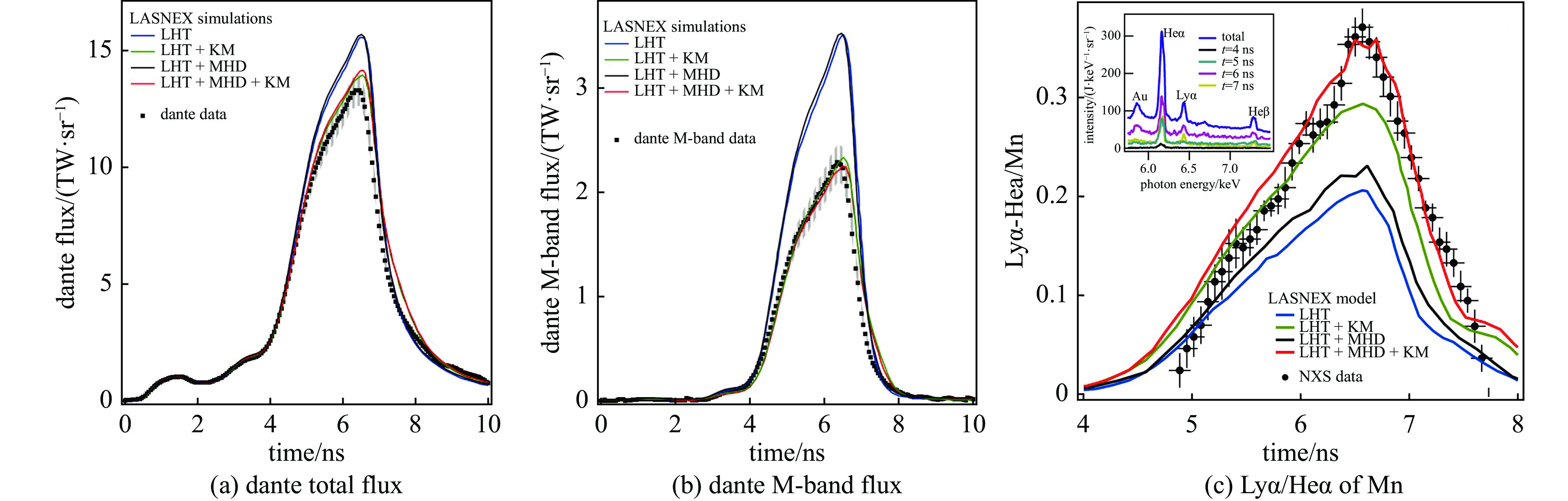
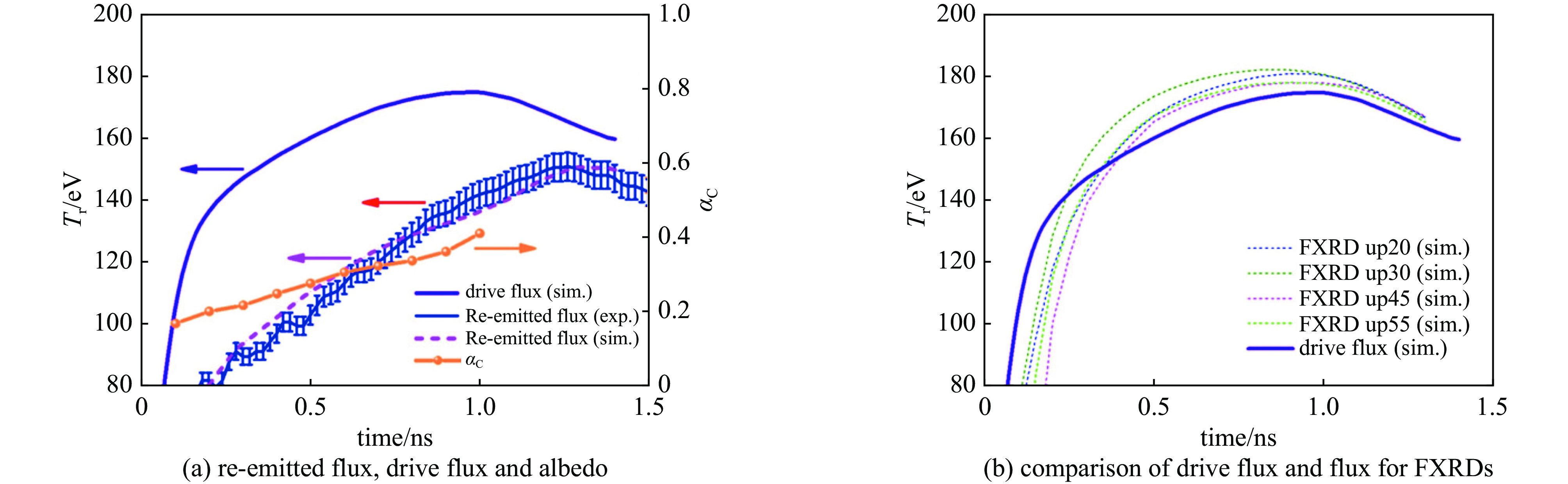
图 3 0.7 倍缩比真空黑腔的辐射流测量结果,体现高流模型对实验的改进拟合能力
Figure 3. Radiation flux measurements in 0.7-scale vacuum hohlraums demonstrating improved modeling with the high-flux approach

-
[1] Amendt P, Glendinning S G, Hammel B A, et al. Direct measurement of X-ray drive from surrogate targets in Nova hohlraums[J]. Physical Review Letters, 1996, 77(18): 3815-3818. doi: 10.1103/PhysRevLett.77.3815 [2] Glenzer S H, Suter L J, Turner R E, et al. Energetics of inertial confinement fusion hohlraum plasmas[J]. Physical Review Letters, 1998, 80(13): 2845-2848. doi: 10.1103/PhysRevLett.80.2845 [3] Kline J L, Glenzer S H, Olson R E, et al. Observation of high soft X-ray drive in large-scale hohlraums at the national ignition facility[J]. Physical Review Letters, 2011, 106: 085003. doi: 10.1103/PhysRevLett.106.085003 [4] Clark D S, Hinkel D E, Eder D C, et al. Detailed implosion modeling of deuterium-tritium layered experiments on the National Ignition Facility[J]. Physics of Plasmas, 2013, 20: 056318. doi: 10.1063/1.4802194 [5] Kritcher A L, Clark D, Haan S, et al. Comparison of plastic, high density carbon, and beryllium as indirect drive NIF ablators[J]. Physics of Plasmas, 2018, 25: 056309. doi: 10.1063/1.5018000 [6] Xie Xufei, Hou Lifei, Cai Hongbo, et al. Measurement of time-dependent drive flux on the capsule for indirectly driven inertial confinement fusion experiments[J]. Physical Review Letters, 2022, 128: 075001. doi: 10.1103/PhysRevLett.128.075001 [7] Meezan N B, Atherton L J, Callahan D A, et al. National ignition campaign Hohlraum energetics[J]. Physics of Plasmas, 2010, 17: 056304. doi: 10.1063/1.3354110 [8] Glenzer S H, Macgowan B J, Meezan N B, et al. Demonstration of ignition radiation temperatures in indirect-drive inertial confinement fusion hohlraums[J]. Physical Review Letters, 2011, 106: 085004. doi: 10.1103/PhysRevLett.106.085004 [9] Farmer W A, Bruulsema C, Swadling G F, et al. Validation of heat transport modeling using directly driven beryllium spheres[J]. Physics of Plasmas, 2020, 27: 082701. doi: 10.1063/5.0005776 [10] Kline J L, Widmann K, Warrick A, et al. The first measurements of soft x-ray flux from ignition scale Hohlraums at the National Ignition Facility using DANTE (invited)[J]. Review of Scientific Instruments, 2010, 81: 10E321. doi: 10.1063/1.3491032 [11] Rosen M D, Scott H A, Hinkel D E, et al. The role of a detailed configuration accounting (DCA) atomic physics package in explaining the energy balance in ignition-scale hohlraums[J]. High Energy Density Physics, 2011, 7(3): 180-190. doi: 10.1016/j.hedp.2011.03.008 [12] Kirkwood R K, Moody J D, Kline J, et al. A review of laser–plasma interaction physics of indirect-drive fusion[J]. Plasma Physics and Controlled Fusion, 2013, 55: 103001. doi: 10.1088/0741-3335/55/10/103001 [13] Town R P J, Rosen M D, Michel P A, et al. Analysis of the National Ignition Facility ignition hohlraum energetics experiments[J]. Physics of Plasmas, 2011, 18: 056302. doi: 10.1063/1.3562552 [14] Hicks D G, Meezan N B, Dewald E L, et al. Implosion dynamics measurements at the National Ignition Facility[J]. Physics of Plasmas, 2012, 19: 122702. doi: 10.1063/1.4769268 [15] Jones O S, Cerjan C J, Marinak M M, et al. A high-resolution integrated model of the National Ignition Campaign cryogenic layered experiments[J]. Physics of Plasmas, 2012, 19: 056315. doi: 10.1063/1.4718595 [16] Moody J D, Callahan D A, Hinkel D E, et al. Progress in hohlraum physics for the National Ignition Facility[J]. Physics of Plasmas, 2014, 21: 056317. doi: 10.1063/1.4876966 [17] MacLaren S A, Schneider M B, Widmann K, et al. Novel characterization of capsule X-ray drive at the national ignition facility[J]. Physical Review Letters, 2014, 112: 105003. doi: 10.1103/PhysRevLett.112.105003 [18] Meezan N B, MacKinnon A J, Hicks D G, et al. X-ray driven implosions at ignition relevant velocities on the National Ignition Facility[J]. Physics of Plasmas, 2013, 20: 056311. doi: 10.1063/1.4803915 [19] Le Pape S, Divol L, Berzak Hopkins L, et al. Observation of a reflected shock in an indirectly driven spherical implosion at the National Ignition Facility[J]. Physical Review Letters, 2014, 112: 225002. doi: 10.1103/PhysRevLett.112.225002 [20] Robey H F, Boehly T R, Celliers P M, et al. Shock timing experiments on the National Ignition Facility: initial results and comparison with simulation[J]. Physics of Plasmas, 2012, 19: 042706. doi: 10.1063/1.3694122 [21] Lawrence Livermore National Laboratory (LLNL). Laser Indirect Drive input to NNSA 2020 Report[R]. 2020. [22] Kritcher A L, Young C V, Robey H F, et al. Design of inertial fusion implosions reaching the burning plasma regime[J]. Nature Physics, 2022, 18(3): 251-258. doi: 10.1038/s41567-021-01485-9 [23] Kritcher A L, Zylstra A B, Callahan D A, et al. Achieving record hot spot energies with large HDC implosions on NIF in Hybrid-E[J]. Physics of Plasmas, 2021, 28: 072706. doi: 10.1063/5.0047841 [24] Jones O S, Suter L J, Scott H A, et al. Progress towards a more predictive model for hohlraum radiation drive and symmetry[J]. Physics of Plasmas, 2017, 24: 056312. doi: 10.1063/1.4982693 [25] Hansen S B, Bauche J, Bauche-Arnoult C, et al. Hybrid atomic models for spectroscopic plasma diagnostics[J]. High Energy Density Physics, 2007, 3(1/2): 109-114. doi: 10.1016/j.hedp.2007.02.032 [26] Lemos N, Farmer W A, Izumi N, et al. Specular reflections (“glint”) of the inner beams in a gas-filled cylindrical hohlraum[J]. Physics of Plasmas, 2022, 29: 092704. doi: 10.1063/5.0099937 [27] Farmer W A, Jones O S, Barrios M A, et al. Heat transport modeling of the dot spectroscopy platform on NIF[J]. Plasma Physics and Controlled Fusion, 2018, 60: 044009. doi: 10.1088/1361-6587/aaaefd [28] Farmer W A, Koning J M, Strozzi D J, et al. Simulation of self-generated magnetic fields in an inertial fusion hohlraum environment[J]. Physics of Plasmas, 2017, 24: 052703. doi: 10.1063/1.4983140 [29] Schurtz G P, Nicolaï P D, Busquet M. A nonlocal electron conduction model for multidimensional radiation hydrodynamics codes[J]. Physics of Plasmas, 2000, 7(10): 4238-4249. doi: 10.1063/1.1289512 [30] Amendt P, Ross J S, Milovich J L, et al. Low-adiabat rugby hohlraum experiments on the National Ignition Facility: comparison with high-flux modeling and the potential for gas-wall interpenetration[J]. Physics of Plasmas, 2014, 21: 112703. doi: 10.1063/1.4901195 [31] Amendt P. Entropy generation from hydrodynamic mixing in inertial confinement fusion indirect-drive targets[J]. Physics of Plasmas, 2021, 28: 072701. doi: 10.1063/5.0049114 [32] Vandenboomgaerde M, Bonnefille M, Gauthier P. The Kelvin-Helmholtz instability in National Ignition Facility hohlraums as a source of gold-gas mixing[J]. Physics of Plasmas, 2016, 23: 052704. doi: 10.1063/1.4948468 [33] Chen Hui, Woods D T, Farmer W A, et al. Understanding the deficiency in inertial confinement fusion hohlraum x-ray flux predictions using experiments at the National Ignition Facility[J]. Physical Review E, 2024, 110: L013201. doi: 10.1103/PhysRevE.110.L013201 [34] Swadling G F, Farmer W A, Chen H, et al. Resolving discrepancies in bang-time predictions for indirect-drive ICF experiments on the NIF: insights from the Build-A-Hohlraum campaign[J]. Physics of Plasmas, 2025, 32: 052707. doi: 10.1063/5.0259922 [35] Ren Kuan, Liu Shenye, Du Huabing, et al. New two-dimensional space-resolving flux detection technique for measurement of hohlraum inner radiation in Shenguang-III prototype[J]. Review of Scientific Instruments, 2015, 86: 103112. doi: 10.1063/1.4934250 [36] Ren Kuan, Liu Shenye, Xie Xufei, et al. First exploration of radiation temperatures of the laser spot, re-emitting wall and entire hohlraum drive source[J]. Scientific Reports, 2019, 9: 5050. doi: 10.1038/s41598-019-41424-6 [37] Xie Xufei, Wu Changshu, Chen Jinwen, et al. Characterization of radiation drive by measuring the localized re-emitted flux from the capsule in inertial confinement fusion experiments[J]. Nuclear Fusion, 2022, 62: 126008. doi: 10.1088/1741-4326/ac8fa2 [38] Kuang Longyu, Li Hang, Jing Longfei, et al. A novel three-axis cylindrical hohlraum designed for inertial confinement fusion ignition[J]. Scientific Reports, 2016, 6: 34636. doi: 10.1038/srep34636 [39] Li Xin, Dong Yunsong, Kang Dongguo, et al. First indirect drive experiment using a six-cylinder-port hohlraum[J]. Physical Review Letters, 2022, 128: 195001. doi: 10.1103/PhysRevLett.128.195001 [40] Farmer W A, Tabak M, Hammer J H, et al. High-temperature hohlraum designs with multiple laser-entrance holes[J]. Physics of Plasmas, 2019, 26: 032701. doi: 10.1063/1.5087140 -

 下载:
下载:
 点击查看大图
图(36)
计量
- 文章访问数: 11
- HTML全文浏览量: 5
- PDF下载量: 0
- 被引次数: 0
