



Investigation on suppression of vacuum breakdown in titanium materials under intense electromagnetic fields via surface self-nanocrystallization
-
摘要: 为进一步提升相对论返波管高功率微波产生器的功率容量,本文提出一种采用表面自纳米化技术抑制相对论返波管强电磁场真空击穿的新思路,并通过实验研究了超声冲击和微粒子喷丸这两种技术对工业纯钛处理后的表面自纳米化效果、场致电子发射特性和强电磁场真空击穿性能。微观形貌和X射线衍射分析结果表明,超声冲击处理后在工业纯钛表层2~3 μm范围内形成梯度纳米化层,表面晶粒细化至约40 nm;微粒子喷丸处理后在工业纯钛表层30 μm范围内形成梯度纳米化层,表面晶粒细化至约48 nm。场致电子发射测试电场-电流曲线表明,表面自纳米化处理可以抑制场致电子发射,尤其是超声冲击处理可以显著抑制工业纯钛的场致电子发射。对比分析输出微波波形和结构壁损伤痕迹发现,超声冲击和微粒子喷丸处理可减弱微波尾蚀和结构壁损伤,证明其确实能够抑制慢波结构强电磁场真空击穿。Abstract:
Background Vacuum breakdown under intense electromagnetic fields in Relativistic Backward Wave Oscillator (RBWO) critically compromise the reliability of high power microwave sources. To meet increasingly demanding power capacity requirments, it is essential to further enhance the performances of resistance to vacuum breakdown. The processes of lectron emission and electron beam bombardment are closely associated with the physical interactions at the material surface. Furthermore, studies have indicated that refining the grain size of titanium suifaces may significantly increase their ability to withstand intense electromagnetic field-induced vacuum breakdown.Purpose Given that surface self-nanocrystallization is a highly effective approach for improving the mechanical properties of metallic materials, particularly through grain fefinement at the nanometer scale, this article proposes a novel strategy utilizing surface self-nanocrystallization technology to suppress vacuum breakdown in RBWO under intense electromagnetic fields. Experimental validation was conducted to evaluate the effectiveness of this method in inhibiting vacuum breakdown under such extreme conditions.Methods This paper employs commercially pure titanium (TA2) as the research object, utilizing ultrasonic peening (USP) and microshot peening (MSP) as two distinct nanoparticle surface processing techniques. The nanostructural effects were characterized through scanning electron microscopy coupled with X-ray diffraction analysis. Subsequently, field emission testing apparatus and an X-band RBWO were employed to conduct comparatice experiments on field electron emission characteristics and vacuum breakdown performance high power microwave generation, respectively.Results USP produces a gradient nanocrystalline layer extending 2-3 μm beneath the surface, with grain size refined to approximately 40 nm. MSP generates a more extensive gradient nanocrystalline layer reaching 30 μm in depth, with surface grains refined to about 48 nm. After undergoing MSP and USP treatment, TA2 exhibits a sequential reduction in the field emission current under the identical electric field, the tail erosion in the output microwave waveforms vanishes, and damage in the high-field region of the slow wave structure is mitigated.Conclusions The results demonstrate that both MSP and USP treatments successfully refine the surface grain size of TA2 to the nanoscale range of several tens of nanometers, forming a gradient nanostructured layer. Such surface self-nanocrystallization effectively suppresses field-induced electron emission and vacuum breakdown under intense electromagnetic fields. Notably, the USP treatment exhibits particularly pronounced inhibitory effects. This methodology provides technical support for further enhancing the power capacity of high power microwave generators based on RBWO. -
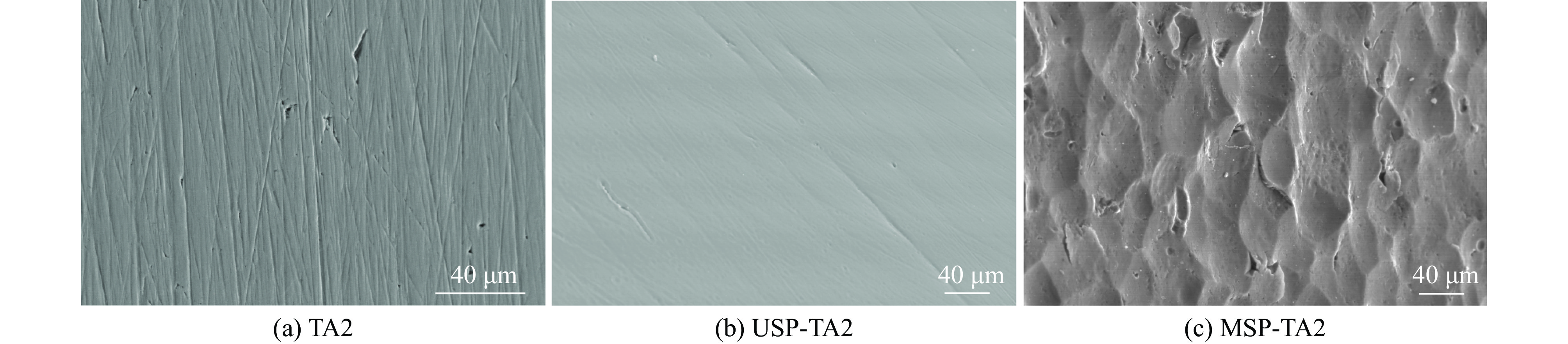
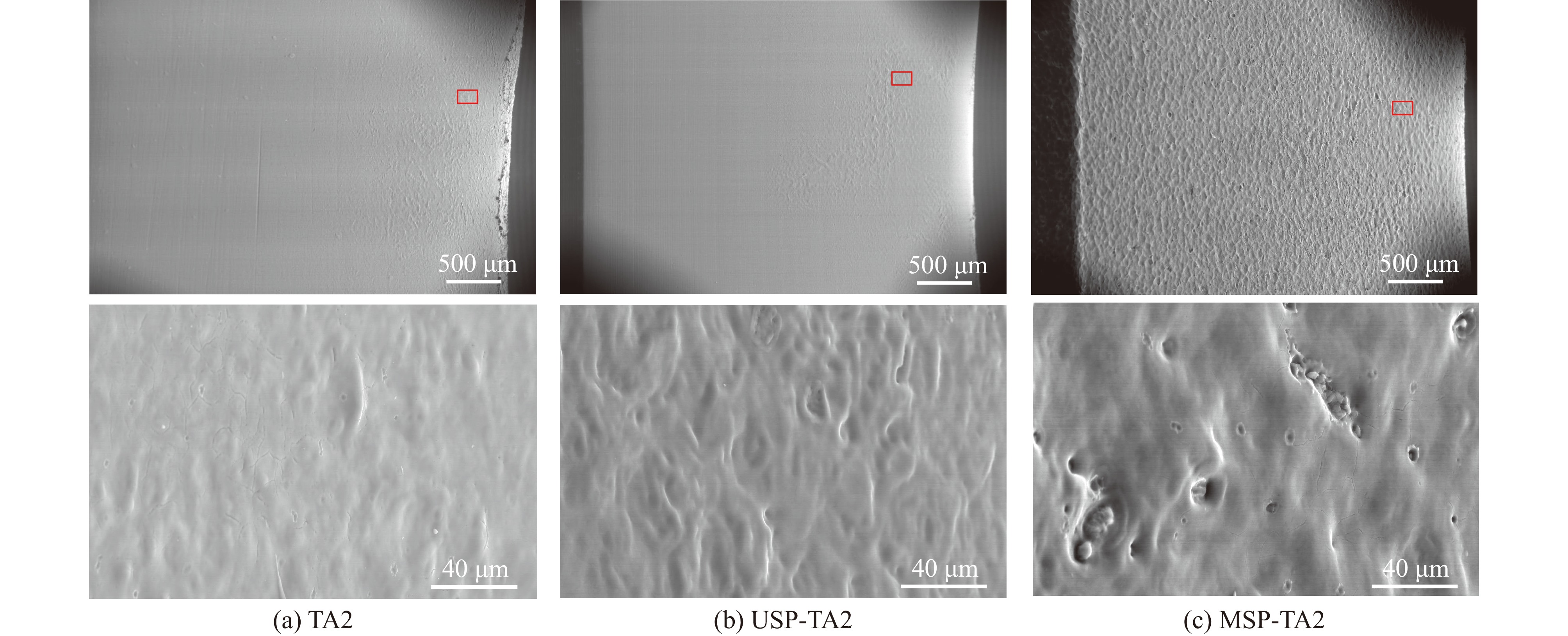
图 1 TA2表面自纳米化处理前后的表面微观形貌
Figure 1. The surface micromorphology of TA2 prior to and subsequent to self-nanocrystallization treatments
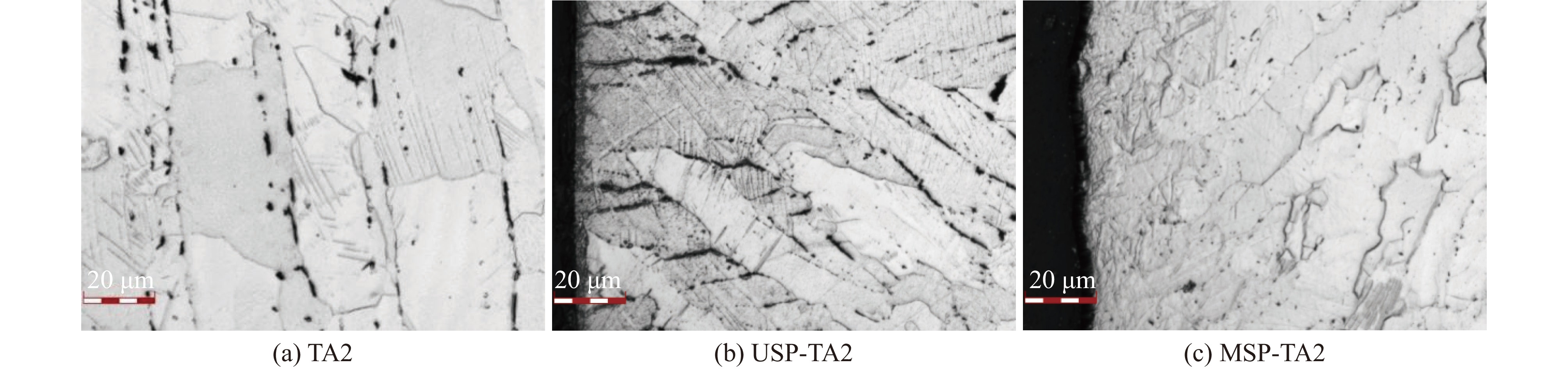
图 2 试样截面的金相显微组织
Figure 2. The cross-sectional microstructure of TA2 prior to and subsequent to self-nanocrystallization treatments
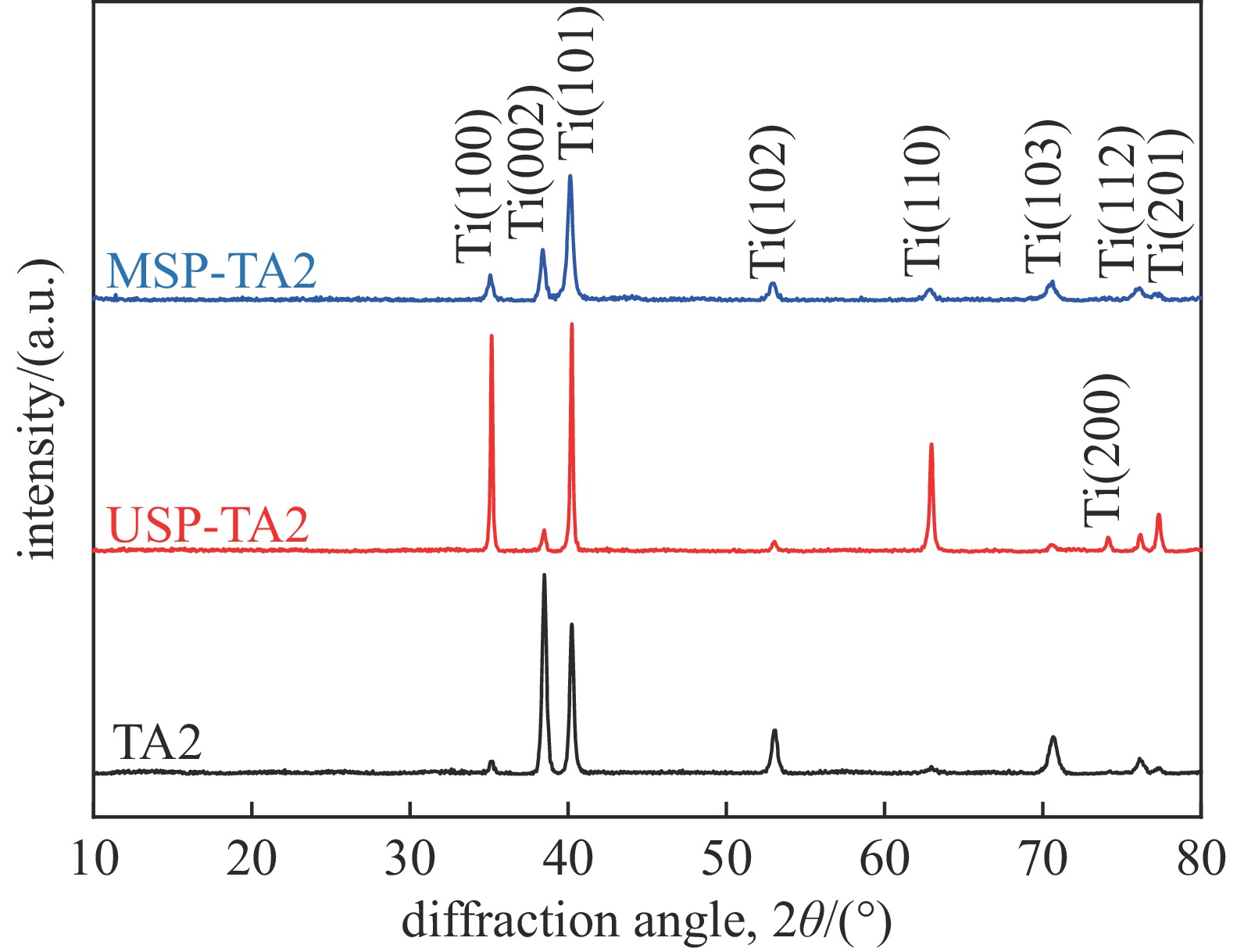
图 3 TA2表面自纳米化处理前后的表面XRD图谱
Figure 3. The X-ray Diffraction (XRD) patterns of TA2 prior to and subsequent to self-nanocrystallization treatments
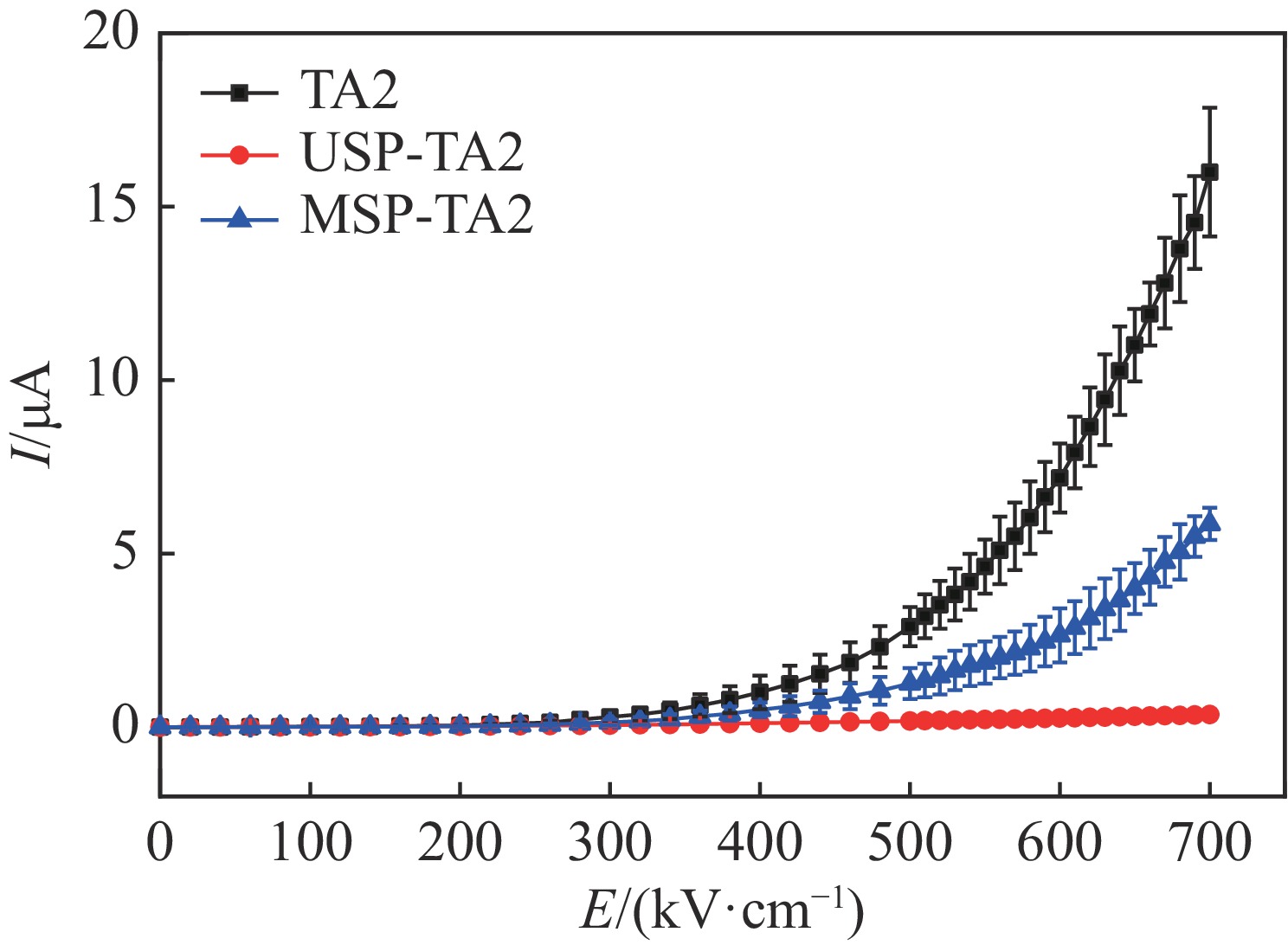
图 4 TA2、USP-TA2、MSP-TA2的场发射电场-电流曲线
Figure 4. The field emission current-electric field characteristics of TA2, USP-TA2, and MSP-TA2

图 5 X波段RBWO强电磁场真空击穿实验装置示意图
Figure 5. Schematic diagram of the X-band RBWO intense electromagnetic field vacuum breakdown experimental device

图 6 微波功率5 GW条件下使用不同慢波结构在20 Hz刚开始连续工作600个脉冲的波形:CH1是二极管电压,CH2是二极管电流,CH3是在线微波波形,CH4是辐射场微波波形
Figure 6. Waveforms of the initial 600 pulses during the commencement of continuous operation at 5 GW microwave power with varied slow-wave structures at 20 Hz: CH1 represents the diode voltage, CH2 corresponds to the diode current, CH3 denotes the online microwave waveform, and CH4 signifies the microwave waveform of radiated field
-
[1] 陈昌华, 刘国治. 相对论返波管导论[M]. 北京: 科学出版社, 2021Chen Changhua, Liu Guozhi. Introduction to relativistic backward wave oscillato[M]. Science Press, 2021 [2] Cheng Changhua, Liu Guozhi, Huang Wenhua, et al. A repetitive X-band relativistic backward-wave oscillator[J]. IEEE Transactions on Plasma Science, 2002, 30(3): 1108-1111. doi: 10.1109/TPS.2002.801656 [3] Xiao Renzhen, Deng Yuqun, Wang Yue, et al. Power combiner with high power capacity and high combination efficiency for two phase-locked relativistic backward wave oscillators[J]. Applied Physics Letters, 2015, 107: 133502. doi: 10.1063/1.4932065 [4] 肖仁珍. 相对论返波管研究进展[J]. 现代应用物理, 2022, 13: 020201Xiao Renzhen. Research progress of relativistic backward wave oscillator[J]. Modern Applied Physics, 2022, 13: 020201 [5] 伍成. 真空强场环境耐电子轰击材料优选研究[D]. 湘潭: 湘潭大学, 2017: 45-50Wu Cheng. Study of the electron bombardment on materials optimization in vacuum strong field environment[D]. Xiangtan: Xiangtan University, 2017: 45-50 [6] Tan Nongchao, Wu Ping, Sun Jun, et al. Experimental study on the influence of grain boundary on breakdown in relativistic backward wave oscillator[J]. Physica Scripta, 2023, 98: 105535. doi: 10.1088/1402-4896/acfac7 [7] Lu K, Lu J. Nanostructured surface layer on metallic materials induced by surface mechanical attrition treatment[J]. Materials Science and Engineering: A, 2004, 375/377: 38-45. [8] 卢柯, 张哲峰, 卢磊, 等. 国家自然科学基金重大项目“金属材料强韧化的多尺度结构设计与制备”结题综述[J]. 中国科学基金, 2013, 27(2): 70-74Lu Ke, Zhang Zhefeng, Lu Lei, et al. Summary and outlook of the major project “design and preparation of multi-scale structure for strengthening and toughening of metallic materials”[J]. Bulletin of National Natural Science Foundation of China, 2013, 27(2): 70-74 [9] Lu Ke, Lu Jian. Surface nanocrystallization (SNC) of metallic materials-presentation of the concept behind a new approach[J]. Journal of Materials Science and Technology, 1999, 15(3): 193-197. [10] 李慧敏, 李淼泉, 刘印刚, 等. 钛合金表层机械处理的纳米化组织、力学性能与机理研究进展[J]. 中国有色金属学报, 2015, 25(3): 641-651 doi: 10.19476/j.ysxb.1004.0609.2015.03.013Li Huimin, Li Miaoquan, Liu Yingang, et al. Research progress in nanocrystalline microstructure, mechanical properties and nanocrystallization mechanism of titanium alloys via surface mechanical treatment[J]. The Chinese Journal of Nonferrous Metals, 2015, 25(3): 641-651 doi: 10.19476/j.ysxb.1004.0609.2015.03.013 [11] 肖旭东, 李勇, 乔丹, 等. 金属材料表面自纳米化技术研究进展[J]. 塑性工程学报, 2021, 28(10): 9-18Xiao Xudong, Li Yong, Qiao Dan, et al. Research on surface self-nanocrystallization of metal material[J]. Journal of Plasticity Engineering, 2021, 28(10): 9-18 [12] 罗钦毫. TB6钛合金表面纳米化层的组织与性能研究[D]. 南昌: 南昌航空大学, 2015: 32-33Luo Qinhao. Structure and properties of surface nanometer layer in TB6 alloy[D]. Nanchang: Nanchang Hangkong University, 2015: 32-33 [13] 王瑜. TLM钛合金表面自纳米化层的制备及组织性能研究[D]. 西安: 长安大学, 2019: 14-28Wang Yu. Study on the structure and properties of surface self-nanometerlayer in TLM titanium alloy[D]. Xi’an: Chang'an University, 2019: 14-28 [14] 田唐永. TC4钛合金喷丸强化组织与性能研究[D]. 大连: 大连理工大学, 2012: 33-38Tian Tangyong. Microstructures and properties of TC4 titanium alloy treated by shot peening[D]. Dalian: Dalian University of Technology, 2012: 33-38 [15] Li Kang, Fu Xuesong, Chen Guoqing, et al. Mechanical properties of strengthened surface layer in Ti-6Al-4V alloy induced by wet peening treatment[J]. Transactions of Nonferrous Metals Society of China, 2016, 26(11): 2868-2873. doi: 10.1016/S1003-6326(16)64415-1 [16] 陈春焕, 任瑞铭. 工业纯钛纳米表层的透射电镜研究[J]. 稀有金属材料与工程, 2010, 39(s1): 98-100Chen Chunhuan, Ren Ruiming. TEM investigation on the surface nanostructured layer of CP-titanium[J]. Rare Metal Materials and Engineering, 2010, 39(s1): 98-100 [17] Kumar S, Chattopadhyay K, Singh V. Effect of surface nanostructuring on corrosion behavior of Ti-6Al-4V alloy[J]. Materials Characterization, 2016, 121: 23-30. doi: 10.1016/j.matchar.2016.09.031 [18] Panin A V, Kazachenok M S, Kozelskaya A I, et al. Mechanisms of surface roughening of commercial purity titanium during ultrasonic impact treatment[J]. Materials Science and Engineering: A, 2015, 647: 43-50. doi: 10.1016/j.msea.2015.08.086 [19] Perevalova O B, Panin A V, Kazachenok M S, et al. Effect of ultrasonic impact treatment on microstructure and fatigue life of 3D printed Ti–6Al–4V titanium alloy[J]. Physics of Metals and Metallography, 2023, 124(10): 1059-1065. doi: 10.1134/S0031918X23601816 [20] 王锦. TC4钛合金超声冲击表面纳米化及高温退火组织与性能研究[D]. 西安: 西安理工大学, 2018: 13-34Wang Jin. The study of nanocrystallization and properties on the surface of TC4 titanium alloy after ultrasonic impact treatment and high temperature annealing[D]. Xi’an: Xi’an University of Technology, 2018: 13-34 [21] 何柏林, 余皇皇. 超声冲击表面纳米化研究的发展[J]. 热加工工艺, 2010, 39(18): 112-115 doi: 10.3969/j.issn.1001-3814.2010.18.032He Bolin, Yu Huanghuang. Development of ultrasonic peening surface nano-crystallization[J]. Hot Working Technology, 2010, 39(18): 112-115 doi: 10.3969/j.issn.1001-3814.2010.18.032 [22] 黄丽婷. 超声冲击工艺对钛合金焊接头性能的影响研究[D]. 南京: 南京航空航天大学, 2014Huang Liting. Research on influence of ultrasonic impact treatment along welded joints for titanium alloy[D]. Nanjing: Nanjing University of Aeronautics and Astronautics, 2014 [23] Zhang H W, Hei Z K, Liu G, et al. Formation of nanostructured surface layer on AISI 304 stainless steel by means of surface mechanical attrition treatment[J]. Acta Materialia, 2003, 51(7): 1871-1881. doi: 10.1016/S1359-6454(02)00594-3 [24] 吕爱强, 刘春明, 刘刚. 表面机械研磨316L不锈钢诱导表层纳米化[J]. 东北大学学报(自然科学版), 2004, 25(9): 848-849Lü Aiqiang, Liu Chunming, Liu Gang. Surface nanocrystallization of 316L stainless steel induced by surface mechanical attrition treatment[J]. Journal of Northeastern University (Natural Science), 2004, 25(9): 848-849 [25] 石朝阳, 刘赤荣, 应才苏. 激光冲击强化技术研究与应用现状[J]. 机械设计与制造, 2010(4): 61-63Shi Chaoyang, Liu Chirong, Ying Caisu. Research and application of laser shock processing[J]. Machinery Design & Manufacture, 2010(4): 61-63 [26] Guo Wei, Sun Rujian, Song Binwen, et al. Laser shock peening of laser additive manufactured Ti6Al4V titanium alloy[J]. Surface and Coatings Technology, 2018, 349: 503-510. doi: 10.1016/j.surfcoat.2018.06.020 [27] 张凌峰, 熊毅, 张毅, 等. 高锰钢在激光冲击作用下的微观特征[J]. 中国激光, 2011, 38: 0603025Zhang Lingfeng, Xiong Yi, Zhang Yi, et al. Microstructure of high manganese steel by laser shock processing[J]. Chinese Journal of Lasers, 2011, 38: 0603025 -

 下载:
下载:
 点击查看大图
计量
- 文章访问数: 24
- HTML全文浏览量: 17
- PDF下载量: 3
- 被引次数: 0
