



Computational ghost imaging based on recursive cross sorting of hadamard basis
-
摘要: 哈达玛散斑的投影顺序直接影响欠采样率下鬼成像的图像重构质量与效率。提出了一种基于哈达玛基的递归交叉排序策略,通过逆向解构层级子空间,利用偶数索引映射机制对具有正交纹理特征的散斑进行交错重组,打破了单一方向特征在采样序列中的连续性堆积。通过在理想和高斯噪声环境下的仿真得出,该策略在0~100%全采样区间内有效削减了传统Russian Dolls排序中的质量指标随采样率增加而出现的震荡现象,实现了成像质量较为平滑演进与稳健收敛,且在0~10%低采样率区间内,其重构图像的峰值信噪比相较于Hadamard自然排序平均提升最大约101.7%,较激光模式散斑排序平均提升最大约11.4%,最大提升约3.4 dB,最后设计了光学实验,验证了该策略的效果。这一排序策略或可为实现快速鬼成像提供有效的途径。Abstract:
Background The projection sequence of Hadamard speckle patterns directly influences the image reconstruction quality and efficiency of Computational Ghost Imaging under undersampled conditions. Optimizing the speckle sorting strategy is an effective approach to achieving high-quality imaging at low sampling rates.Purpose This study aims to address the oscillation of quality metrics observed during the sampling process of traditional sorting strategies and to further enhance the signal-to-noise ratio and convergence stability within the low-sampling-rate regime.Methods A Recursive Cross (RC) sorting strategy based on the Hadamard basis is proposed. By inversely deconstructing hierarchical subspaces and utilizing an even-index mapping mechanism, this method interleaves and reorganizes speckles with orthogonal texture features, thereby disrupting the continuous accumulation of unidirectional features in the sampling sequence. Numerical simulations under both ideal and gaussian noise environments, along with optical experiments, were conducted to validate the proposed method.Results Simulation results demonstrate that the RC strategy effectively eliminates the oscillation of evaluation metrics observed in Russian Dolls sorting as the sampling rate increases across the full 0–100% range, achieving a smooth evolution and robust convergence of imaging quality. Particularly in the low-sampling-rate range of 0–10%, the Peak Signal-to-Noise Ratio of the reconstructed images shows a maximum improvement of approximately 101.7% compared to Hadamard natural sorting and 11.4% compared to Laser Model Speckle sorting, with a maximum gain of about 3.4 dB.Conclusions By optimizing the sampling path of spectral energy, the RC sorting strategy improves the data acquisition efficiency of ghost imaging, potentially offering an effective technical pathway for realizing rapid and real-time ghost imaging applications. -
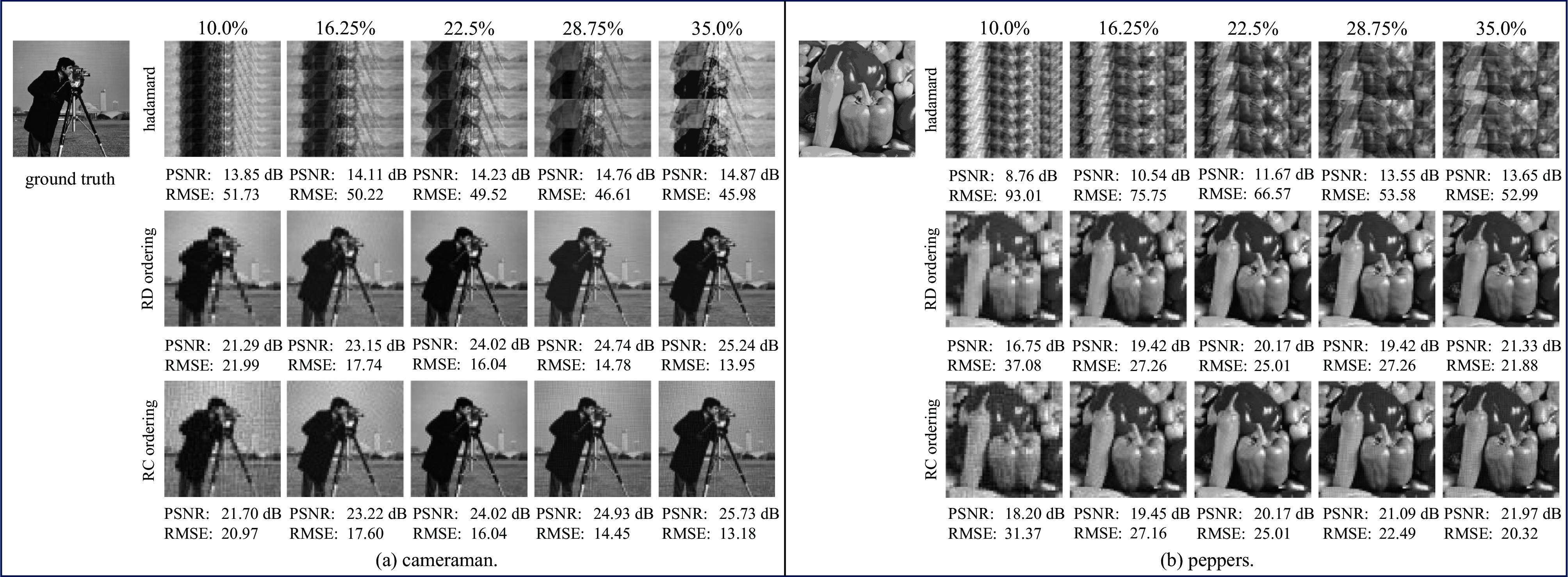
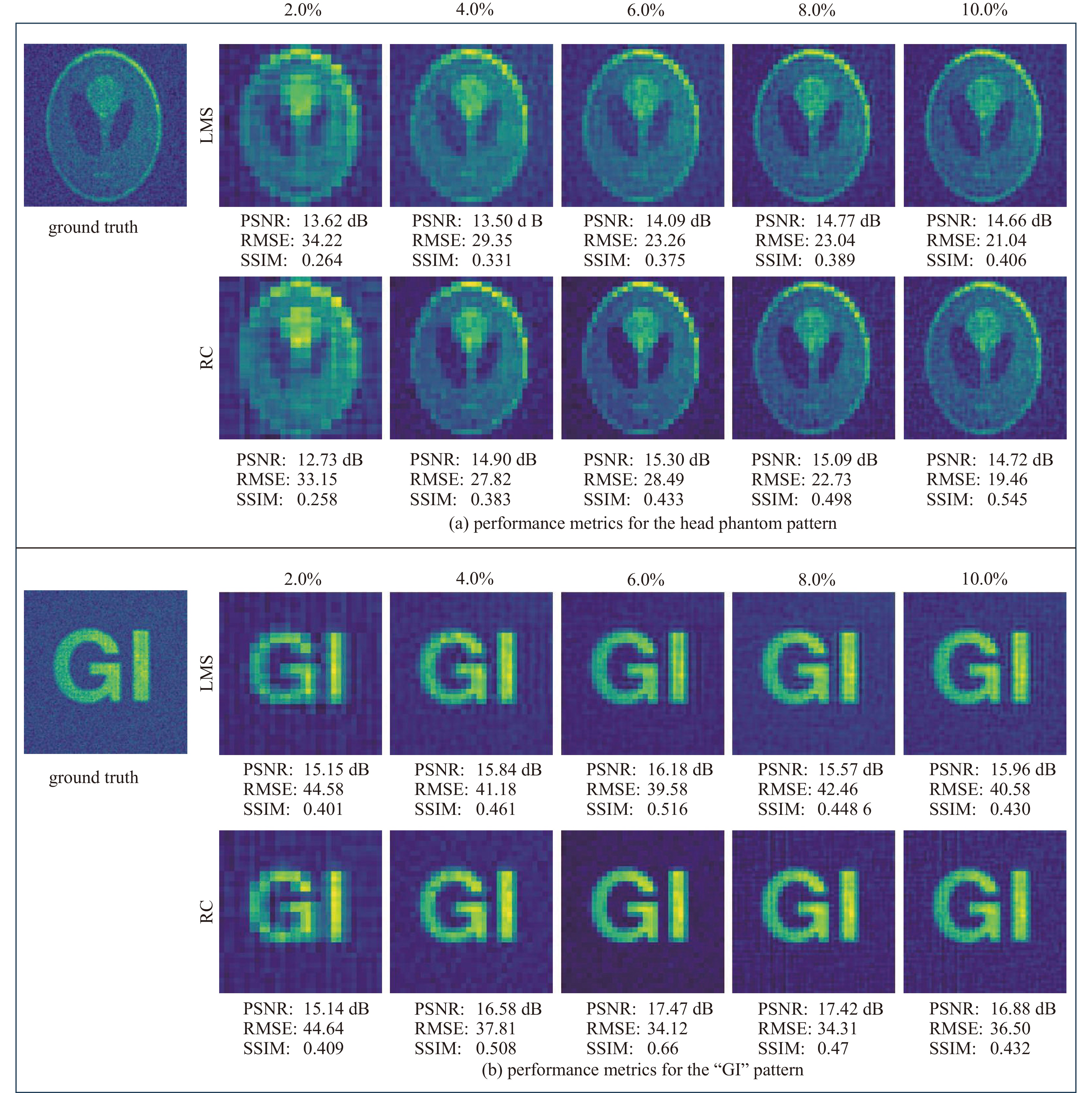
图 3 两张待测物图片部分采样率下的仿真重构结果
Figure 3. Simulation reconstruction results of two test objects at partial sampling rates

图 4 理想(c=0)与噪声(c=0.3)环境下,“cameraman”与“peppers”的三种排序策略重构质量对比
Figure 4. Comparison of reconstruction quality for "cameraman" and "peppers" using different sorting strategies under ideal (c=0) and noisy (c=0.3) conditions
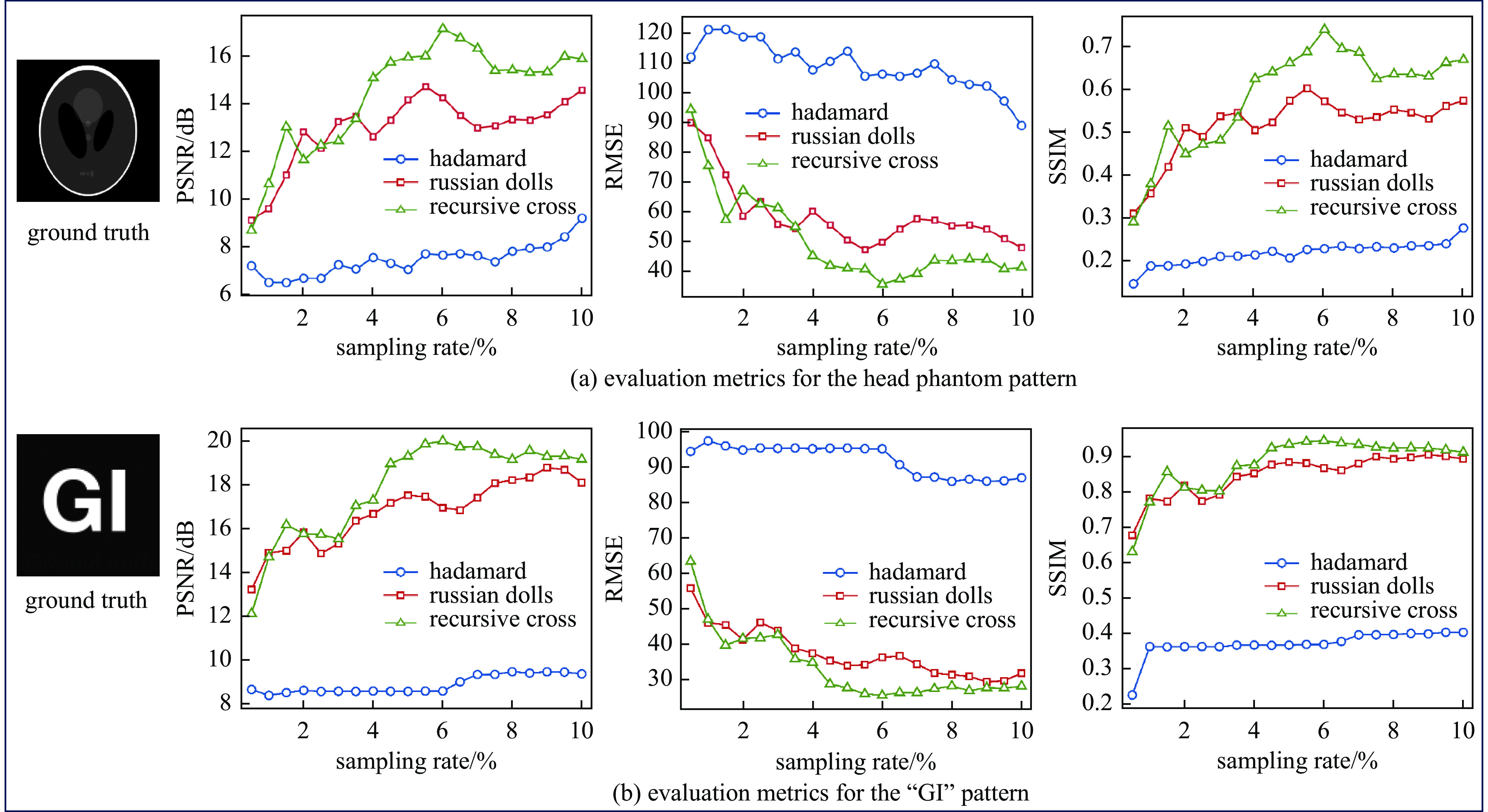
图 5 噪声环境下RC、LMS与Hadamard三种排序策略的重构质量对比
Figure 5. Comparison of reconstruction quality using RC, LMS, and Hadamard sorting strategies under noisy conditions
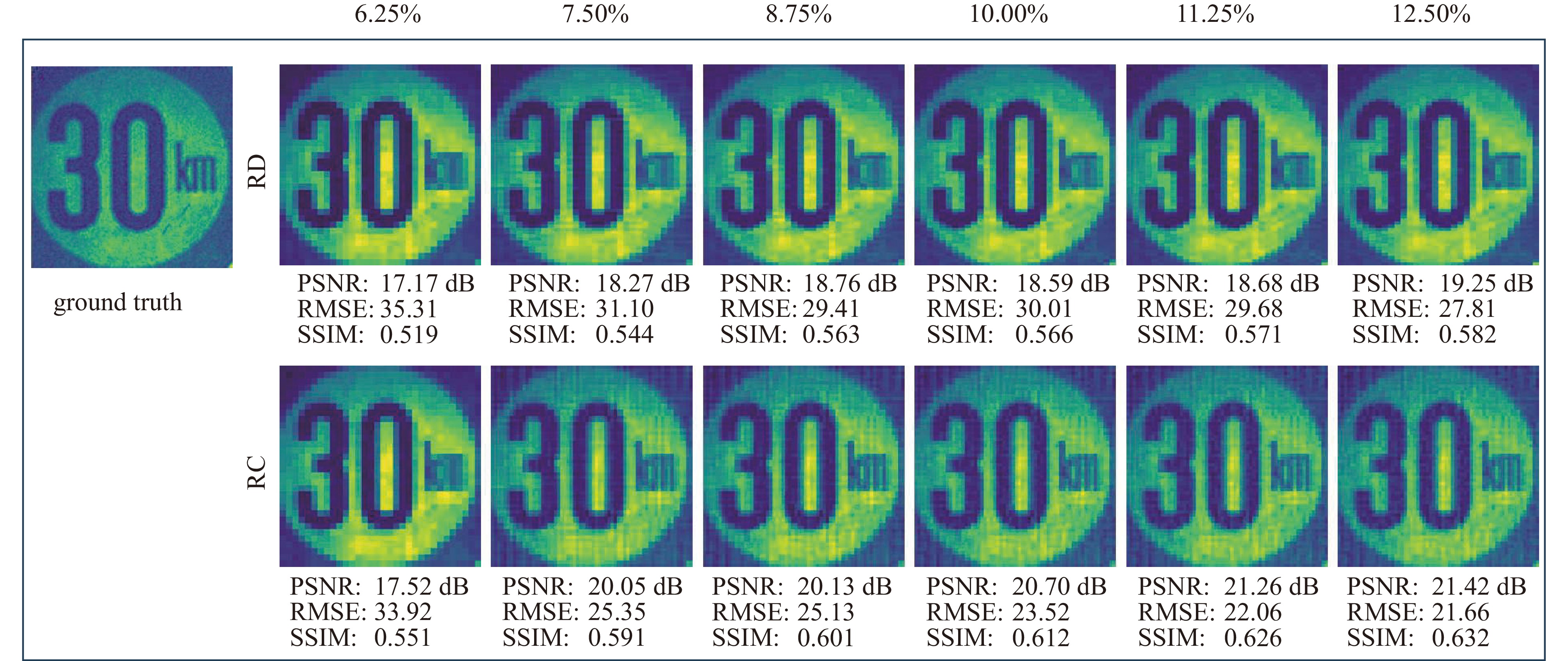
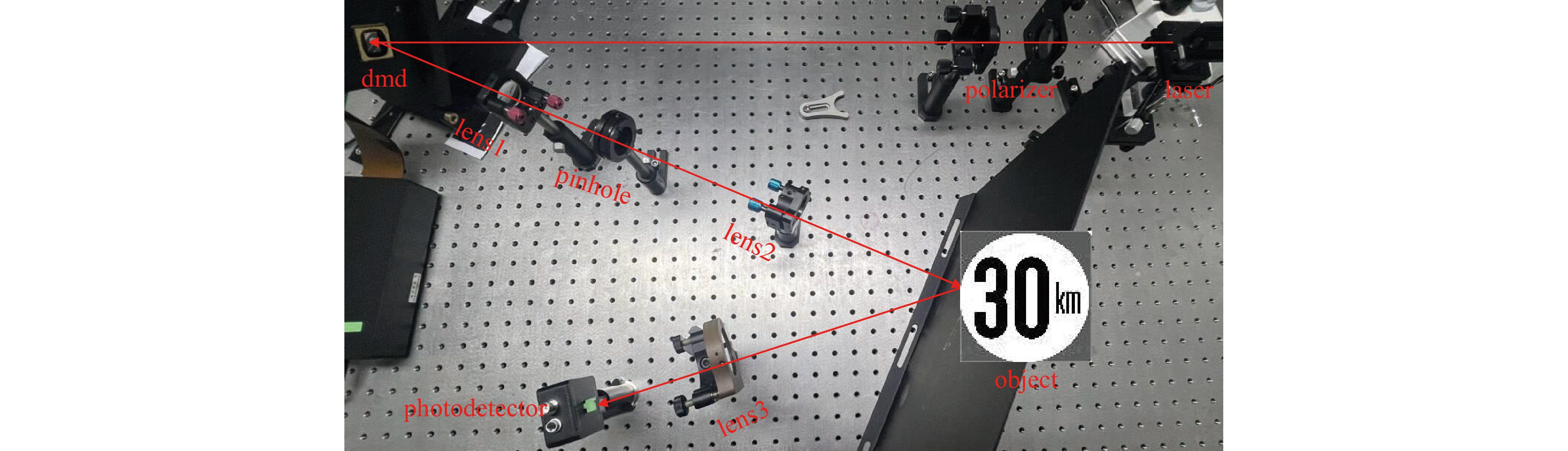
图 7 低采样率下RD与RC排序方案针对“30 km”物体的实验重构对比
Figure 7. Comparison of experimental reconstructions for the "30 km" object using RD and RC sorting schemes at low sampling rates
-
[1] Erkmen B I, Shapiro J H. Ghost imaging: from quantum to classical to computational[J]. Advances in Optics and Photonics, 2010, 2(4): 405-450. doi: 10.1364/AOP.2.000405 [2] Moreau P A, Toninelli E, Gregory T, et al. Ghost imaging using optical correlations[J]. Laser & Photonics Reviews, 2018, 12: 1700143. doi: 10.1002/lpor.201700143 [3] Strekalov D V, Sergienko A V, Klyshko D N, et al. Observation of two-photon “ghost” interference and diffraction[J]. Physical Review Letters, 1995, 74(18): 3600-3603. doi: 10.1103/PhysRevLett.74.3600 [4] Edgar M P, Gibson G M, Bowman R W, et al. Simultaneous real-time visible and infrared video with single-pixel detectors[J]. Scientific Reports, 2015, 5: 10669. doi: 10.1038/srep10669 [5] Wu Han, Hu Bo, Chen Lu, et al. Mid-infrared computational temporal ghost imaging[J]. Light: Science & Applications, 2024, 13: 124. [6] Liu Hongchao, Zhang Shuang. Computational ghost imaging of hot objects in long-wave infrared range[J]. Applied Physics Letters, 2017, 111: 031110. doi: 10.1063/1.4994662 [7] Yang Xu, Yu Zhongyang, Xu Lu, et al. Underwater ghost imaging based on generative adversarial networks with high imaging quality[J]. Optics Express, 2021, 29(18): 28388-28405. doi: 10.1364/OE.435276 [8] Li Yuliang, Chen Mingliang, Qi Jinquan, et al. Underwater ghost imaging with detection distance up to 9.3 attenuation lengths[J]. Optics Express, 2023, 31(23): 38457-38474. doi: 10.1364/OE.499186 [9] Wang Tao, Chen Meiyun, Wu Heng, et al. Underwater compressive computational ghost imaging with wavelet enhancement[J]. Applied Optics, 2021, 60(23): 6950-6957. doi: 10.1364/AO.431712 [10] Yin Manqian, Wang Le, Zhao Shengmei. Experimental demonstration of influence of underwater turbulence on ghost imaging[J]. Chinese Physics B, 2019, 28: 094201. doi: 10.1088/1674-1056/ab33ee [11] Clemente P, Durán V, Torres-Company V, et al. Optical encryption based on computational ghost imaging[J]. Optics Letters, 2010, 35(14): 2391-2393. doi: 10.1364/OL.35.002391 [12] Zhao Shengmei, Wang Le, Liang Wenqiang, et al. High performance optical encryption based on computational ghost imaging with QR code and compressive sensing technique[J]. Optics Communications, 2015, 353: 90-95. doi: 10.1016/j.optcom.2015.04.063 [13] Guo Zhe, Chen Suhua, Zhou Ling, et al. Optical image encryption and authentication scheme with computational ghost imaging[J]. Applied Mathematical Modelling, 2024, 131: 49-66. doi: 10.1016/j.apm.2024.04.012 [14] Zhang Leihong, Xiong Rui, Chen Jian, et al. Optical image compression and encryption transmission-based ondeep learning and ghost imaging[J]. Applied Physics B, 2020, 126: 18. doi: 10.1007/s00340-020-7379-5 [15] 张航宇, 吴仪, 赵帅, 等. 采用卷积神经网络提高鬼成像的边缘质量[J]. 强激光与粒子束, 2024, 36: 079002 doi: 10.11884/HPLPB202436.240030Zhang Hangyu, Wu Yi, Zhao Shuai, et al. Edge quality improvement of ghost imaging based on convolutional neural network[J]. High Power Laser and Particle Beams, 2024, 36: 079002 doi: 10.11884/HPLPB202436.240030 [16] Belinsky A V, Gostev P P, Magnitskiy S A, et al. Ghost fiber optic 3D endoscopy[J]. JETP Letters, 2023, 117(3): 202-206. doi: 10.1134/S0021364022602718 [17] Eshun A, Davenport D, Demory B, et al. 3D quantum ghost imaging microscope[J]. Optica, 2025, 12(7): 1109-1112. doi: 10.1364/OPTICA.565248 [18] Tong Zhishen, Hu Chenyu, Wang Jian, et al. Single-shot super-resolution imaging via discernibility in the high-dimensional light-field space based on ghost imaging[J]. Photonics Research, 2025, 13(6): 1709-1725. doi: 10.1364/PRJ.554680 [19] Katkovnik V, Astola J. Compressive sensing computational ghost imaging[J]. Journal of the Optical Society of America A, 2012, 29(8): 1556-1567. doi: 10.1364/JOSAA.29.001556 [20] Katz O, Bromberg Y, Silberberg Y. Compressive ghost imaging[J]. Applied Physics Letters, 2009, 95: 131110. doi: 10.1063/1.3238296 [21] Zhao Shengmei, Zhuang Peng. Correspondence normalized ghost imaging on compressive sensing[J]. Chinese Physics B, 2014, 23: 054203. doi: 10.1088/1674-1056/23/5/054203 [22] Mizutani Y, Shibuya K, Taguchi H, et al. Single-pixel imaging by Hadamard transform and its application for hyperspectral imaging[C]//Proceedings of SPIE 10021, Optical Design and Testing VII. 2016: 100210B. [23] Wang Le, Zhao Shengmei. Fast reconstructed and high-quality ghost imaging with fast Walsh–Hadamard transform[J]. Photonics Research, 2016, 4(6): 240-244. doi: 10.1364/PRJ.4.000240 [24] Yuan Xiao, Zhang Leihong, Chen Jian, et al. Multiple-image encryption scheme based on ghost imaging of Hadamard matrix and spatial multiplexing[J]. Applied Physics B, 2019, 125: 174. doi: 10.1007/s00340-019-7286-9 [25] Gao Zhujun, Yin Jianhua, Bai Yanfeng, et al. Imaging quality improvement of ghost imaging in scattering medium based on Hadamard modulated light field[J]. Applied Optics, 2020, 59(27): 8472-8477. doi: 10.1364/AO.400280 [26] Sun Mingjie, Meng Lingtong, Edgar M P, et al. A Russian Dolls ordering of the Hadamard basis for compressive single-pixel imaging[J]. Scientific Reports, 2017, 7: 3464. doi: 10.1038/s41598-017-03725-6 [27] Yang Mochou, Wang Peng, Wu Yi, et al. A ghost imaging framework based on laser mode speckle pattern for underwater environments[J]. Communications Engineering, 2024, 3: 52. doi: 10.1038/s44172-024-00200-9 -

 下载:
下载:
 点击查看大图
计量
- 文章访问数: 13
- HTML全文浏览量: 7
- PDF下载量: 0
- 被引次数: 0
