



Flux-controlled pulse demagnetization method for demagnetization equilibrium of magnetically shielded rooms
-
摘要: 极弱磁场测量,如生命科学中使用的磁测量,需要近零磁环境,一般由高磁导率材料构成的磁屏蔽室提供。磁屏蔽室的性能可以通过消磁技术改善。常规的交流衰减消磁无法通过磁化状态评估快速确定并优化消磁参数;相较而言,脉冲消磁能通过磁链的测量和控制直接反映磁化状态。本研究提出了一种适用于磁屏蔽室消磁平衡的通量控制脉冲消磁方法,以实现消磁过程的精确调控。首先考虑损耗及环境磁场作用建立消磁等效电路模型,并引入磁链偏移量以修正控制参数;在此基础上测量磁屏蔽材料的磁性能,并建立磁屏蔽室的有限元模型以分析其理论性能极限。最后通过测试磁屏蔽室内部的实际残余磁场,证明该方法能在双层磁屏蔽室中心区域实现低至3.1 nT的平均残余磁场。Abstract:
Background Extremely weak magnetic field measurements in life science require near-zero magnetic environments, typically provided by magnetically shielded rooms (MSRs) constructed of high permeability materials. The shielding performance can be improved by demagnetization technologies.Purpose Conventional AC attenuation demagnetization does not allow for rapid determination and optimization of demagnetization parameters through magnetization state assessment. In contrast, pulse demagnetization can directly reflect the magnetization state through measuring and controlling the magnetic flux linkage. Therefore, this study proposes a flux-controlled pulse demagnetization method for MSR demagnetization equilibrium to regulate the demagnetization process precisely.Methods The equivalent circuit model is established by considering the losses and the ambient magnetic field, and the flux linkage offset is introduced to correct the control parameters. On this basis, the magnetic properties of the material are measured, and a finite element model of the MSR is established to analyze its theoretical performance limit.Results By testing the residual magnetic field inside the MSR, it has been demonstrated that this method can achieve an average residual magnetic field as low as 3.1 nT in the central area of the double-layer MSR.Conclusions The comparison with the conventional demagnetization can illustrate the improvement of pulse demagnetization in static magnetic shielding performance. The average residual magnetic field is improved by 46.6% for 120 complete demagnetization cycles. -
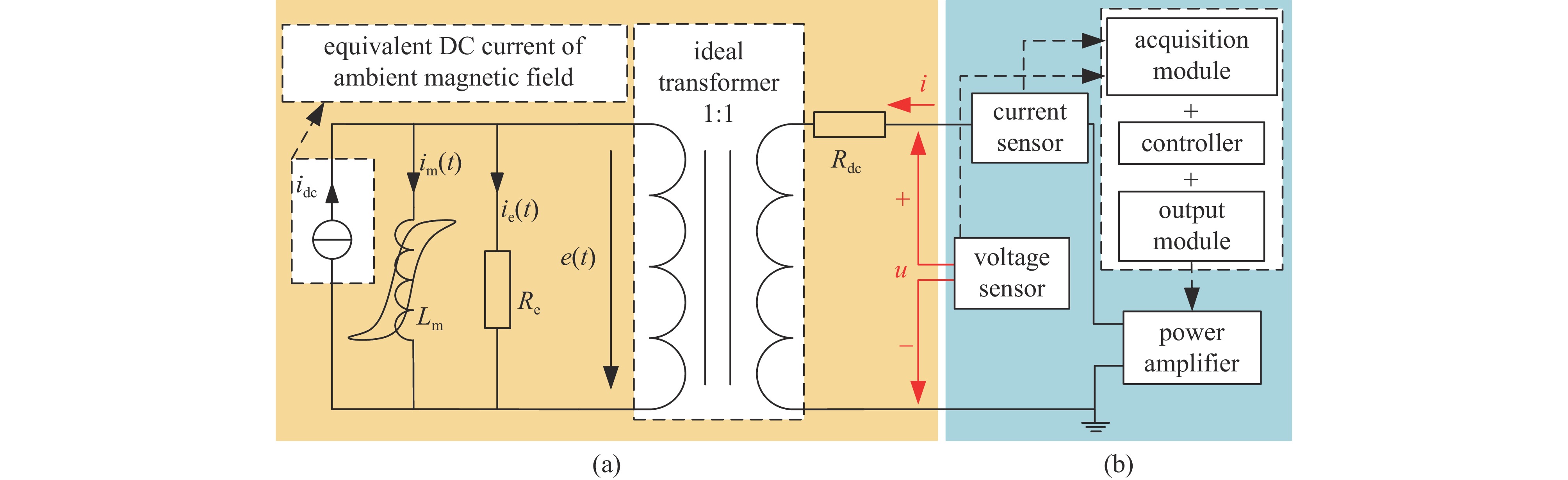
图 1 电路模型和消磁设备
Figure 1. Circuit model and demagnetization equipment for pulse demagnetization
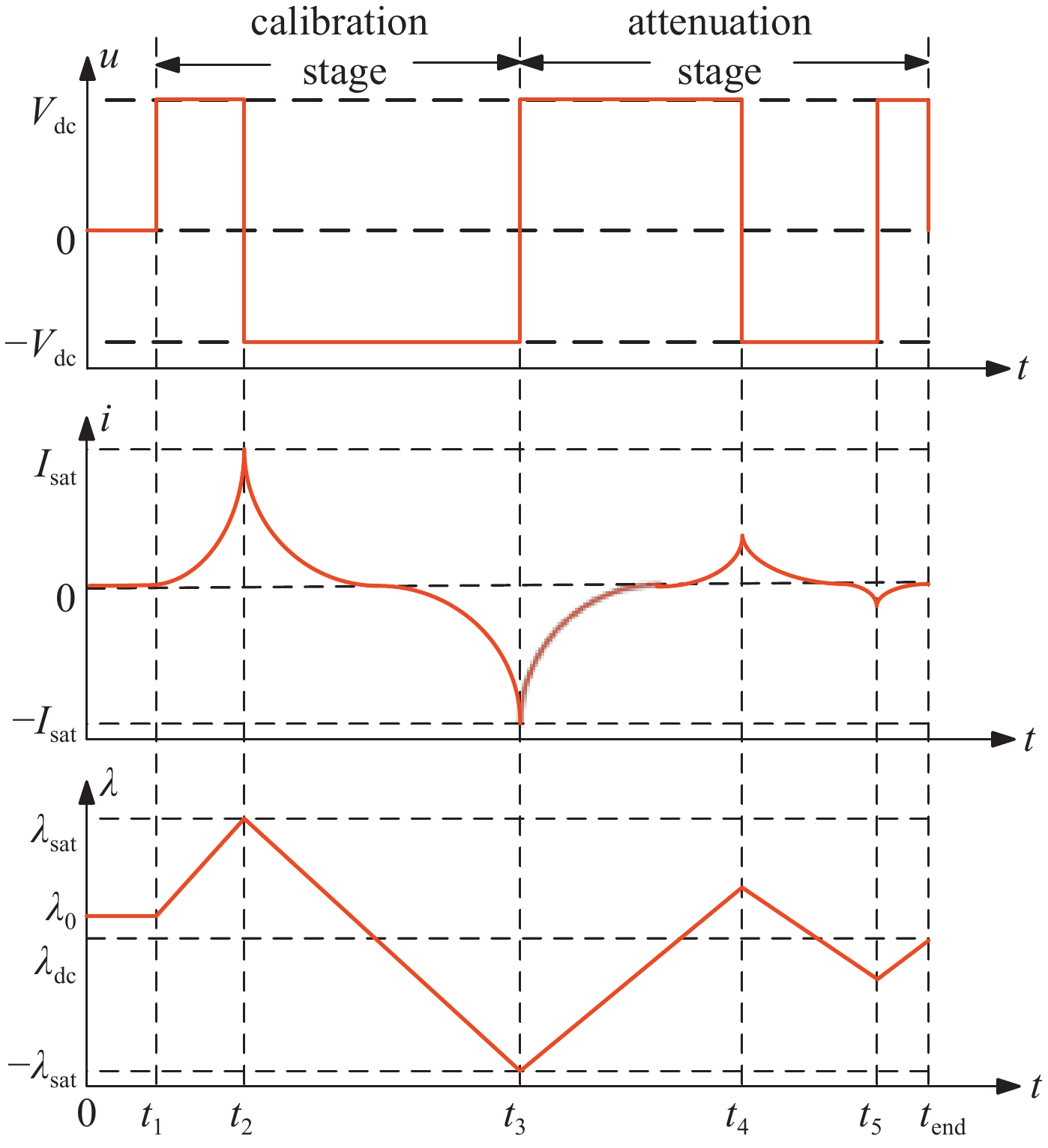
图 2 消磁平衡过程中电压、电流、磁链同步变化示意图
Figure 2. (Schematic diagram) The applied voltage, the demagnetization current, and the flux linkage during demagnetization equilibrium
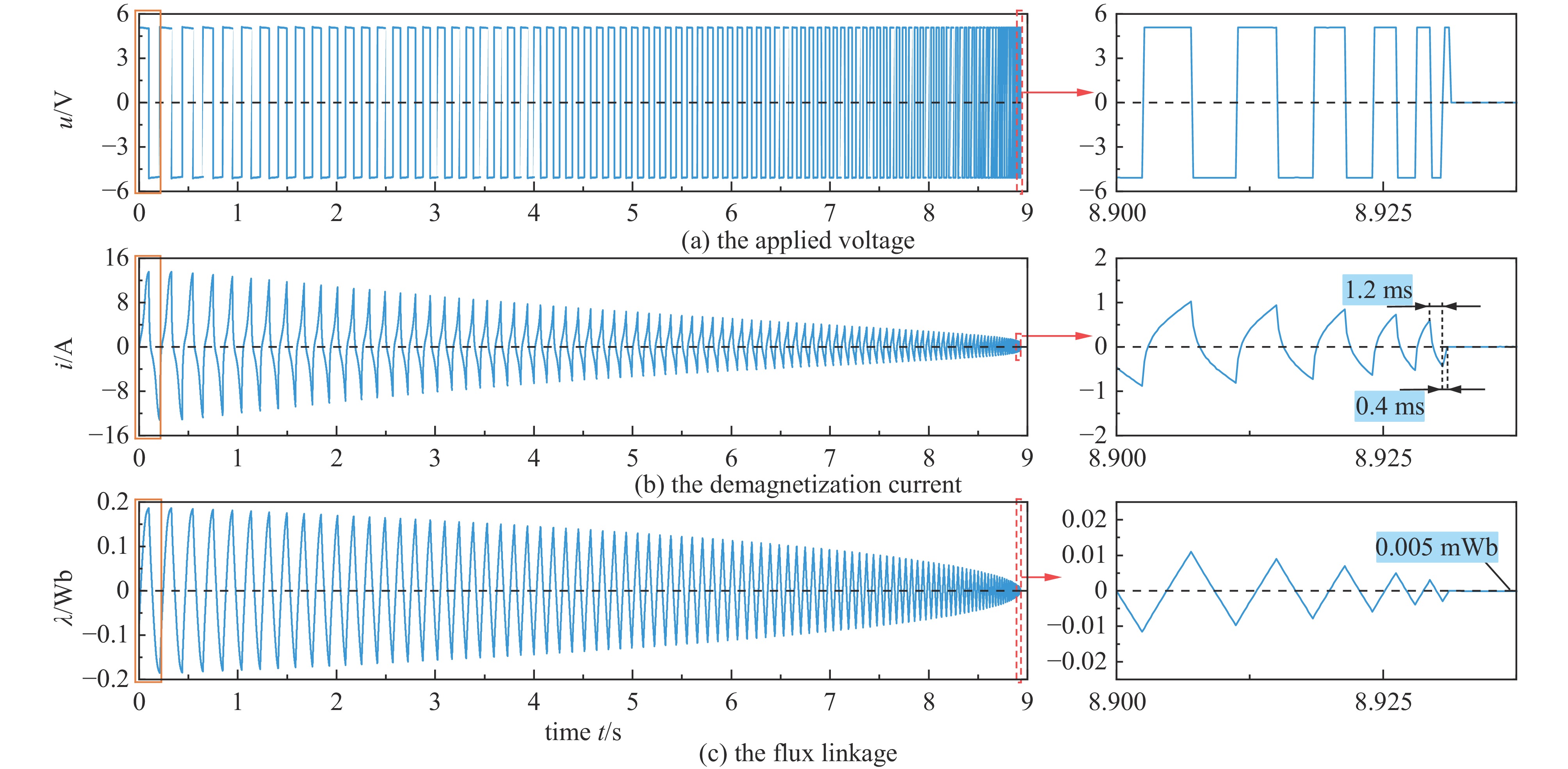
图 6 磁屏蔽室消磁过程电压、电流、磁链同步变化图
Figure 6. Synchronous changes in voltage, current, and flux linkage during the demagnetization process of the MSR with $ N=200 $
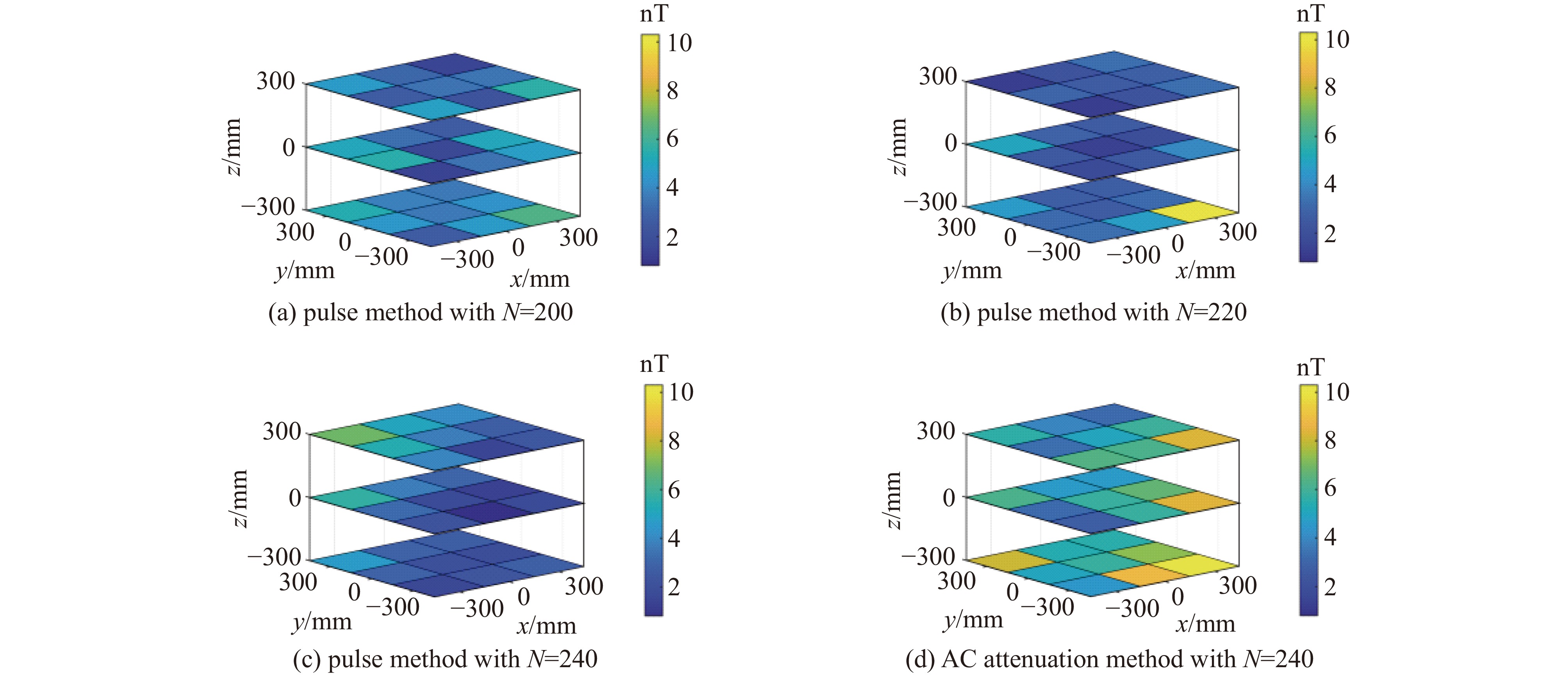
图 7 不同实验条件下的残余磁场分布图
Figure 7. Distribution of the residual magnetic field in the center area under different experimental conditions
表 1 残余磁场估算结果
Table 1. Estimation results of residual magnetic field
material property $ {B}_{\max } $/pT $ {B}_{\min } $ pT $ {B}_{\text{avg}} $ pT initial magnetization curve 5 600 3800 4200 anhysteresis magnetization curve 98 59 63  下载: 导出CSV
表 2 残余磁场平均值结果
Table 2. Results of average residual magnetic field
method average residual magnetic field/nT pulse demagnetization with $ N=200 $ 3.8 pulse demagnetization with $ N=220 $ 3.2 pulse demagnetization with $ N=240 $
AC attenuation demagnetization with $ N=240 $3.1
5.8
下载: 导出CSV
-
[1] 房建成, 魏凯, 江雷, 等. 超高灵敏极弱磁场与惯性测量科学装置与零磁科学展望[J]. 航空学报, 2022, 43: 527752Fang Jiancheng, Wei Kai, Jiang Lei, et al. Scientific facilities for ultrasensitive measurement of magnetic field and inertial rotation and prospects of zero-magnetism science[J]. Acta Aeronautica et Astronautica Sinica, 2022, 43: 527752 [2] Wei Kai, Zhao Tian, Fang Xiujie, et al. Ultrasensitive atomic comagnetometer with enhanced nuclear spin coherence[J]. Physical Review Letters, 2023, 130: 063201. doi: 10.1103/PhysRevLett.130.063201 [3] 李立毅, 孙芝茵, 潘东华, 等. 近零磁环境装置现状综述[J]. 电工技术学报, 2015, 30(15): 136-140 doi: 10.3969/j.issn.1000-6753.2015.15.015Li Liyi, Sun Zhiyin, Pan Donghua, et al. Status reviews for nearly zero magnetic field environment facility[J]. Transactions of China Electrotechnical Society, 2015, 30(15): 136-140 doi: 10.3969/j.issn.1000-6753.2015.15.015 [4] Thiel F, Schnabel A, Knappe-Grüneberg S, et al. Demagnetization of magnetically shielded rooms[J]. Review of Scientific Instruments, 2007, 78: 035106. doi: 10.1063/1.2713433 [5] Zhang Di, Shi Minxia, Yang Jianzhi, et al. An excitation optimization method for demagnetization systems combined with magnetic shaking in MSR[J]. IEEE Transactions on Instrumentation and Measurement, 2025, 74: 6004810. doi: 10.1109/tim.2025.3547103 [6] Thiel F, Schnabel A, Knappe-Grneberg S, et al. Proposal of a demagnetization function[J]. IEEE Transactions on Magnetics, 2007, 43(6): 2959-2961. doi: 10.1109/TMAG.2007.893717 [7] Thiel F. Demagnetization of layered ferromagnetic structures for magnetically shielding: frequency considerations[J]. IEEE Transactions on Magnetics, 2009, 45(12): 5307-5314. doi: 10.1109/TMAG.2009.2022935 [8] Sun Z, Reisner M, Fierlinger P, et al. Dynamic modeling of the behavior of permalloy for magnetic shielding[J]. Journal of Applied Physics, 2016, 119: 193902. doi: 10.1063/1.4949516 [9] Sun Zhiyin, Fierlinger P, Han Jiecai, et al. Limits of low magnetic field environments in magnetic shields[J]. IEEE Transactions on Industrial Electronics, 2021, 68(6): 5385-5395. doi: 10.1109/TIE.2020.2987267 [10] Altarev I, Fierlinger P, Lins T, et al. Minimizing magnetic fields for precision experiments[J]. Journal of Applied Physics, 2015, 117: 233903. doi: 10.1063/1.4922671 [11] Kovan B, De Leon F, Czarkowski D, et al. Mitigation of inrush currents in network transformers by reducing the residual flux with an ultra-low-frequency power source[J]. IEEE Transactions on Power Delivery, 2011, 26(3): 1563-1570. doi: 10.1109/TPWRD.2010.2102778 [12] De Leon F, Farazmand A, Jazebi S, et al. Elimination of residual flux in transformers by the application of an alternating polarity DC voltage source[J]. IEEE Transactions on Power Delivery, 2015, 30(4): 1727-1734. doi: 10.1109/TPWRD.2014.2377199 [13] Zhang Shuo, Yao Chenguo, Zhao Xiaozhen, et al. Improved flux-controlled VFCV strategy for eliminating and measuring the residual flux of three-phase transformers[J]. IEEE Transactions on Power Delivery, 2020, 35(3): 1237-1248. doi: 10.1109/TPWRD.2019.2937900 [14] Bertotti G. General properties of power losses in soft ferromagnetic materials[J]. IEEE Transactions on Magnetics, 1988, 24(1): 621-630. doi: 10.1109/20.43994 [15] Sun Jinji, Ji Airu, Wang Pengfei, et al. Nyquist magnetic noise analysis and experiments of low-frequency shielding soft magnetic materials[J]. Sensors and Actuators A: Physical, 2025, 382: 116113. doi: 10.1016/j.sna.2024.116113 [16] Liu Xin, Yao Chenguo, Liang Shibin, et al. Measurement of the no-load characteristics of single-phase transformer using an improved low-frequency method[J]. IEEE Transactions on Industrial Electronics, 2018, 65(5): 4347-4356. doi: 10.1109/TIE.2017.2762624 [17] Jazebi S, Zirka S E, Lambert M, et al. Duality derived transformer models for low-frequency electromagnetic transients—Part I: topological models[J]. IEEE Transactions on Power Delivery, 2016, 31(5): 2410-2419. doi: 10.1109/TPWRD.2016.2517327 [18] Yang Jianzhi, Zhang Xu, Shi Minxia, et al. Experimental studies on the performance of magnetic shields under different magnetization conditions[J]. Journal of Physics D: Applied Physics, 2023, 56: 215001. doi: 10.1088/1361-6463/acc412 -


 点击查看大图
计量
- 文章访问数: 22
- HTML全文浏览量: 13
- PDF下载量: 3
- 被引次数: 0
